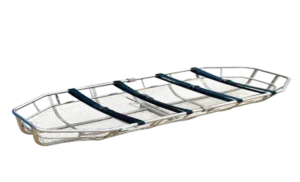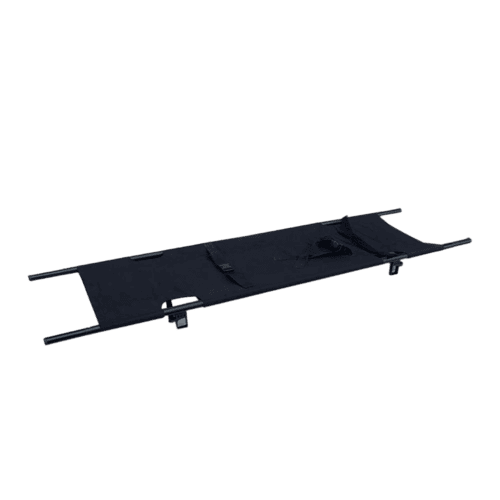
A military medic I know described a scene from a field exercise that stuck with me: a two-hundred-and-thirty-pound soldier with a simulated leg injury needed evacuation over uneven terrain, and the standard aluminum folding stretcher — the one his unit had been issued — buckled at a weld joint halfway to the extraction point. Nobody was seriously hurt because it was a training scenario, but the lesson was loud: lightweight is good until it’s not strong enough. The AM-F014 is the stretcher you spec when “strong enough” isn’t negotiable.
The F014 is our heavy-duty foldaway stretcher, and the material choice tells you most of what you need to know: the frame is steel, not aluminum. Steel adds weight — the F014 weighs about twelve kilograms, roughly three kilos more than our aluminum folding models — but it adds something else that matters more in extreme-use scenarios: fatigue resistance. When you’re loading and unloading a two-hundred-fifty-kilogram patient multiple times a day, or when that stretcher is bouncing in the back of a military transport vehicle over unpaved roads, the metal is absorbing stress cycles that aluminum would eventually fail under. Steel has an endurance limit — below a certain stress threshold, it basically doesn’t fatigue. Aluminum doesn’t have that property. Every load cycle counts against it. For a stretcher that may see heavy loads for years, that metallurgy fact translates directly to patient safety.
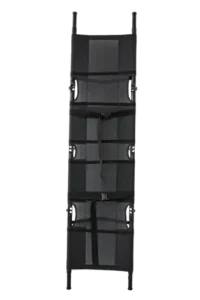
The weight capacity is rated at two hundred and fifty kilograms, which covers bariatric patients that exceed the limits of standard emergency stretchers. The frame uses rectangular-section steel tubing with reinforced corner joints — not just welded, but gusseted with steel brackets at the four primary load points. The folding mechanism is a center hinge with a locking pin that engages at full extension; to fold, you pull the pin, collapse the two halves face-to-face, and the assembled package is roughly one meter by half a meter by twenty centimeters. It stacks in a supply closet, mounts flat against a wall in an ambulance bay, or fits in the equipment compartment of a disaster response vehicle.
The patient surface is a single sheet of heavy-gauge PVC-coated polyester — the same material used in military litters — stretched over the frame and secured with double-stitched seams. It’s impermeable to blood, bodily fluids, and most chemical agents. You can hose it down, pressure-wash it, or wipe it with hospital-grade disinfectant without degrading the coating. Four integrated restraint straps with quick-release buckles keep the patient secured during transport. Two pairs of carrying handles are welded to the frame at each end — loop-style handles that distribute weight across the palm rather than cutting into fingers, which matters when four people are carrying a heavy patient and coordination isn’t perfect.
The F014 was designed with military field hospitals, disaster medical assistance teams, and bariatric transport services in mind. It’s also the right stretcher for industrial sites — oil rigs, mining operations, remote construction camps — where the on-site medic needs equipment that survives being stored in a conex box for six months and deployed without inspection. It’s heavier than our aluminum models, and I’m not going to pretend that’s not a tradeoff. But when the patient exceeds two hundred kilos, or when the stretcher is going to be treated like expeditionary equipment rather than clinical furniture, the F014 is what you want under them. Send me your weight requirements and deployment environment — I’ll help you pick the right frame material for what you’re actually doing, not what looks lighter on a spec sheet.
Frequently Asked Questions
What specifications should I review for this model?
Key specifications including dimensions, capacity, power requirement and material composition are provided in the model datasheet. Contact us with your project requirements for the complete specification sheet.
What documents are available for import?
Datasheet, user manual, packing information and applicable conformity documents are confirmed per destination market. Registration requirements vary by country and are reviewed project by project.
Can I request a sample or reference installation?
Sample availability and reference installation details are confirmed based on the product category and order volume. Contact us with your specific requirements.