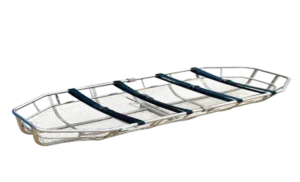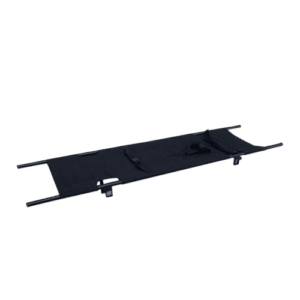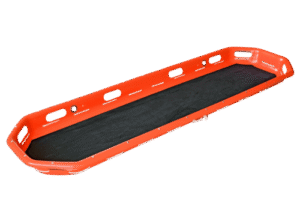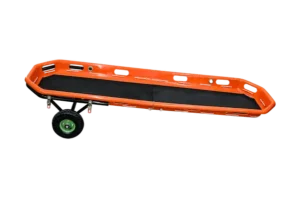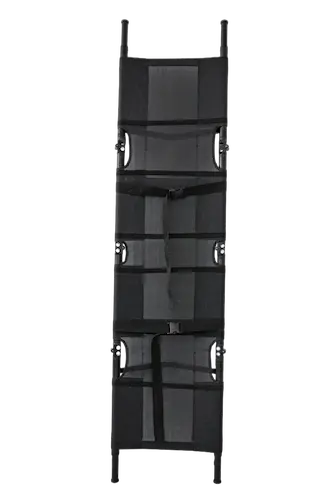
Sodium chloride is not kind to medical equipment. I learned this the expensive way — watching a perfectly good aluminum stretcher develop pitting corrosion around its hinge pins after six months on a coast guard vessel. The crew had been rinsing it with fresh water after every deployment, doing everything right, and the salt still found its way into the grain boundaries. When you’re operating in a maritime environment, the question isn’t whether corrosion will happen. It’s how fast, and what you’re willing to replace when it does.
The AM-F007T is our titanium-frame foldaway stretcher, and it exists because aluminum and steel both have problems in salt water that titanium simply doesn’t. Titanium is essentially immune to chloride-induced corrosion at ambient temperatures — the same property that makes it the material of choice for seawater piping in nuclear submarines. For a rescue stretcher that lives on a boat, gets splashed with seawater during helicopter hoists, and sits in a humid equipment locker between calls, that property is worth the premium. The F007T won’t rust. It won’t pit. It won’t develop the white powdery oxide that tells you your aluminum frame is losing structural integrity one atom at a time.
The weight is the other headline. Titanium has roughly the strength of steel at about fifty-six percent of the weight. The F007T frame weighs just over seven kilograms — lighter than our aluminum models and nearly half the weight of the steel F014. A seven-kilogram stretcher can be carried one-handed by a rescue swimmer climbing a Jacob’s ladder, passed up to a helicopter crew without mechanical advantage, or deployed from a rigid inflatable boat without the operator having to brace against the pitch and roll. In maritime rescue, weight isn’t a convenience metric — it’s a safety variable. Every kilogram you’re not lifting is a kilogram of attention you can give to the patient.
The folding mechanism uses the same center-hinge design as our other foldaway models, with a titanium locking pin — no dissimilar metal contact to create a galvanic corrosion cell. The fabric is a marine-grade PVC mesh that drains water passively; the stretcher can be hoisted with the patient still in it, and the water sheets off through the mesh rather than pooling under the patient. That detail cuts hoist weight in real time and prevents the patient from lying in a puddle of seawater during the ascent. The carrying handles are reinforced with the same fabric, stitched in a box pattern with UV-resistant thread — sun exposure on an open deck degrades standard polyester thread within a season.
The F007T is rated for one hundred and fifty kilograms — not the highest in our line, but appropriate for rescue scenarios where patient weight distribution across the mesh surface keeps the load well within the frame’s structural margin. Four attachment points for hoist bridles are integrated into the frame — not bolted on as an afterthought — and rated for the full load in a vertical lift configuration. The bridle points use captive-eye bolts that can’t unscrew under vibration, which matters when the helicopter is generating enough rotor wash to shake loose anything that isn’t secured.
Who needs a titanium stretcher? Coast guard and maritime rescue services operating in salt water. Offshore oil and gas platform medical teams. Naval vessels with sick bays that deploy rescue teams in open ocean conditions. Helicopter emergency medical services that do over-water hoist operations. And any organization that has learned — the hard way or the expensive way — that a corroded stretcher hinge is a litigation risk, a mission failure, or both. Titanium costs more up front, but replace one rusted-out aluminum stretcher at full procurement cost and the economics start to make sense. I’m not going to tell you every stretcher needs to be titanium. But if salt water is in your operational picture, I will tell you that aluminum is a consumable and the F007T is an investment. Get in touch with your operational profile and I’ll quote accordingly.
Model Comparison
| Specification | AM-F007T | AM-F007X (Carbon) | AM-F007Y | AM-F002 |
|---|---|---|---|---|
| Material | Aluminum alloy | Carbon fiber | Aluminum alloy | Aluminum + Oxford fabric |
| Expanded size | 229×55×16 cm | 229×55×16 cm | 208×55×15 cm | 215×53.5×15.5 cm |
| Folding size | 53×24×23 cm | 53×24×23 cm | 55×23×18 cm | 107×17.5×11 cm |
| Load limit | 300 kg | 300 kg | 300 kg | 159 kg |
| Net weight | — | 8.4 kg | 5.7 kg | 10 kg |
| Special | Support legs | Ultra-light carbon fiber | Lightest 5.7 kg | Flame-retardant PVC fabric |
Frequently Asked Questions
What specifications should I review for this model?
Key specifications including dimensions, capacity, power requirement and material composition are provided in the model datasheet. Contact us with your project requirements for the complete specification sheet.
What documents are available for import?
Datasheet, user manual, packing information and applicable conformity documents are confirmed per destination market. Registration requirements vary by country and are reviewed project by project.
Can I request a sample or reference installation?
Sample availability and reference installation details are confirmed based on the product category and order volume. Contact us with your specific requirements.