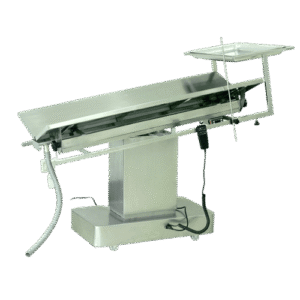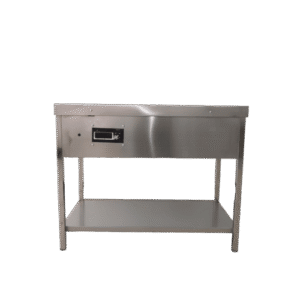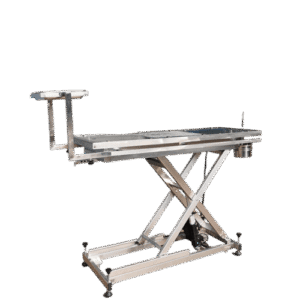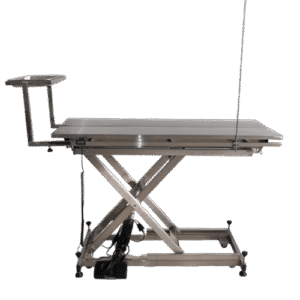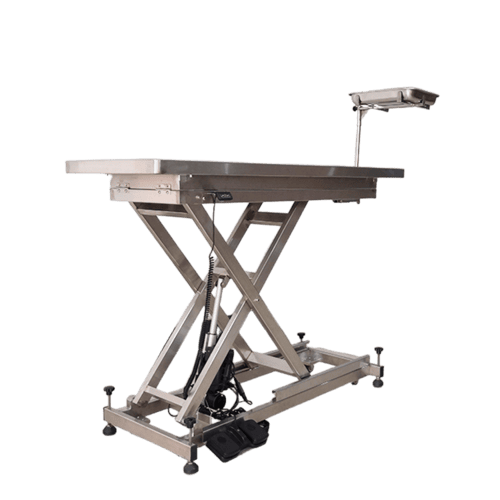
I designed the AM-P2 because I kept hearing the same thing from clinic owners: they needed a table that just worked. Not the fanciest thing in the catalog, not something with features nobody uses — just a flat, stable surface that goes up and down reliably, day after day. That is harder to build than it sounds. When you strip away the bells and whistles, every remaining component has to be right because there is nothing else to hide behind.
The AM-P2 is our entry-level flat electric vet operating table, and honestly, that word does it a disservice. It is not entry-level in build quality. The frame is all stainless steel — not just the parts you see, but the internal brackets, the column housing, every fastener that bears load. The lift mechanism uses a quiet electric motor that handles 39 kilograms without straining. When you are three spays into a Tuesday morning and the fourth patient is already prepped and waiting, the last thing you need is a table that wobbles or creaks or, worst case, drifts down mid-suture. That does not happen on the P2. The lift locks where you set it and stays there.
The flat tabletop is what makes this table versatile. No V-grooves, no contours, no channels — just a level surgical field that works for spays, neuters, mass removals, dental procedures under anesthesia, wound repairs, whatever walks through the door. I have had vets tell me they prefer flat tops for most small animal work because positioning is simpler. You are not fighting a shape you did not ask for. A towel under the patient gives you the pitch you need, and the rest of the surface stays available for instruments, monitoring leads, whatever you need close at hand. The table surface is seamless stainless steel, resistant to blood, iodine, alcohol, and the aggressive cleaning agents that a surgical surface has to survive. Rounded edges mean nothing catches and nothing cuts.
Height adjustment runs smooth from roughly 48 centimeters at the low end up to about 98 centimeters. That range covers the spread from a seated procedure to standing surgery for most clinicians, regardless of their own height. The foot pedal control is straightforward — step on it, the table moves. Take your foot off, it stops. No touchscreen to get bloody, no remote to lose under the autoclave, no buttons that require fine motor control when your hands are gloved and sterile. I wanted the controls to be something you could operate with your elbow if you had to. Every vet knows exactly what I am talking about — you are mid-procedure, you realize the table height is slightly off, and you need to adjust without breaking sterility or asking someone else to crawl under the drapes to find a pedal.
For clinics that are building out a new surgery suite or replacing an aging hydraulic table that has been leaking oil since 2012, the AM-P2 is the pragmatic choice. It is not the table you buy to impress visitors. It is the table that shows up for work every day, handles whatever you put on it, and does not give you a reason to think about it — which, in a surgical setting, is exactly what you want from your equipment. The best surgical table is the one nobody notices because it never causes a problem.
Model Comparison
| Specification | AM-P1 | AM-P2 | AM-P3 | AM-P4 | AM-P6 | AM-P7 |
|---|---|---|---|---|---|---|
| Tabletop size | 140×50 cm | 140×50 cm | 140×50 cm | 140×50 cm | 90×50 cm | 100×55 cm |
| Tabletop style | Inlaid (1/3 grille + 2/3 plane) | Flat | V-type constant temp. | V-type | Rounded corner | Seamless flat |
| Tabletop material | 304 SS 1.5 mm | 304 SS 1.5 mm | 304 SS | 304 SS 1.5 mm | 304 SS | 304 SS |
| Frame | 304 SS brushed 2.0 mm | 304 SS brushed 2.0 mm | 304 SS | 304 SS brushed 2.0 mm | — | 304 SS |
| Side rail | 10×25 mm | — | — | 10×25 mm | — | — |
| Height range | —(样册未列) | —(样册未列) | —(样册未列) | —(样册未列) | 75–105 cm | 80 cm(固定) |
| Lift control | Hand + foot switch | Hand + foot switch | Electric | Hand + foot switch | Electric foot control | — |
| Tilt | Manual, 4 gears | — | — | — | — | — |
| Weighing | No | No | No | No | Yes (high-precision electronic) | Yes |
| Accessories | Thickened tray, infusion rack, dirt basin | Infusion rack, dirt basin | Pull-out sink, buckle rope | Thickened tray, infusion rack, dirt basin | — | — |
Frequently Asked Questions
What specifications should I review for this model?
Key specifications including dimensions, capacity, power requirement and material composition are provided in the model datasheet. Contact us with your project requirements for the complete specification sheet.
What documents are available for import?
Datasheet, user manual, packing information and applicable conformity documents are confirmed per destination market. Registration requirements vary by country and are reviewed project by project.
Can I request a sample or reference installation?
Sample availability and reference installation details are confirmed based on the product category and order volume. Contact us with your specific requirements.