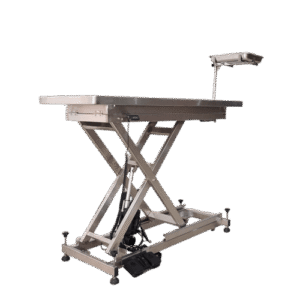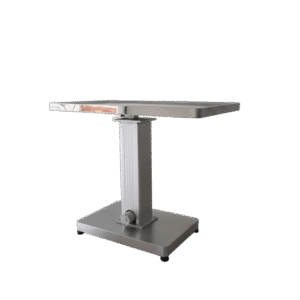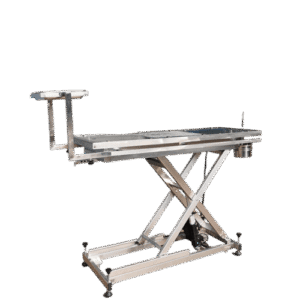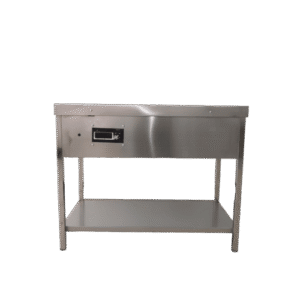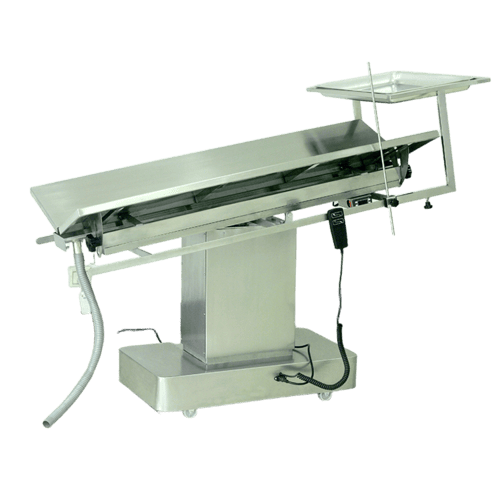
Hypothermia during surgery is one of those things that does not get discussed enough until you lose a patient to it, and then it is all you can think about. Small animals lose body heat fast — cats, rabbits, ferrets, avian patients, even small-breed dogs under anesthesia. Their thermoregulation shuts down. The surgical prep solution cools their skin through evaporation. The anesthesia itself depresses their metabolic rate. Before you know it their core temperature has dropped two degrees, and at that point you are fighting complications across multiple systems: prolonged recovery, coagulopathy, increased infection risk, altered drug metabolism. The AM-P3 exists because I got tired of watching vets pile heating pads and warm water bottles around their patients like they were improvising a solution that should have been built into the table from the start.
The P3 combines our V-type tabletop design with an integrated constant-temperature heating system. The heating element is embedded directly beneath the table surface, not strapped on as an aftermarket accessory. Temperature is adjustable across a clinical range of roughly 30 to 45 degrees Celsius, and the controller holds the set point steady. No cycling between too hot and too cold the way external pads tend to do when their cheap thermostats kick in and out. The temperature sensor is positioned close to the surface — not deep in the heating element — so it reads what the patient actually experiences, not what is happening inside the hardware. For exotics patients where a one-degree fluctuation can push a borderline case into a crisis, that precision is not negotiable.
The V-shape serves two purposes here. First, the same centering and drainage benefits that the P4 provides for large dogs apply to the P3’s typical patient population — the contour keeps small patients positioned and directs fluids away from the surgical field. Second, and more subtly important, the V-shape increases the contact surface area between the patient and the heated tabletop compared to a flat surface. More contact means more efficient heat transfer, which means the heating system can maintain the target temperature at a lower, safer set point. That reduces the risk of thermal injury to patients with poor peripheral circulation — a real concern with rabbits and other exotics whose thin skin tolerates direct heat poorly.
The lift supports 196 kilograms, which is overbuilt for the typical P3 patient but completely deliberate. The same robust drive system and stainless steel construction that our larger tables use, scaled into a platform that prioritizes thermal management. Height range is 48 to 98 centimeters, controlled by the familiar sealed foot pedal that lets you adjust without breaking sterility. The motor runs quieter than you would expect for something this heavily built, because a sudden mechanical noise in a room where a critically ill exotic is already stressed can undo an hour of careful stabilization.
I built the P3 for the vets who see the patients that other tables were not designed to protect. If your caseload includes exotics, geriatric small dogs, neonatal puppies and kittens, or any animal that cannot afford to lose body heat on your table — and honestly, which surgical patient can — this is the table that solves a problem most surgeons do not realize they have been working around for years.
Model Comparison
| Specification | AM-P1 | AM-P2 | AM-P3 | AM-P4 | AM-P6 | AM-P7 |
|---|---|---|---|---|---|---|
| Tabletop size | 140×50 cm | 140×50 cm | 140×50 cm | 140×50 cm | 90×50 cm | 100×55 cm |
| Tabletop style | Inlaid (1/3 grille + 2/3 plane) | Flat | V-type constant temp. | V-type | Rounded corner | Seamless flat |
| Tabletop material | 304 SS 1.5 mm | 304 SS 1.5 mm | 304 SS | 304 SS 1.5 mm | 304 SS | 304 SS |
| Frame | 304 SS brushed 2.0 mm | 304 SS brushed 2.0 mm | 304 SS | 304 SS brushed 2.0 mm | — | 304 SS |
| Side rail | 10×25 mm | — | — | 10×25 mm | — | — |
| Height range | —(样册未列) | —(样册未列) | —(样册未列) | —(样册未列) | 75–105 cm | 80 cm(固定) |
| Lift control | Hand + foot switch | Hand + foot switch | Electric | Hand + foot switch | Electric foot control | — |
| Tilt | Manual, 4 gears | — | — | — | — | — |
| Weighing | No | No | No | No | Yes (high-precision electronic) | Yes |
| Accessories | Thickened tray, infusion rack, dirt basin | Infusion rack, dirt basin | Pull-out sink, buckle rope | Thickened tray, infusion rack, dirt basin | — | — |
Frequently Asked Questions
What specifications should I review for this model?
Key specifications including dimensions, capacity, power requirement and material composition are provided in the model datasheet. Contact us with your project requirements for the complete specification sheet.
What documents are available for import?
Datasheet, user manual, packing information and applicable conformity documents are confirmed per destination market. Registration requirements vary by country and are reviewed project by project.
Can I request a sample or reference installation?
Sample availability and reference installation details are confirmed based on the product category and order volume. Contact us with your specific requirements.