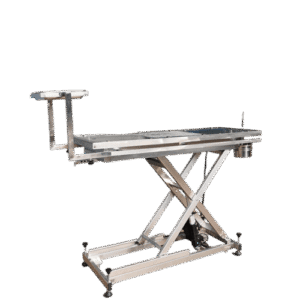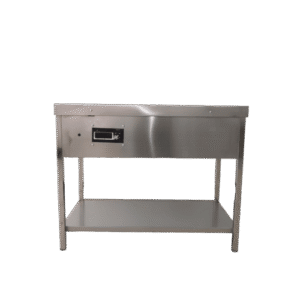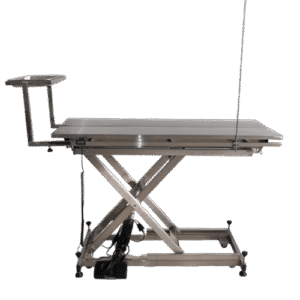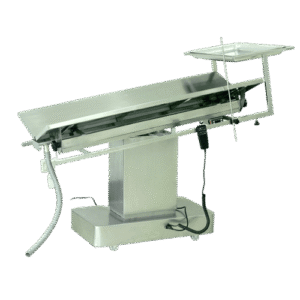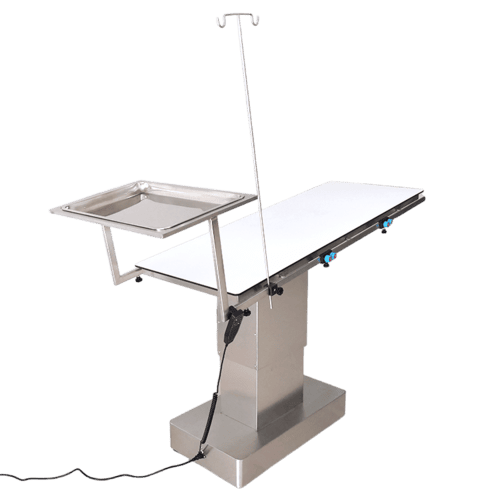
Nothing kills the rhythm of an orthopedic procedure faster than stopping to shoot a radiograph. You drape out, you wait for the plate, you realize the angle was off, you reposition the patient, you re-drape, you start over. Twenty minutes gone. The AM-P5 is our answer to that problem. This is a C-arm compatible vet operating table, and every design choice we made was about letting the surgeon image without interrupting the surgery — because in orthopedics, the difference between intraoperative imaging and post-operative discovery is the difference between a single procedure and a revision.
The tabletop is radiolucent along its full length. That means you can slide a C-arm into position — under the table for a ventrodorsal view, lateral approach, oblique angles — and get a live fluoroscopic image without moving the patient off the table. When you are placing lag screws in a comminuted fracture, checking implant positioning during a TPLO, confirming reduction before closing, or verifying that a pin did not wander into a joint space, the ability to confirm your work intraoperatively changes outcomes. You catch misplacements before closure instead of discovering them on post-op films when the patient is already waking up and everyone has gone home.
The frame is built around imaging access, and I mean that literally — we designed the table from the imaging requirements outward, not the other way around. The base has a low profile with generous ground clearance so the C-arm can approach from multiple angles without the table column or base supports casting a shadow on the fluoroscopic image. We tested this with actual C-arm units from several manufacturers during development, positioning them at every clinically relevant angle, to make sure the clearance was real and not just a number on a CAD drawing. The table width is slightly narrower than our general-purpose surgical tables, because the imaging equipment needs room to maneuver around the patient without the table edges blocking access.
Load capacity is 131 kilograms — sufficient for most orthopedic patients including large-breed dogs undergoing cruciate repair or fracture fixation. The electric lift covers the standard 48-to-98-centimeter range, foot-pedal controlled so the surgeon’s hands stay sterile. Stainless steel construction throughout, sealed control surfaces, all the usual Ascend Medtech durability standards. An orthopedic table takes more punishment than almost any other piece of equipment in the hospital: blood, bone dust, PMMA cement residue, and the kind of aggressive cleaning agents that dissolve lesser materials.
The P5 is not a general-purpose surgery table, and I do not market it as one. It is purpose-built for the clinics that do enough orthopedics to justify a dedicated imaging-compatible platform. If fracture repair, cruciate stabilization, joint surgery, and trauma cases make up a real percentage of your caseload, this table pays for itself in reduced procedure time, fewer retakes, and fewer revision surgeries — the kind of return that shows up in both your balance sheet and your complication rates.
Model Comparison
| Specification | AM-P1 | AM-P2 | AM-P3 | AM-P4 | AM-P6 | AM-P7 |
|---|---|---|---|---|---|---|
| Tabletop size | 140×50 cm | 140×50 cm | 140×50 cm | 140×50 cm | 90×50 cm | 100×55 cm |
| Tabletop style | Inlaid (1/3 grille + 2/3 plane) | Flat | V-type constant temp. | V-type | Rounded corner | Seamless flat |
| Tabletop material | 304 SS 1.5 mm | 304 SS 1.5 mm | 304 SS | 304 SS 1.5 mm | 304 SS | 304 SS |
| Frame | 304 SS brushed 2.0 mm | 304 SS brushed 2.0 mm | 304 SS | 304 SS brushed 2.0 mm | — | 304 SS |
| Side rail | 10×25 mm | — | — | 10×25 mm | — | — |
| Height range | —(样册未列) | —(样册未列) | —(样册未列) | —(样册未列) | 75–105 cm | 80 cm(固定) |
| Lift control | Hand + foot switch | Hand + foot switch | Electric | Hand + foot switch | Electric foot control | — |
| Tilt | Manual, 4 gears | — | — | — | — | — |
| Weighing | No | No | No | No | Yes (high-precision electronic) | Yes |
| Accessories | Thickened tray, infusion rack, dirt basin | Infusion rack, dirt basin | Pull-out sink, buckle rope | Thickened tray, infusion rack, dirt basin | — | — |
Frequently Asked Questions
What specifications should I review for this model?
Key specifications including dimensions, capacity, power requirement and material composition are provided in the model datasheet. Contact us with your project requirements for the complete specification sheet.
What documents are available for import?
Datasheet, user manual, packing information and applicable conformity documents are confirmed per destination market. Registration requirements vary by country and are reviewed project by project.
Can I request a sample or reference installation?
Sample availability and reference installation details are confirmed based on the product category and order volume. Contact us with your specific requirements.