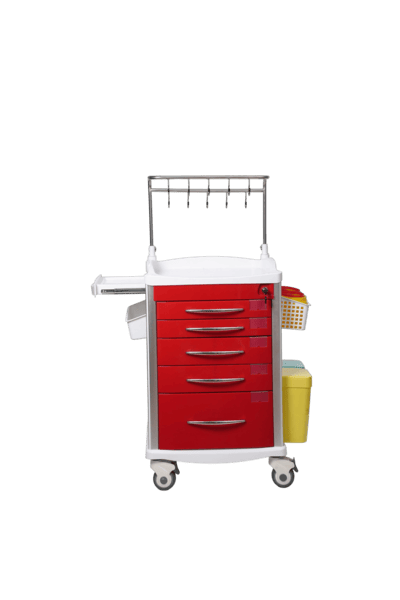
I was walking through a small private hospital in Kunming when I noticed a nurse setting up an IV infusion for an elderly patient and struggling to position two separate drip stands around the bed. One stand held the primary infusion. The other held a secondary antibiotic. She had to reach over the patient for the flow regulator on the far stand every time she checked the drip rate — awkward positioning, repeated forty times a shift across ten patients. The ITT600 is the infusion trolley that solves the problem of managing multiple infusions from one mobile platform.
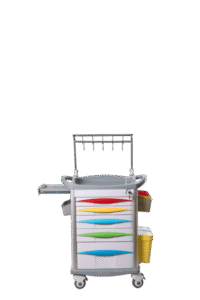
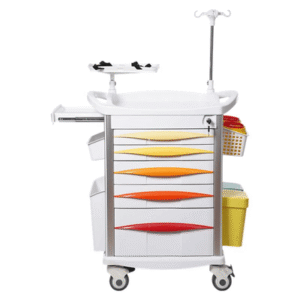
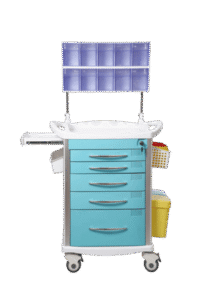
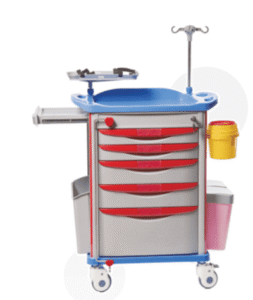
The AM-ITT600 is the smallest infusion trolley in our ITT series — two IV poles, a single storage basket, and a slim frame. It’s designed for the basic clinical reality that many patients need more than one infusion but don’t need a full-scale six-pole trolley. The two telescoping IV poles extend to one hundred eighty centimeters, each with four folding hooks that support a total of eight infusion containers across both poles — enough for a primary infusion, a secondary piggyback, and a maintenance line with capacity to spare. The poles are stainless steel with locking collars at the telescoping joint — no plastic parts in the weight-bearing mechanism, because a dropped IV bag on a patient who’s volume-dependent is a clinical incident, not a maintenance issue.
The storage basket is a single removable wire unit, sized for a box of gloves, a handful of alcohol wipes, a roll of tape, and a tourniquet — the supplies a nurse needs for IV starts and site checks. It’s not a medication storage system; it’s a work basket. The frame below the basket has a flat base plate — steel, powder-coated — that can hold a small sharps container or a box of IV tubing sets. The entire trolley weighs about twelve kilograms unladen and is forty-five centimeters wide, which means it fits between patient beds in a shared ward without the nurse having to rearrange the room.
The casters are one hundred millimeters, twin-wheel, with two locking and two free. The base is a five-point star configuration — not the rectangular base of larger infusion trolleys — which gives the ITT600 a smaller floor footprint and better maneuverability between beds and around IV pumps on floor stands. The central pole connecting the casters to the basket and IV poles is chrome-plated steel with a smooth surface finish — wipe-clean, no crevices for tape residue and alcohol pad wrappers to accumulate.
Who uses the ITT600? Small inpatient wards where the nurse-to-patient ratio means one nurse manages all infusions for a unit and needs a mobile, two-line setup that follows them between beds. Outpatient infusion clinics doing short-duration antibiotic or iron infusions where patients sit in recliners and a dedicated infusion pole per chair would cost more than the chairs themselves. Home health infusion services where the equipment needs to travel in a vehicle and set up in a living room that wasn’t designed for clinical equipment. And any facility running a small infusion service where the full six-pole ITT780 would be overkill.
If two poles aren’t enough for your typical infusion setup, the ITT650 adds a third pole and a larger basket. If you’re running a dedicated infusion center with multi-drug protocols, the ITT750 and ITT780 offer four and six poles respectively. But for the clinic or small ward where two lines cover ninety percent of patients and the trolley needs to disappear into a supply closet when not in use, the ITT600 is the right size at the right price. Send me your average lines-per-patient and room dimensions — I’ll spec the ITT that keeps your nurses from stretching across beds.
Frequently Asked Questions
What specifications should I review for this model?
Key specifications including dimensions, capacity, power requirement and material composition are provided in the model datasheet. Contact us with your project requirements for the complete specification sheet.
What documents are available for import?
Datasheet, user manual, packing information and applicable conformity documents are confirmed per destination market. Registration requirements vary by country and are reviewed project by project.
Can I request a sample or reference installation?
Sample availability and reference installation details are confirmed based on the product category and order volume. Contact us with your specific requirements.