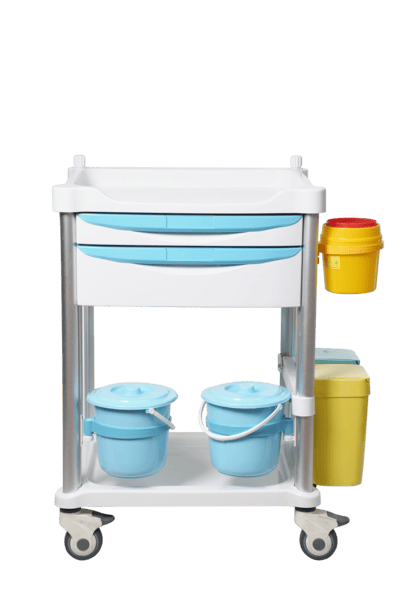
I spent a morning at a dermatology outpatient clinic in Hangzhou that ran thirty-plus minor procedures a day — biopsies, cryotherapy, lesion excisions, intralesional injections. Their treatment trolley had a large work surface and two drawers, which meant the actual procedure supplies lived in a separate storage cabinet and the nurse was constantly walking between the trolley and the cabinet. The work surface was great for procedures. The drawer count was the bottleneck. They needed the opposite of most treatment trolleys: more drawers, less tray, because the procedures were small and the inventory was large. The CT680 is that inverted design.
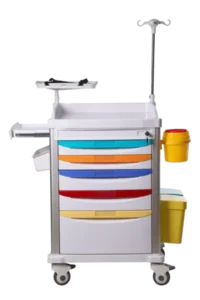
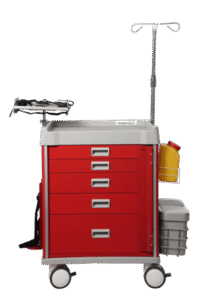
The AM-CT680 is our drawer-heavy treatment trolley — six lockable drawers and a single stainless steel work tray, reversing the tray-to-drawer ratio of the rest of the CT line. Six drawers means six categories of dedicated storage: local anesthetics and injectables, biopsy instruments, cryotherapy supplies, suture and wound closure materials, dressings and bandages, and procedure-specific kits (punch biopsy, shave biopsy, electrocautery). Each drawer is on a full-extension slide, lockable via the central pin-tumbler system, and divided with adjustable aluminum inserts. The single top tray is still 304-grade stainless with a raised lip — enough working area for a minor procedure field, but not the multi-tray stepped system of the CT780. The tradeoff is deliberate: the CT680 assumes the procedure surface can be small because the procedures are small, and the real value is in having every supply category in its own drawer at arm’s reach.
The six drawers are organized vertically — the most frequently accessed supplies in the top two drawers, descending to less-accessed bulk supplies in the bottom drawers. The drawer slides are the same fifteen-thousand-cycle rating as the full CT line. The drawer fronts have full-width label holders — not the small snap-in cards of the smaller models, but full-width slots that accept printed labels from a standard label maker. In a high-volume clinic where multiple staff members access the same trolley, clear labeling on every drawer front isn’t optional — it’s how you prevent the 8 AM rush from turning into a ten-minute hunt for the biopsy punches.
The side baskets are larger than the CT690’s — two deep wire baskets on each side, four total — providing bulk storage for gauze, tape, gloves, procedure drapes, and the consumables consumed by thirty daily procedures. The frame is steel with a wider base than the CT690 to maintain stability when the four side baskets are fully loaded. Four anti-static casters, central locking, full-width push handle. The trolley is about sixty-five centimeters wide and designed to live in a procedure room rather than travel between rooms.
The CT680 is the right choice for high-volume outpatient clinics — dermatology, minor surgery, wound care centers — where the procedure mix is broad and the supply variety is wider than what two or four drawers can organize. It’s also suited for hospital-based procedure units that do cystoscopies, flexible sigmoidoscopies, lumbar punctures, and other procedures that involve many small, single-use items from multiple categories. If your clinic does fewer procedure types and two or four drawers suffice, the CT650 and CT690 are more compact and less expensive. But if your staff is walking to a supply cabinet between every case because the trolley only has two drawers, the CT680’s six-drawer design solves that specific bottleneck. Send me your procedure list and supply categories — I’ll map the drawer configuration.
Frequently Asked Questions
What specifications should I review for this model?
Key specifications including dimensions, capacity, power requirement and material composition are provided in the model datasheet. Contact us with your project requirements for the complete specification sheet.
What documents are available for import?
Datasheet, user manual, packing information and applicable conformity documents are confirmed per destination market. Registration requirements vary by country and are reviewed project by project.
Can I request a sample or reference installation?
Sample availability and reference installation details are confirmed based on the product category and order volume. Contact us with your specific requirements.