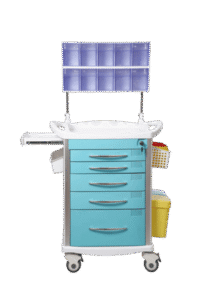
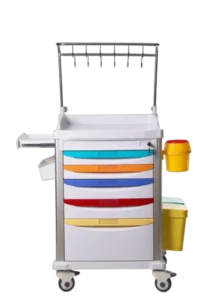
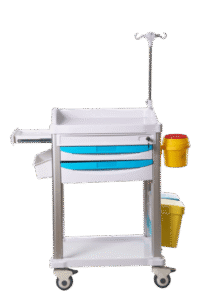
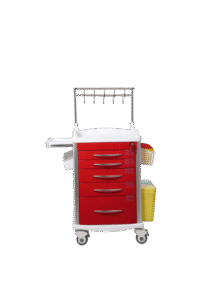
An outpatient clinic manager in Nanjing told me her staff was spending more time hunting for supplies than doing procedures — not because they were disorganized, but because everything lived in two drawers and the categories bled into each other. Dressing supplies mixed with phlebotomy supplies mixed with suture removal kits. She needed the same footprint as their existing trolley but with twice the drawer count, so every category had its own home. The AM-201F is the 101A’s bigger sibling — same stainless top, four drawers instead of two, same fifteen-minute assembly from flat-pack.
The AM-201F takes the design of the AM-101A and doubles the drawer count without significantly expanding the footprint. Four medium-depth drawers on full-extension ball-bearing slides — each drawer can be assigned to a specific procedure category. The typical configuration: drawer one for wound care and dressings, drawer two for phlebotomy and IV start supplies, drawer three for instruments and procedure kits, drawer four for patient assessment tools — blood pressure cuffs, thermometers, pulse oximeters, otoscopes. The separation isn’t just about organization; it’s about infection control. Wound care supplies and phlebotomy supplies living in different drawers reduces cross-contamination risk simply by keeping them apart.
The top surface is the same 304-grade stainless steel as the 101A — seamless, lipped, sized for a standard procedure tray with room for a sharps container at one corner. The three-sided tubular guard rails serve the same dual purpose: supply retention during movement and push-handle function. The lower shelf is expanded compared to the 101A — deeper and reinforced — to accommodate heavier items like a portable suction unit or a stack of procedure packs. Two wire baskets are mounted on the sides rather than below the drawers, providing the same bulk storage without reducing the clearance under the bottom drawer.
The frame is tubular steel, powder-coated, with the same four-caster configuration as the 101A but with an upgraded caster diameter of one hundred twenty-five millimeters. The larger casters improve tracking over door thresholds and elevator gaps — small improvement in smoothness, significant improvement in the daily experience of pushing a loaded trolley across a hospital campus. Central locking is via a foot bar at the base, and the locking mechanism is fully enclosed to prevent contamination ingress.
The AM-201F is the right choice for busy outpatient clinics, treatment rooms in community hospitals, phlebotomy stations, and any clinical environment where the supply categories are diverse enough to justify four separate drawers. It’s the next logical step up from the 101A — more organization, same fundamental reliability, slightly larger footprint. If your procedure volume is moderate and two drawers cover your categories, the 101A saves you money and floor space. If your staff is doing wound care, phlebotomy, minor procedures, and patient assessments from the same cart, four drawers pays for itself in reduced hunting time and better infection control. Send me your procedure mix and I’ll tell you whether two drawers or four makes sense.
Frequently Asked Questions
What specifications should I review for this model?
Key specifications including dimensions, capacity, power requirement and material composition are provided in the model datasheet. Contact us with your project requirements for the complete specification sheet.
What documents are available for import?
Datasheet, user manual, packing information and applicable conformity documents are confirmed per destination market. Registration requirements vary by country and are reviewed project by project.
Can I request a sample or reference installation?
Sample availability and reference installation details are confirmed based on the product category and order volume. Contact us with your specific requirements.