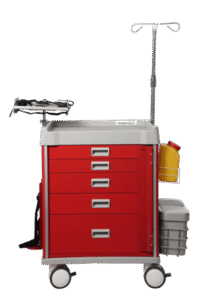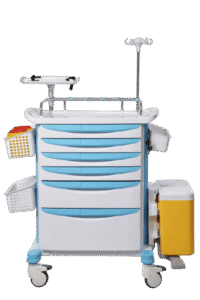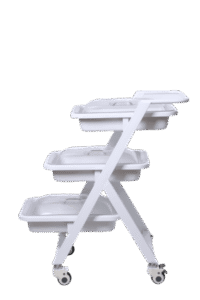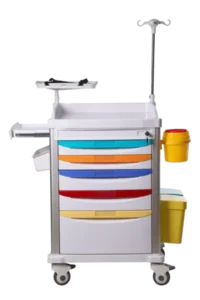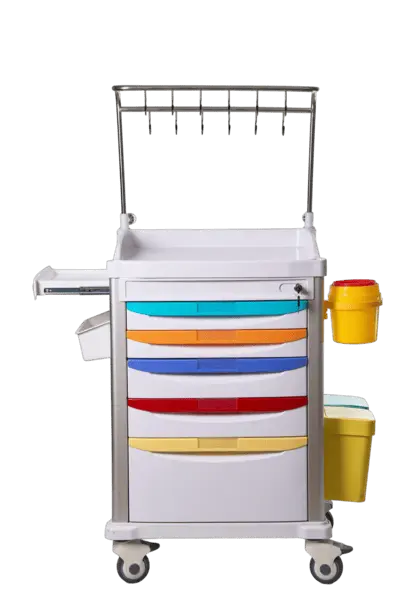
A day surgery unit in Nanjing ran a post-op recovery bay with eight recliners and a single set of IV poles bolted between the chairs — a setup that worked until they started a new multimodal analgesia protocol that required three separate infusions per patient. Suddenly the fixed poles were one line short, and the nurses were hanging a third bag from a portable drip stand that didn’t match height and kept getting kicked under the recliners. The ITT650 is the three-pole infusion trolley that solves the “I need one more line” problem.
The AM-ITT650 sits in the middle of our infusion trolley range — three telescoping IV poles instead of the ITT600’s two, with a medium-capacity storage basket and a reinforced steel base. Three poles give you twelve hanging points, which covers the standard post-operative regimen: a maintenance crystalloid, an antibiotic, and an analgesic infusion or PCA setup. Two of the three poles have standard four-hook tops, and the third has a two-hook top with a wider hook spacing — designed to hold larger-volume bags like three-liter irrigation or TPN without the bag crowding the adjacent hooks.
The basket is larger than the ITT600’s — roughly thirty liters of open storage — divided into two compartments with a removable center divider. One side holds IV start supplies (tourniquets, alcohol wipes, tape, gauze, catheters in graduated sizes). The other side holds IV tubing sets, extension sets, three-way stopcocks, and the small hardware that multiplies across a busy shift. The compartmentalization means the nurse reaches for a catheter and finds catheters — not a tangled mess of tubing that takes thirty seconds to sort. At two in the morning on a twelve-hour shift, that level of simple organization matters more than a spec sheet can convey.
The frame is steel, powder-coated white, with a five-point star base that provides stability even when all three poles are fully extended and loaded. A loaded IV pole is top-heavy by physics; the five-point base plus the weight of the basket and supplies keeps the center of gravity low. Four casters, two locking, all one hundred twenty-five millimeters with smooth-rolling bearings. The casters have thread guards — small metal shields around the wheel hubs that prevent IV tubing, patient blankets, and curtain cords from wrapping around the axle. Those thread guards save nurses from the universal experience of pulling an infusion stand only to find it’s tethered to the bedside curtain by a loop of tubing.
The ITT650 is the right match for day surgery recovery units, general medical-surgical wards, and any clinical area where the typical patient has two to three simultaneous lines and the trolley needs to move between beds with the nurse. If your patients rarely exceed two lines, the ITT600 gives you the same quality in a lighter, narrower frame. If your unit runs complex protocols with four or more lines and multiple infusion pumps on each pole, the ITT750 or ITT780 are the next steps up. For the ward running three standard lines on most patients and wanting one mobile unit instead of a collection of drip stands, the ITT650 is purpose-built. Email me your typical infusion protocol — I’ll map the pole count to your workflow.
Frequently Asked Questions
What specifications should I review for this model?
Key specifications including dimensions, capacity, power requirement and material composition are provided in the model datasheet. Contact us with your project requirements for the complete specification sheet.
What documents are available for import?
Datasheet, user manual, packing information and applicable conformity documents are confirmed per destination market. Registration requirements vary by country and are reviewed project by project.
Can I request a sample or reference installation?
Sample availability and reference installation details are confirmed based on the product category and order volume. Contact us with your specific requirements.