I sat in on a surgical safety audit at a private dental surgery center in Guangzhou two years ago. The anesthesiologist — a meticulous man in his fifties who’d been practicing since before propofol was ubiquitous — was using a general-purpose medical trolley for his anesthesia setup. The controlled substances were in a separate locked cabinet across the room, which meant every induction required two trips: one to the cabinet with a key, one to the trolley with the drugs. He’d adapted to the workflow, but the workflow was wasting two minutes per case. In a facility doing twelve cases a day, that’s nearly half an hour of walking — and every trip was a break in sterile attention. The AT625 was designed for him.
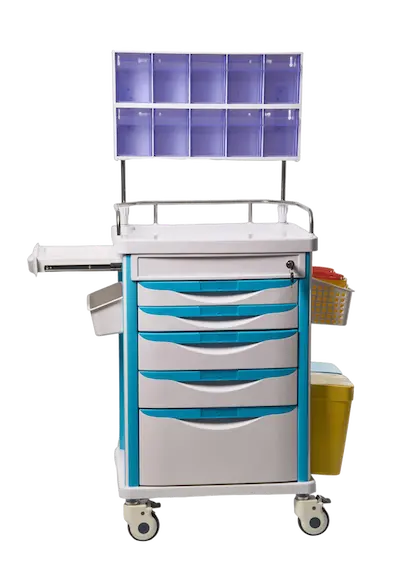
The AM-AT625 is our compact anesthesia trolley, and the first thing you notice is the locked narcotics drawer integrated directly into the unit — not across the room, not in a separate cabinet, but right there under the work surface. It’s a steel drawer with a double-lock mechanism: the standard central lock that secures all drawers, plus an independent keyed narcotics lock that requires a separate key. Two-person control — one key for the cart, one for the controlled substances — is standard practice in most anesthesia departments, and the AT625 enforces it mechanically. No “someone left the main key in the lock” compromising the fentanyl.
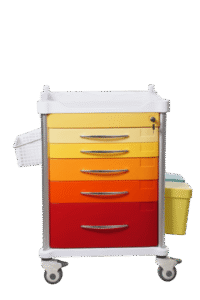
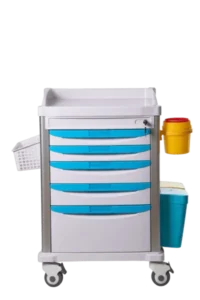
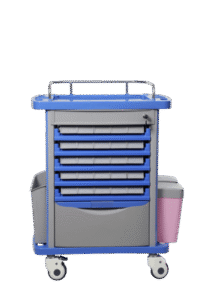
The work surface is an open tray design — no lid, no cover, immediate access to everything. An anesthesiologist mid-induction doesn’t have time to flip open a top cover. The tray is stainless steel, seamless, with a raised lip around the perimeter to keep syringes and vials from rolling off. Below the tray, the narcotics drawer sits at hand height. Below that, five general-purpose drawers — three shallow, two medium — hold induction agents, muscle relaxants, emergency drugs, airway equipment, and disposables. The shallow drawers have silicone mat inserts that keep glass ampoules from rattling against each other during trolley movement — small detail, but the anesthesiologist who spent ten years in a teaching hospital will notice the silence immediately.
The chassis is steel with a wrap-around rubber bumper at working height. Four anti-static casters — one hundred twenty-five millimeters, twin-wheel — with central locking. Anti-static matters in an OR environment where oxygen is in use and static discharge across a metal trolley body is a genuine ignition risk. The casters have conductive rubber that dissipates static to the floor rather than building a charge. It’s the kind of specification that doesn’t show up in a product photo but gets checked by the biomedical engineering department during OR commissioning.
The AT625 is the right fit for smaller surgical suites — dental surgery centers, endoscopy clinics doing sedation, outpatient plastic surgery, and any operating environment where the anesthesia setup needs to be complete and self-contained on one mobile unit. It’s narrower than the AT650 and AT780, designed for procedure rooms where the anesthesia machine, ventilator, and monitoring stack already occupy most of the head-end real estate. If you need a dedicated intubation drawer or full difficult airway kit storage, the AT650 adds two more drawers and a side-mounted equipment pole. If you need an ABS body for lighter weight, the AT780 swaps the steel for polymer. But for the anesthesiologist who needs controlled substances locked at hand height and five organized drawers in a frame that doesn’t crowd the surgical field, the AT625 is purpose-built. Tell me your daily case volume and drug categories — I’ll map the drawer layout to your workflow.
Frequently Asked Questions
What specifications should I review for this model?
Key specifications including dimensions, capacity, power requirement and material composition are provided in the model datasheet. Contact us with your project requirements for the complete specification sheet.
What documents are available for import?
Datasheet, user manual, packing information and applicable conformity documents are confirmed per destination market. Registration requirements vary by country and are reviewed project by project.
Can I request a sample or reference installation?
Sample availability and reference installation details are confirmed based on the product category and order volume. Contact us with your specific requirements.