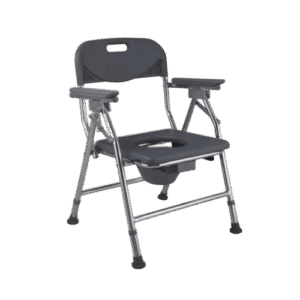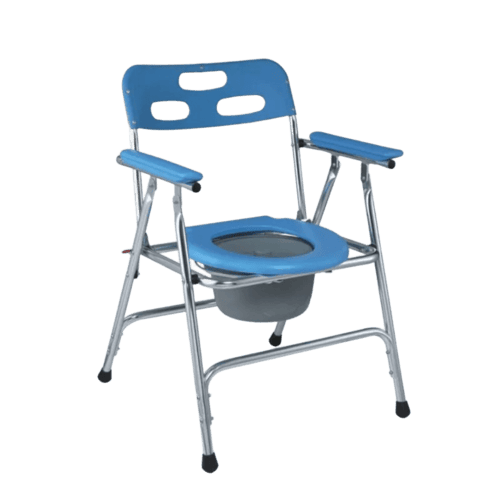
A ward nurse in a Melbourne hospital once showed me how she transferred a post-hip-surgery patient onto a commode. She positioned the chair parallel to the bed, lowered the near-side armrest, placed a sliding board under the patient, and guided them across in one smooth lateral motion. It took maybe twenty seconds, and the patient never had to stand, pivot, or bear weight on the surgical leg. “The armrest is the difference,” she said. “If it flips up, I have to get the patient to lean away. If it drops down, the path is completely clear.” The AM-FS8992L has drop-down armrests, and that detail is why it’s in hospital wards and nursing homes across a dozen countries.
The 8992L is our hospital-grade toilet chair — built for facilities where multiple patients use the same equipment across shifts, where infection control is a documented protocol, and where the chair needs to survive daily disinfectant exposure. The frame is anodized aluminum with a thicker oxide layer than our home-use chairs — about twenty-five microns versus the standard fifteen. Does that matter to a home user? No. Does it matter when the chair is wiped down with quaternary ammonium disinfectant three times a day, every day, for years? Yes — the thicker anodization resists the chemical etching that eventually dulls and pits standard aluminum, creating microscopic crevices where bacteria can colonize.
The drop-down armrests are the clinical feature that separates the 8992L from our home commodes. Each armrest has a release lever at the hinge point. Pull the lever, and the armrest drops below seat level. The entire side of the chair is now open — no barrier between the bed and the seat for a sliding board transfer. When the patient is seated and the armrest is raised and locked, it’s rated for full body-weight loading during sit-to-stand. The armrest padding is seamless molded PU — no seams on the contact surface to delaminate under repeated disinfectant exposure.
The seat is HDPE, textured, U-shaped opening, removable for deep cleaning. The bucket is the standard ten-liter design with lid and carry handle, sliding on a rear rail. The rail itself is stainless steel instead of aluminum — stainless holds up better to the stronger cleaning chemicals used in clinical settings. The backrest is contoured HDPE. Legs adjust across five height positions with spring-loaded pins that have a slightly heavier spring rate than our home chairs — deliberate, because hospital equipment gets adjusted frequently by different staff, and a pin that’s too easy to pull can release accidentally during use.
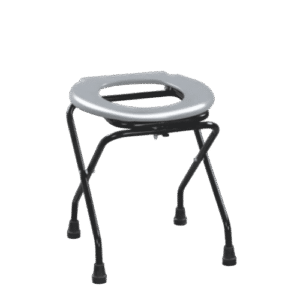
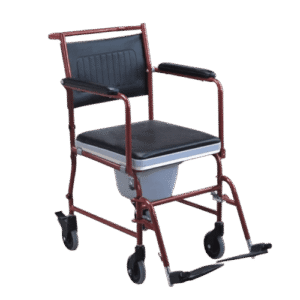
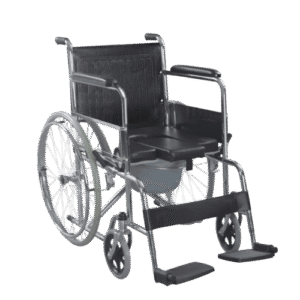
The 8992L doesn’t have wheels — intentional. In a hospital setting, a commode on unlocked casters is a fall risk. If a confused patient tries to use it as a walker, it rolls away. The fixed rubber feet plant the chair exactly where staff places it. If mobility between rooms is needed, the chair is light enough — about eight kilograms — to be carried by a single staff member. This is not a home commode. It’s more expensive than the 897 or 692 because the materials and finishes are spec’d for clinical durability, not home convenience. If you’re buying for a family member at home, get the 897 and save the money. If you’re equipping a hospital ward or nursing home, the 8992L is the right tool. Send me your facility type and bed count.
Frequently Asked Questions
What specifications should I review for this model?
Key specifications including dimensions, capacity, power requirements and material composition are provided in the model datasheet. Contact us with your project requirements for the complete specification sheet.
What documents are available for import?
Datasheet, user manual, packing information and applicable conformity documents are confirmed per destination market. Registration requirements vary by country and are reviewed project by project.
Can I request a sample or reference installation?
Sample availability and reference installation details are confirmed based on the product category and order volume. Contact us with your specific requirements.