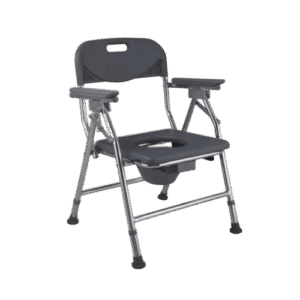
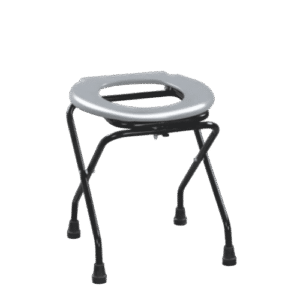
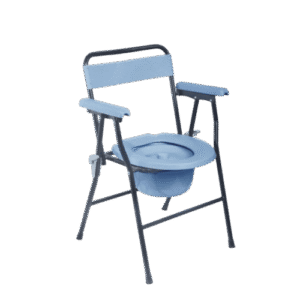
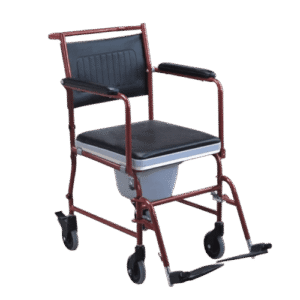
Pressure injuries don’t announce themselves. They develop quietly — a patch of skin over the sacrum that stays compressed against a chair seat for hours because the patient can’t shift their own weight. By the time it’s visible, it’s already a stage one ulcer, and the treatment costs more than the chair that could have prevented it. The AM-FS609GCU is our reclining toilet chair — tilt-in-space backrest, pressure-relief positioning, and commode function in one unit. It’s the chair I built for patients who sit for hours, not minutes.
The tilt mechanism is what makes the 609GCU different from every other commode in our line. The backrest reclines independently through a range of roughly ninety to one hundred and thirty-five degrees. More importantly, the entire seat and backrest assembly tilts as a unit — what clinicians call tilt-in-space — so the angle between the user’s hips and torso stays constant while the overall position reclines. That’s the difference between redistributing pressure across the back without creating shear forces at the sacrum. A chair that just reclines the backrest while the seat stays flat pinches the skin at the hip angle. Tilt-in-space rotates the whole seating system, maintaining the hip angle and distributing pressure safely up the back.
The seat cushion is a multi-layer foam system — a viscoelastic top layer that conforms to body shape, a higher-density support layer underneath, and a waterproof PU cover that’s seamless on the contact surfaces. The foam density was chosen to distribute pressure without bottoming out over a four-to-six-hour sitting period. This is not an overnight sleeping surface. But for a patient who spends their waking hours in a chair because transfers require two-person assistance, the pressure-relief difference between a standard HDPE commode seat and the 609GCU’s cushion system is clinically meaningful.
The commode function is integrated — a ten-liter bucket slides out from a rear rail. The seat has a U-shaped opening under a removable cushion insert. For shower use, the cushion removes and the HDPE seat pan underneath has drainage channels. The chair rolls on four five-inch casters, all lockable, so a caregiver can position it bedside, recline the patient for pressure relief, and roll it to the bathroom without a transfer. One chair, three functions — recliner, commode, shower — and the patient stays in it the whole time.
The frame is heavier-gauge aluminum — thirty-millimeter tubing — with reinforcement at the tilt pivot points. Weight capacity is one hundred and twenty kilograms. Armrests are padded and flip up. Footrests adjust and swing away. A five-point positioning harness is included — not a restraint, a positioning aid for patients with poor trunk control.
The 609GCU is the most expensive commode in our line, and it should be — the tilt mechanism, cushion system, and heavier frame cost more to manufacture. Whether it’s worth it depends on one question: does the patient sit in the chair for more than two hours at a time? If yes, pressure relief is prevention, not luxury. If no — if it’s used for twenty-minute toileting — save the money and get the 897 or 692. But if you’re caring for someone who can’t reposition themselves and spends their days in a chair, the 609GCU pays for itself the first time it prevents a pressure injury. Email me the patient’s daily sitting duration and mobility level.
Frequently Asked Questions
What specifications should I review for this model?
Key specifications including dimensions, capacity, power requirements and material composition are provided in the model datasheet. Contact us with your project requirements for the complete specification sheet.
What documents are available for import?
Datasheet, user manual, packing information and applicable conformity documents are confirmed per destination market. Registration requirements vary by country and are reviewed project by project.
Can I request a sample or reference installation?
Sample availability and reference installation details are confirmed based on the product category and order volume. Contact us with your specific requirements.