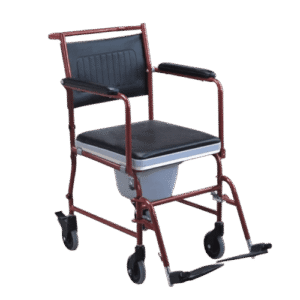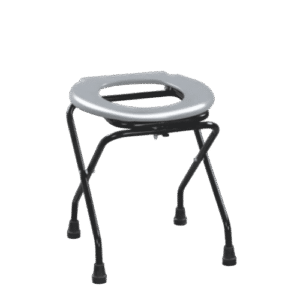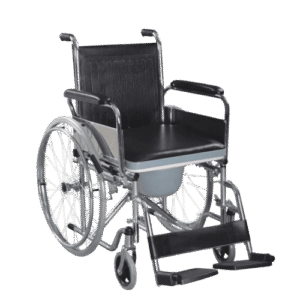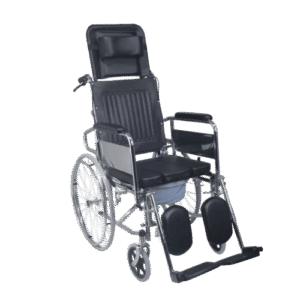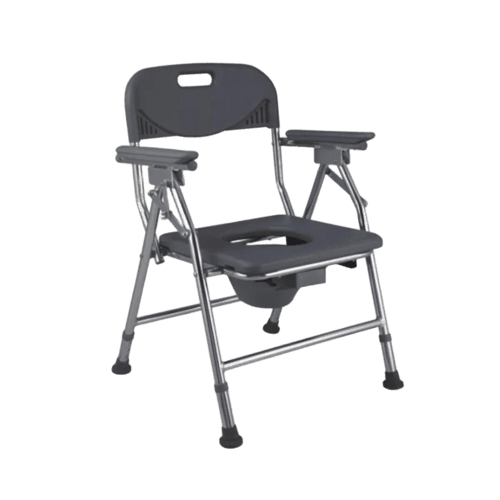
I received a call from a bariatric care coordinator in Manchester two years ago that I haven’t forgotten. Her patient weighed one hundred and sixty-eight kilograms. She had gone through three standard commode chairs in eighteen months — one collapsed at a weld joint, one the armrest snapped during a transfer, and the third the patient refused to use because he could feel the frame flex when he sat down and had lost all trust in the equipment. “I don’t need a nicer commode,” she said. “I need one that doesn’t make my patient feel like he’s about to hit the floor.” The AM-FS8995L is the chair I built in response.
The 8995L is our heavy-duty bedside commode — one hundred and eighty kilogram capacity, and that rating isn’t aspirational. The frame uses reinforced aluminum tubing with a thirty-two millimeter diameter, up from twenty-five on our standard commodes. The corner joints are gusseted with steel brackets — not just welded, but mechanically reinforced at the four points that bear the highest torsional load when a heavy patient shifts position. I’ve watched our testing team load this frame to one hundred and ten percent of rated capacity and cycle it through two thousand sit-stand repetitions. The welds held. The frame didn’t creak. The patient doesn’t hear anything that erodes confidence.
The seat is wider — fifty-one centimeters between armrests, compared to forty-four on standard models. For bariatric users, a narrow seat creates pressure points on the outer thighs within minutes and makes lateral transfers dangerous because the target surface is too small. The wider seat solves both problems. The seat material is reinforced HDPE with a textured surface — no padding, because padding compresses unevenly under higher weight and creates pressure points. The U-shaped opening is generous enough that personal hygiene is manageable without repositioning.
The armrests drop down — not flip up. A flip-up armrest requires the patient to lean away to create clearance, exactly the motion you don’t want a heavy patient making mid-transfer. A drop-down armrest releases at the hinge and falls below seat level, creating a completely open side for a sliding board transfer from bed to commode. No leaning, no clearance issues. When locked in the raised position, it’s rated for the patient’s full weight during sit-to-stand. The commode bucket is twelve liters with a reinforced handle and a quarter-turn locking lid — because a friction-fit lid popping open under load costs a caregiver thirty minutes of cleanup and a patient their dignity.
The 8995L costs more than a standard commode because the frame is heavier-gauge, the joints are reinforced, and the armrest mechanism is more complex. Whether the premium is justified depends entirely on the user. For a seventy-five-kilogram post-surgical patient who needs a bedside commode for two weeks, a standard model is more than adequate. For a bariatric patient who needs reliable bedside toileting for months or years — and whose safety depends on equipment that doesn’t fail — the 8995L is the cheapest insurance you can buy. Send me the user’s weight and transfer method, and I’ll tell you straight whether this chair fits.
Frequently Asked Questions
What specifications should I review for this model?
Key specifications including dimensions, capacity, power requirement and material composition are provided in the model datasheet. Contact us with your project requirements for the complete specification sheet.
What documents are available for import?
Datasheet, user manual, packing information and applicable conformity documents are confirmed per destination market. Registration requirements vary by country and are reviewed project by project.
Can I request a sample or reference installation?
Sample availability and reference installation details are confirmed based on the product category and order volume. Contact us with your specific requirements.