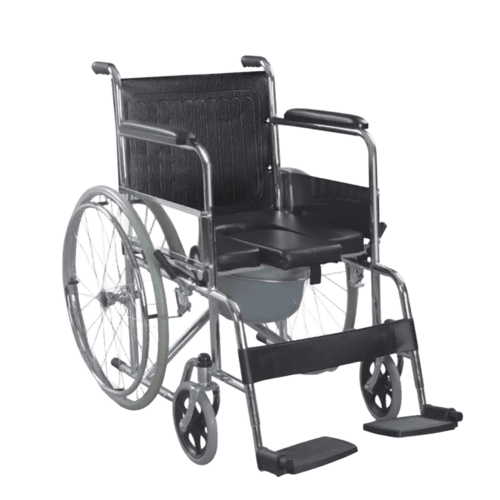
When a patient weighs over one hundred and fifty kilograms, the conversation about commodes changes. It stops being about features and starts being about structural integrity — whether the frame will hold, whether the casters will roll under load, whether the armrests will support the force of a sit-to-stand attempt without bending. I’ve watched bariatric patients refuse to use equipment because they could feel it flex beneath them, and I understand that refusal completely. Trust is the most important feature on a bariatric product. The AM-FS609U is built to earn that trust.
The 609U is our highest-capacity commode — two hundred kilograms rated, validated on a hydraulic test rig that cycled the frame through repetitive loading at one hundred and ten percent of the rated weight. The frame is a hybrid design: steel at the primary load-bearing joints and pivot points, aluminum for the non-structural tubing to keep total weight manageable. Steel where it matters, aluminum where it doesn’t. The steel components are powder-coated — thicker and more impact-resistant than paint. The weld joints are inspected individually before assembly, not batch-sampled. For a two-hundred-kilogram-rated product, a bad weld isn’t a warranty claim — it’s a patient injury.
The seat is fifty-six centimeters wide — the widest in our line, twelve centimeters wider than standard. That width is not for comfort; it’s the minimum required for a bariatric patient’s hip span to clear the armrests without compression. The cushion is the same multi-layer foam system as the 609GCU: viscoelastic top layer, high-density support layer, waterproof seamless PU cover. For a bariatric patient, pressure relief is more critical than for a standard-weight user because higher body mass means higher interface pressure at every contact point, and the sacrum and ischial tuberosities bear the brunt.
The tilt-in-space recline uses the same mechanism as the 609GCU — the entire seat-and-backrest assembly tilts as a unit to redistribute pressure without shear. For a bariatric patient who may spend extended periods in the chair because transfers are physically demanding for the caregiver, the recline function is not optional. It’s the difference between a two-hour sitting tolerance and four hours, and those extra two hours might be the time the caregiver needs to eat, rest, or attend to other responsibilities before the next transfer.
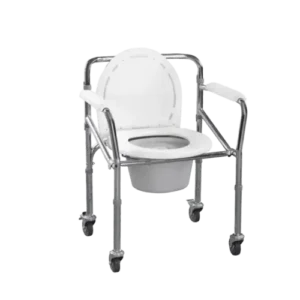
The casters are six inches instead of five — larger wheels distribute weight across a larger contact patch, reducing rolling resistance and preventing the casters from digging into soft flooring. All four lock, and the locking pedals are oversized so a caregiver can engage them with their foot without bending down and taking their hands off the patient. The commode bucket is twelve liters on a stainless steel rail rated for the full weight during slide-out. The armrests drop down for lateral transfers — because with a bariatric patient, there is no “leaning away” to create clearance for a flip-up armrest.
The 609U is the most expensive and heaviest commode we build — about twenty-eight kilograms assembled. It’s not portable in the sense of being carried room to room; it’s mobile on its own casters. If your patient is under one hundred and thirty-five kilograms, the 609GCU saves you money and weight. If your patient exceeds that — or approaches it and you want margin — the 609U is the only commode in our line rated to handle them safely. Send me the patient’s weight, daily sitting duration, and whether they have any existing pressure injuries. I’ll tell you straight up if the 609U is necessary or if a lighter model works, because I’d rather sell you the right chair than the expensive one.
Frequently Asked Questions
What specifications should I review for this model?
Key specifications including dimensions, capacity, power requirements and material composition are provided in the model datasheet. Contact us with your project requirements for the complete specification sheet.
What documents are available for import?
Datasheet, user manual, packing information and applicable conformity documents are confirmed per destination market. Registration requirements vary by country and are reviewed project by project.
Can I request a sample or reference installation?
Sample availability and reference installation details are confirmed based on the product category and order volume. Contact us with your specific requirements.