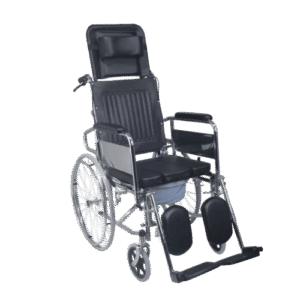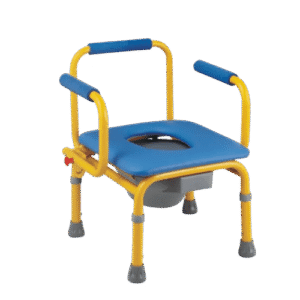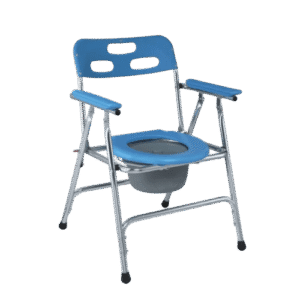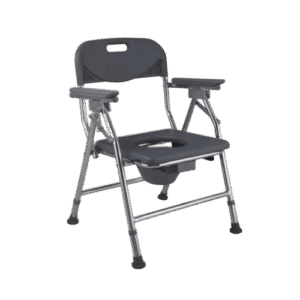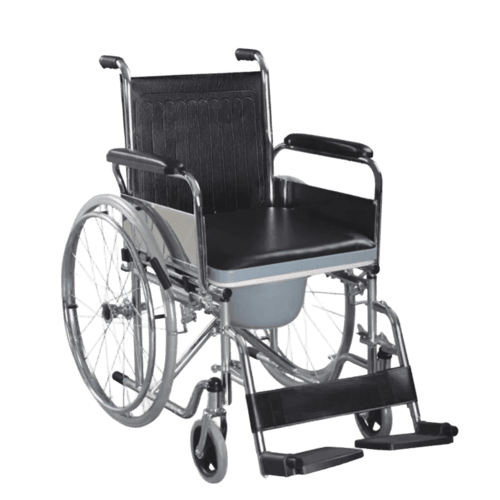
My grandmother used a standard commode chair for the last three years of her life, and she hated it. Not because it didn’t function — the bucket caught what it needed to catch — but because the seat was too low, the armrests were too far forward, and every time she stood up she had to rock forward twice to build momentum, like a car stuck in snow. She never complained to the family. She complained to me, because I worked in medical equipment and she figured I could do something about it. The AM-FS681 is what I did about it.
“Old person toilet chair” is the bluntest product name in our line, and I kept it that way on purpose. This chair is designed for elderly users — not post-surgical patients, not bariatric users. It’s designed for the specific ergonomic needs of aging bodies: reduced knee flexion, weaker quadriceps, slower reaction time, and the balance degradation that makes a standard-height commode feel like a controlled fall rather than a controlled sit.
The seat height range starts higher than our standard commodes — forty-six to fifty-eight centimeters instead of forty-one to fifty-six. That extra five centimeters means an elderly user with stiff knees doesn’t have to drop as far to reach the seat. The seat angle has a two-degree rearward tilt — invisible to the eye, noticeable to the body — that shifts the user’s center of gravity slightly backward, reducing the forward-leaning tendency that causes the “rocking twice to stand” motion. It’s the difference between rising independently and requiring caregiver assistance every time.
The armrests are positioned higher relative to the seat — about three centimeters higher than our standard commodes. Higher armrests put the shoulders in a stronger mechanical position to push down during sit-to-stand. Lower armrests force a deeper elbow bend, reducing the mechanical advantage of the triceps and pectorals — exactly the muscles elderly users are losing strength in. The armrest padding is denser because elderly users press harder during standing. The PU cover is textured for grip — wet hands on smooth armrests is a fall waiting to happen.
The base is wider — about five centimeters more splay on the rear legs — increasing resistance to tipping if the user leans heavily to one side during a transfer. The rubber feet are softer durometer for more friction on smooth flooring. The bucket is ten liters with a lid and carry handle. The seat is HDPE, textured, U-shaped opening, removable. The frame is aluminum with five-level pin adjustment. No casters — because an elderly user with balance issues should never have a chair that can roll unexpectedly. No folding — because for permanent use, reliability matters more than storability.
The 681 costs slightly more than the 897 — the wider base, higher armrests, and adjusted seat geometry add manufacturing cost. Whether it’s worth the premium depends on who’s using it. For a forty-year-old post-surgical patient with normal knee flexion, the 897 is perfectly fine. For a seventy-eight-year-old with arthritic knees and a fall history, the 681’s ergonomic adjustments are the reason they can use the toilet independently. That independence is worth more than the price difference. Send me the user’s age, mobility level, and whether they can stand from a standard chair without assistance.
Frequently Asked Questions
What specifications should I review for this model?
Key specifications including dimensions, capacity, power requirements and material composition are provided in the model datasheet. Contact us with your project requirements for the complete specification sheet.
What documents are available for import?
Datasheet, user manual, packing information and applicable conformity documents are confirmed per destination market. Registration requirements vary by country and are reviewed project by project.
Can I request a sample or reference installation?
Sample availability and reference installation details are confirmed based on the product category and order volume. Contact us with your specific requirements.