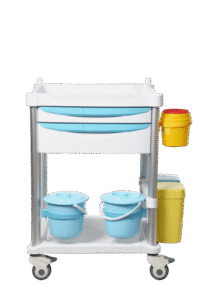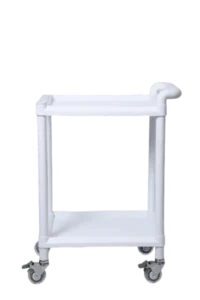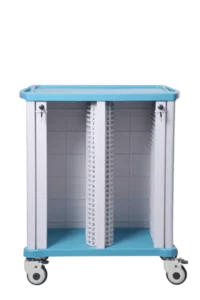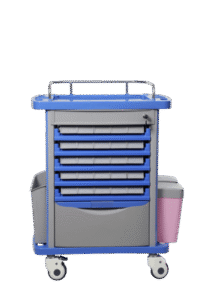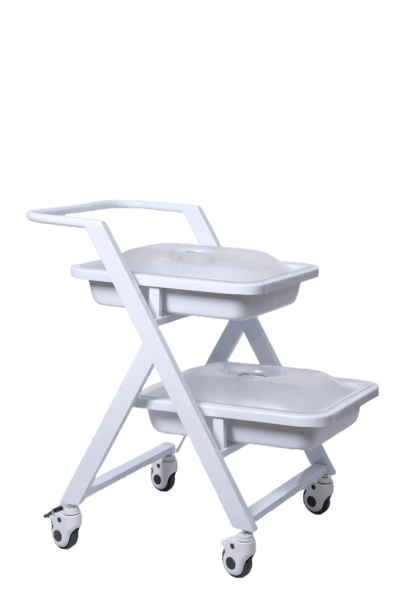
I visited a GI endoscopy center in Shanghai that processed fifty cases a day. Scopes didn’t live in the procedure rooms — they cycled continuously through a central reprocessing department two floors up. A scope transport technician brought clean scopes down in sealed trays, and the used scopes went back up in the same trays after each case. The ETV01’s hanging system was wrong for them — they needed a cart designed for trays, not hanging scopes. The ETV02 is that cart.
The AM-ETV02 is the tray-based counterpart to the ETV01’s hanging system. The top section is a large, flat stainless steel work surface — deeper and wider than the ETV01’s tray — designed to hold two scope transport trays side by side. The surface has a raised lip and a drainage channel, same passive gravity system as the ETV01, because trays arriving from reprocessing are wet and the procedure room floor shouldn’t be. A clear polycarbonate splash guard on three sides contains spray and splatter during scope handling, and the front edge is open for the endoscopist’s access.
Below the work surface, six drawers provide organized storage — two more than the ETV01 — reflecting the higher throughput of a tray-based workflow. Two shallow drawers for biopsy forceps, snares, clips, and injection needles. Two medium drawers for valves, cleaning adapters, water bottles, and leak testing equipment. Two deep drawers at the bottom for procedure-specific kits — EMR kits, ERCP accessories, dilation balloons — that are high-cost, procedure-specific, and need to be immediately available when the endoscopist calls for them mid-procedure. Full-extension slides, silicone mats, quiet operation through all six drawers.
The frame is steel, powder-coated, with a wider stance than the ETV01 — about sixty-two centimeters — because the tray surface needs stability when loaded with two full scope trays and an endoscopist is working off the surface. The casters are the same anti-static type, one hundred twenty-five millimeters, with central locking. A side-mounted handle on each end allows two-person positioning when the trolley is fully loaded — at about sixty kilograms with all supplies and two scope trays in place, one-person steering is possible but two-person is safer in a crowded procedure room.
An integrated scope documentation holder on the side panel stores the reprocessing logs and scope identification sheets that travel with each tray — no more loose papers clipped to the IV pole or tucked under the processor. A small retractable side shelf provides a temporary surface for the endoscopist’s personal items — phone, pager, coffee that’s been cold for two hours — without contaminating the main working area.
The ETV02 is the right choice for high-volume endoscopy centers with central reprocessing workflows, where scopes arrive in trays and the procedure room trolley functions as a receiving station and supply hub rather than a scope storage unit. If your scopes are stored in the procedure room between cases and you want the mechanical protection of vertical hanging, the ETV01 is the better match. If your center runs thirty-plus cases a day with tray-based scope logistics, the ETV02’s larger work surface, six-drawer capacity, and tray-centric design earn their footprint. Send me your daily case volume and reprocessing workflow — I’ll tell you which ETV fits your logistics.
Frequently Asked Questions
What specifications should I review for this model?
Key specifications including dimensions, capacity, power requirement and material composition are provided in the model datasheet. Contact us with your project requirements for the complete specification sheet.
What documents are available for import?
Datasheet, user manual, packing information and applicable conformity documents are confirmed per destination market. Registration requirements vary by country and are reviewed project by project.
Can I request a sample or reference installation?
Sample availability and reference installation details are confirmed based on the product category and order volume. Contact us with your specific requirements.