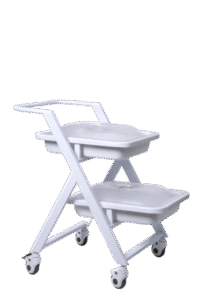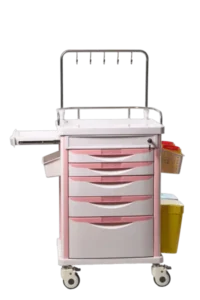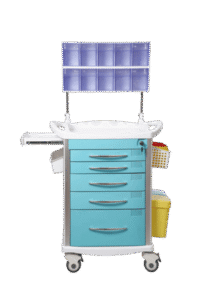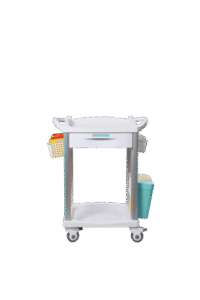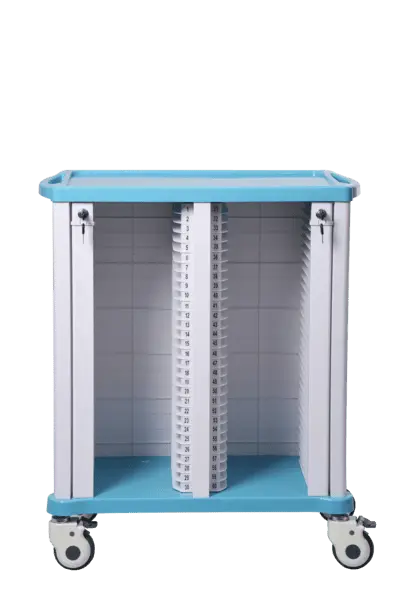
A nursing director at a geriatric hospital in Nanjing showed me her medication round workflow: a medicine trolley pushed by one nurse, followed by a second nurse pushing a records trolley stacked with sixty patient charts, each chart in a binder, each binder about three centimeters thick when you included the MAR, the care plan, the wound assessment forms, and the consultant notes. Her records trolley was a repurposed library cart — functional but not purpose-built — and the charts were stacked horizontally, which meant pulling a chart from the bottom of the stack required lifting thirty binders. The 02CHT60D2 was designed so that every chart is equally accessible without moving any other chart.
The AM-02CHT60D2 is our largest medical records trolley — a double-sided unit holding sixty patient charts in vertical slots, thirty on each side. Each slot is an individual compartment, angled at roughly thirty degrees from vertical, with a clear label holder at the top edge. The angle means the chart binder rests against the compartment back rather than slumping forward, and the label is readable from standing height — about one hundred and fifty centimeters from the floor — without the nurse bending over. When you’re reviewing sixty charts on a morning round, the cumulative difference between reading labels at standing height versus bending to read horizontal stacks is measurable in back pain avoided.
The double-sided design means two nurses can access charts simultaneously from opposite sides — one doing medication reconciliation, the other updating care plans — without reaching around each other. In a large ward where the morning shift involves a team huddle around the records trolley, single-sided access becomes a bottleneck. The 02CHT60D2 eliminates that bottleneck by turning the trolley into a mobile workstation that supports team-based charting.
The top surface is a flat ABS work surface, full-width across both sides, large enough for a laptop or tablet, a stack of blank forms, and a hand sanitizer dispenser. The surface has a raised lip on three sides to prevent items from sliding off during movement. Below the chart compartments, a lower shelf provides storage for blank chart binders, form stocks, and administrative supplies. The frame is steel, powder-coated, with four anti-static casters — one hundred fifty millimeters, all locking, central release bar — because a fully loaded sixty-chart trolley weighs about eighty kilograms and needs casters that track straight and lock securely. The push handle is a full-width rail at each end, and the trolley locks via a central key that secures both sides’ chart compartments behind a sliding cover — important for patient confidentiality when the trolley is parked in a corridor during rounds.
The 02CHT60D2 is built for large inpatient wards, medical records departments, and long-term care facilities where the patient census exceeds forty and the paper chart is still the primary documentation medium. If your ward has twenty-five or fewer patients, the 02CHT50AD with fifty-chart single-sided capacity is a more compact and less expensive alternative. But for the nursing unit that runs a morning huddle around the chart trolley and needs every patient’s record accessible without shuffling, the 02CHT60D2’s double-sided, sixty-slot design is purpose-built. Email me your bed count and chart format — I’ll confirm the slot configuration.
Frequently Asked Questions
What specifications should I review for this model?
Key specifications including dimensions, capacity, power requirement and material composition are provided in the model datasheet. Contact us with your project requirements for the complete specification sheet.
What documents are available for import?
Datasheet, user manual, packing information and applicable conformity documents are confirmed per destination market. Registration requirements vary by country and are reviewed project by project.
Can I request a sample or reference installation?
Sample availability and reference installation details are confirmed based on the product category and order volume. Contact us with your specific requirements.