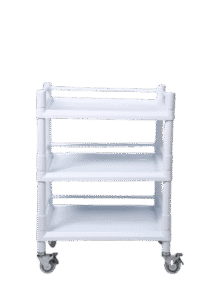
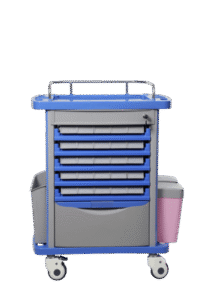
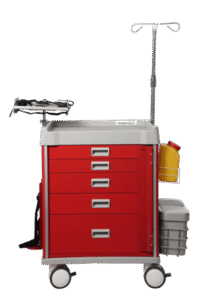
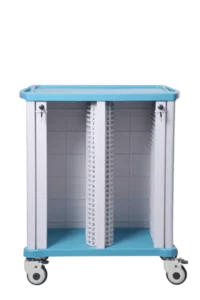
I shadowed a wound care nurse at a burn unit in Chongqing for a full shift. The first thing I noticed was the logistics of her trolley — she was doing sequential dressing changes on three patients in a shared bay, and her setup required a clean tray, a sterile tray, a used-instrument tray, and a supply tray. Four separate surfaces, but her existing trolley had two. She was stacking trays on the lower shelf, bending down every time she needed a fresh piece of gauze, and the waste container was a plastic bag taped to the side rail. The CT780 is the treatment trolley built for the nurse who needs multiple organized surfaces at working height.
The AM-CT780 is our largest treatment trolley — four stainless steel trays arranged in a stepped configuration, two lockable drawers, and two side-mounted wire baskets. The tray system is what defines this model: two large work trays at the primary working height, one smaller intermediate tray positioned just below them, and a bottom tray at waist level. The stepped layout means all four surfaces are reachable without bending or crouching — a detail that a wound care nurse doing six hours of dressing changes in a row will feel in their lower back by the end of the shift. The top two trays are the sterile working zone. The intermediate tray holds clean but non-sterile supplies. The bottom tray is the collection zone for used instruments and waste.
Each tray is 304-grade stainless steel, seamless, with a raised lip. The lips aren’t just for spill containment — they’re designed as instrument stops, so a forceps placed at the edge of the tray stays on the tray rather than sliding onto the floor when the trolley is repositioned. The top tray dimensions are generous: about sixty by forty-five centimeters, enough for a full sterile field for a complex wound dressing. The surface between trays is open — no panels blocking access to the lower levels — so the nurse can reach any tray from the working position without walking around the trolley.
The two drawers are lockable with the same pin-tumbler central locking system as our medication and anesthesia lines. In a treatment trolley, locked drawers typically hold expensive dressing products — silver-impregnated dressings, negative-pressure wound therapy supplies, skin substitutes — items with enough unit cost that open-access storage is a budget control issue. The side baskets are open wire, holding bulk supplies like gauze rolls, bandages, tape, and the consumables consumed at high volume in wound care.
The frame is steel, powder-coated, with four anti-static casters and central locking. A fold-down side shelf on one end provides an additional temporary surface — useful for a tablet showing the wound care plan or a patient’s chart. The push handle is full-width at the rear, and the trolley is about seventy centimeters wide — intentionally wider than a medication cart, because treatment procedures need more lateral working space.
The CT780 is the right choice for wound care clinics, burn units, surgical dressing rooms, and any clinical environment where a single nurse manages multiple-step procedures that require segregated clean, sterile, and used surfaces. If your procedure workflow is simpler and two trays suffice, the CT690 or CT650 are more compact alternatives. If you need maximum drawer storage rather than tray surfaces, the CT680 emphasizes drawers over trays. But for the nurse who’s been stacking trays on a two-level cart and bending down every three minutes, the CT780’s four-level stepped tray system is the ergonomic upgrade they’ve been describing to their supervisor for months. Send me your procedure type and I’ll configure the tray layout.
Frequently Asked Questions
What specifications should I review for this model?
Key specifications including dimensions, capacity, power requirement and material composition are provided in the model datasheet. Contact us with your project requirements for the complete specification sheet.
What documents are available for import?
Datasheet, user manual, packing information and applicable conformity documents are confirmed per destination market. Registration requirements vary by country and are reviewed project by project.
Can I request a sample or reference installation?
Sample availability and reference installation details are confirmed based on the product category and order volume. Contact us with your specific requirements.