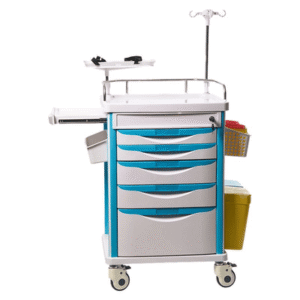
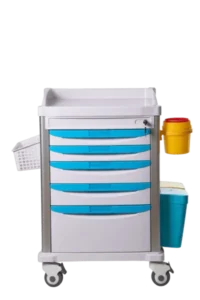
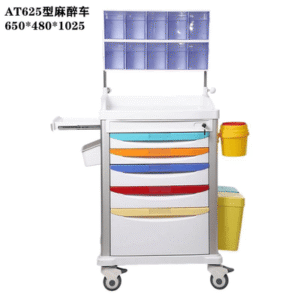
I spent a night in a Level I trauma center ED in Chengdu — the kind of night where three codes ran simultaneously and the crash carts were moving between bays faster than the cleaning staff could restock them. The senior ED nurse pulled me aside at 3 AM and pointed at their standard crash cart: “It’s fine for one code. It’s not enough for the third code of the night when we haven’t had time to restock and the airway drawer is empty. I need more drawers — more compartmentalization — so a partially depleted cart is still a functional cart.” The ET780 is the answer to that problem.
The AM-ET780 is our largest emergency crash cart — eight drawers instead of the ET750’s six, which means roughly thirty percent more internal volume and, more importantly, more categories. When you have eight drawers, you can separate pediatric medications from adult, advanced airway from basic airway, intraosseous access from peripheral IV, and still have a dedicated drawer for post-resuscitation care supplies. The extra two drawers aren’t about carrying more of the same thing — they’re about preventing the “everything in one drawer” situation that happens when a code cart runs out of drawer slots and a nurse has to dig through a mixed drawer of unrelated supplies while a patient is deteriorating.
Color coding follows the same ACLS-based system as the ET750: red for medications (now split into two drawers — first-line ACLS drugs in one, secondary drugs and infusions in another), blue for airway (basic in one drawer, advanced and surgical airway in a second), yellow for circulation and vascular access, green for diagnostic equipment including a portable ultrasound probe storage slot, white for disposables and procedure kits, and the bottom drawer for fluids and volume expanders. The eighth drawer is black-label — a flexible slot that hospitals typically configure for department-specific needs: burn care supplies in a burn unit, neuro exam tools in a neuro ICU, pediatric-specific equipment in a PICU.
The defibrillator platform is wider than the ET750’s — sized to hold the larger biphasic defibrillators with integrated pacing and capnography that are becoming standard in high-acuity EDs. The CPR board is full-length, sliding out from the base frame on smooth rails rather than friction slides — when someone is doing compressions on a three-hundred-pound patient, that board needs to deploy with one hand without sticking. The oxygen cylinder bracket accepts D and E sizes, side-mounted, with a secondary strap for transport security.
Two IV poles are standard on the ET780 — one on each side — both telescoping to a hundred and eighty centimeters with locking collars. In a post-ROSC transport to the ICU, running two infusions and a pressure bag on the same crash cart keeps lines organized and reduces the number of devices rolling alongside the patient bed. The push handles are on both ends, and the central locking casters have a toe-release bar that can be operated from either side.
The ET780 makes sense in emergency departments running multiple simultaneous resuscitations, cardiac and neuro ICUs where codes are frequent and complex, and any facility where the code cart needs to support advanced interventions beyond basic ACLS — intraosseous access, surgical airway, portable ultrasound-guided procedures, post-arrest targeted temperature management setup. If your unit runs standard codes with a typical ACLS drug list and basic-to-intermediate airway, the ET750 gives you everything you need in a smaller, lower-cost package. If you’re the code team lead who’s been frustrated by a depleted cart at the wrong moment, the ET780’s extra compartmentalization keeps partially stocked drawers functional. Drop me a note with your code volume and typical interventions — I’ll help you spec the right cart for the worst ten minutes of your shift.
Frequently Asked Questions
What specifications should I review for this model?
Key specifications including dimensions, capacity, power requirement and material composition are provided in the model datasheet. Contact us with your project requirements for the complete specification sheet.
What documents are available for import?
Datasheet, user manual, packing information and applicable conformity documents are confirmed per destination market. Registration requirements vary by country and are reviewed project by project.
Can I request a sample or reference installation?
Sample availability and reference installation details are confirmed based on the product category and order volume. Contact us with your specific requirements.