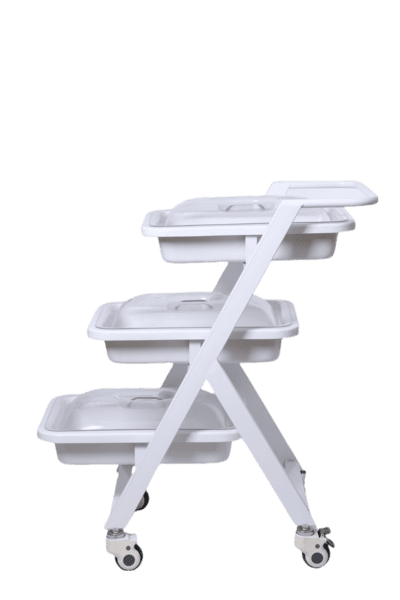
The first time I saw a damaged endoscope in a hospital equipment room, it was a three-hundred-thousand-yuan gastroscope coiled too tightly in a storage drawer because the facility didn’t have a proper scope trolley. The bending section had developed a permanent curve — not enough to fail a leak test, but enough that the gastroenterologist had been compensating with extra angulation for six months before anyone noticed. Endoscopes are precision optical instruments wrapped in a flexible sheath, and storing them coiled in a drawer is like storing a violin by sitting on the case. The ETV01 was designed because endoscopes deserve to hang.
The AM-ETV01 is our endoscope trolley with a vertical hanging system — the defining feature. The trolley body contains a central shaft, enclosed on three sides with a clear polycarbonate front door, where endoscopes hang vertically from their control bodies. The hanging bracket accommodates up to four scopes — typically two gastroscopes and two colonoscopes, or a mixed set depending on the endoscopy suite’s inventory. Each scope hangs freely without touching the shaft walls or the other scopes. The insertion tube hangs straight, the bending section is unstressed, and the scope body is supported at the control handle — the same orientation as the manufacturer’s storage recommendation. Nothing is coiled, nothing is compressed, nothing is stacked.
Below the hanging shaft, four drawers provide storage for endoscope accessories: biopsy forceps, cleaning brushes, water bottles, suction valves, biopsy valves, and the small consumables that live in every endoscopy procedure room. Two shallow drawers for small accessories, two medium drawers for larger items like spare light guide connectors and leak testers. The drawers are on full-extension slides with silicone mat inserts — the same silence and rattle-elimination as our anesthesia line. An endoscopy suite is a relatively quiet clinical environment, and a rattling drawer is disproportionately disruptive.
The top of the trolley is a stainless steel tray — the working surface where the endoscopist places the scope immediately after a procedure before it goes to reprocessing. The tray has a raised rim and a drainage channel that directs fluid to a collection container mounted below — because post-procedure scopes are wet, and a pool of rinse water on a flat surface is both a contamination risk and a slip hazard. The drainage system is passive — gravity-fed, no pump, nothing to fail.
The chassis is steel with an anti-static caster set, which matters in a procedure room with video processors, monitors, and electrosurgical units all sharing the same floor. The casters have central locking, and the trolley is narrow enough — about fifty-five centimeters — to park next to the endoscopy tower without obstructing the endoscopist’s access to the processor controls. A side-mounted handle on the rear panel provides a push point, but this trolley is designed more for positioning than transport — it lives in the procedure room, not in the corridor.
The ETV01 is the right choice for endoscopy suites that need protected vertical scope storage in the procedure room itself — gastroenterology, pulmonology, urology, and any service that performs flexible endoscopy. If your workflow involves reprocessed scopes arriving from a central sterile processing department on a separate transport cart, the ETV02 with its tray-based scope storage may better match your logistics. But if your scopes live in the procedure room between cases and you want them hanging the way the manufacturer intended, the ETV01 is the tool. Email me with your scope inventory and procedure room layout — I’ll spec the hanging configuration that fits.
Frequently Asked Questions
What specifications should I review for this model?
Key specifications including dimensions, capacity, power requirement and material composition are provided in the model datasheet. Contact us with your project requirements for the complete specification sheet.
What documents are available for import?
Datasheet, user manual, packing information and applicable conformity documents are confirmed per destination market. Registration requirements vary by country and are reviewed project by project.
Can I request a sample or reference installation?
Sample availability and reference installation details are confirmed based on the product category and order volume. Contact us with your specific requirements.