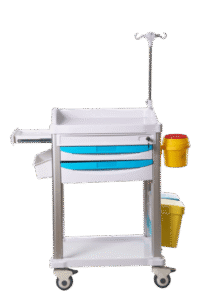
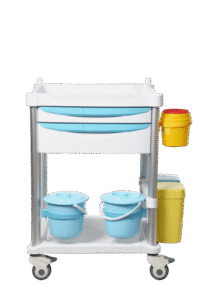
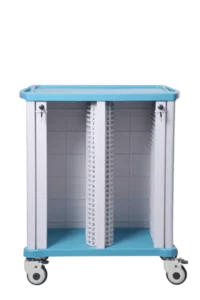
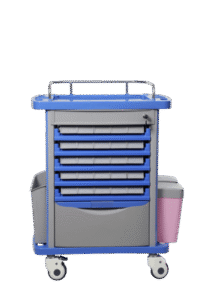
The infusion center director at an oncology hospital in Guangzhou gave me a tour of her chemotherapy bay — twenty recliners, each patient on a three-to-five drug protocol, and every recliner surrounded by a forest of individual IV poles. The nurses navigated a slalom course of metal stands just to reach the patient, and when a patient needed the bathroom mid-infusion, disconnecting and reconnecting from multiple poles turned a two-minute bathroom break into a five-minute equipment maneuver. The ITT780 exists because some patients need more than three lines and some units need one organized platform instead of six separate stands.
The AM-ITT780 is the largest infusion trolley in the ITT series — six telescoping IV poles on a heavy-duty steel base, with a large-capacity storage basket and an integrated pump rack. Six poles provide twenty-four hanging points, which covers the most complex multi-drug protocols: chemotherapy pre-medications, primary chemotherapy agent, hydration fluids, antiemetics, rescue medications, and a maintenance line — all on one mobile unit that wheels with the patient to the bathroom and back. Each pole is individually height-adjustable with locking collars, and the pole tops have four folding hooks. The hooks are reinforced — each rated for three kilograms — because a three-liter TPN bag at the end of a hook applies more leverage than most people estimate.
The storage basket is a two-tier design: an upper basket for immediate-use supplies (alcohol wipes, tape, gloves, saline flushes) and a lower basket for backup supplies (extra tubing sets, IV catheters, extension sets, needleless connectors). The upper basket has a removable tray insert that a nurse can carry to the medication preparation area, load with the shift’s supplies, and drop back into the basket — eliminating multiple trips between the patient bay and the supply room. The lower basket has a clear polycarbonate front panel so inventory level is visible without opening or reaching into the basket.
The integrated pump rack is the hidden feature that makes the ITT780 more than just a collection of poles. Mounted on the central column between the poles and the basket, the rack holds up to four volumetric infusion pumps or syringe drivers — the electronic pumps that control flow rates for chemotherapy and critical infusions. The rack has a cable management channel that routes pump power cords to a central point, and a small surge-protected power strip is integrated into the base. One power cord from the trolley to the wall — not four separate cords trailing across the floor. In an infusion bay where trip hazards are a constant safety concern, cable management is a patient safety feature.
The base is the heaviest in the ITT line — a rectangular steel plate with reinforced corner gussets — because six loaded IV poles create a high center of gravity and the base needs to counter that moment. Four casters, one hundred fifty millimeters, all locking, with a central lock-release bar. The larger casters track smoothly over the threshold plates and floor gaps common in hospital corridors, and the locking bar can be engaged with a foot from either side of the trolley.
The ITT780 is built for dedicated infusion centers, chemotherapy bays, and critical care step-down units where multi-drug protocols are the rule rather than the exception. If your patient population rarely exceeds four simultaneous lines, the ITT750 gives you four poles in a smaller footprint at a lower cost. If you’re running a small infusion clinic with one-to-two line protocols, the ITT600 or ITT650 are the appropriate scale. But for the oncology unit, the transplant infusion center, or the clinical research unit running protocol-driven multi-drug infusions, the ITT780 consolidates six stands into one unit and makes the nurse’s walk through the bay a straight line instead of a slalom. Contact me with your protocol line count and I’ll spec the pole configuration.
Frequently Asked Questions
What specifications should I review for this model?
Key specifications including dimensions, capacity, power requirement and material composition are provided in the model datasheet. Contact us with your project requirements for the complete specification sheet.
What documents are available for import?
Datasheet, user manual, packing information and applicable conformity documents are confirmed per destination market. Registration requirements vary by country and are reviewed project by project.
Can I request a sample or reference installation?
Sample availability and reference installation details are confirmed based on the product category and order volume. Contact us with your specific requirements.