I visited a community health station in a residential neighborhood in Chengdu — one doctor, one nurse, three consultation rooms, and a treatment room the size of a generous walk-in closet. The nurse showed me her procedure setup: a small table against the wall, supplies in wall-mounted cabinets above and below, and she had to turn her back to the patient every time she needed something from a cabinet. She needed a mobile treatment cart that fit the room, held the supplies for her top ten procedures, and didn’t require her to face away from the patient. The CT650 is the treatment trolley for small spaces.
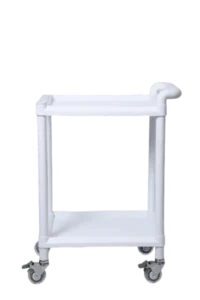
The AM-CT650 is the most compact trolley in the CT treatment series — two stainless steel trays at the top, two medium-depth drawers below, and a tubular steel frame that’s forty-eight centimeters wide. That’s the width of a standard office filing cabinet, which means the CT650 fits into consultation rooms, treatment alcoves, and clinic corners where larger treatment trolleys would block the workflow. The two trays provide a working surface and a supply-staging surface — enough for wound dressings, suture removal, injections, ear syringing, and the ten to fifteen procedures that make up ninety percent of primary care workload.
The two drawers are lockable — central pin-tumbler — and configured for a primary care formulary: one drawer for wound care and dressings, one for instruments, local anesthetics, and injection supplies. That’s not a lot of drawers by hospital standards, but in a community health setting where the procedure repertoire is well-defined and limited, two drawers cover the inventory without wasted space. Full-extension slides, silicone mat inserts — the same quality as the larger CT models, because a smaller trolley doesn’t mean smaller clinical demands. A dressing done in a community clinic still needs to be sterile, organized, and efficient.
The side baskets are single units — one on each side, smaller than the CT690’s baskets — holding tape, gauze rolls, gloves, and the consumables that don’t fit in categorized drawers. The frame includes a lower shelf for a sharps container and a box of procedure packs. Four casters, two locking, one hundred millimeters. The push handle is a single loop at one end, and the trolley is light enough — about fourteen kilograms unladen — to be lifted over a door threshold by one person.
The CT650 is for small clinics, community health stations, school health offices, occupational health units, and individual consultation rooms in larger facilities where the doctor or nurse wants a personal treatment trolley rather than sharing a unit between rooms. It’s also the right choice for mobile clinical services — immunization outreach, health screening vans, home visit services — where the trolley needs to load into a vehicle and deploy in spaces not designed for medical equipment. If you need more tray surface for complex wound care, the CT690 or CT780 add more trays and drawers at the cost of a wider footprint. But for the small-room clinician who’s tired of turning their back on the patient to reach a wall cabinet, the CT650 puts the supplies at hand level while keeping the room navigable. Tell me your room dimensions and procedure list.
Frequently Asked Questions
What specifications should I review for this model?
Key specifications including dimensions, capacity, power requirement and material composition are provided in the model datasheet. Contact us with your project requirements for the complete specification sheet.
What documents are available for import?
Datasheet, user manual, packing information and applicable conformity documents are confirmed per destination market. Registration requirements vary by country and are reviewed project by project.
Can I request a sample or reference installation?
Sample availability and reference installation details are confirmed based on the product category and order volume. Contact us with your specific requirements.