A medical director at a chain of dialysis centers in Jiangsu called me after a patient arrest in one of his facilities. The staff had an AED and a basic emergency kit — no organized drawer system, no dedicated crash cart, and the first-responder nurse spent forty-five seconds finding the epinephrine because it was in a sealed kit that hadn’t been opened since its last inspection six months prior. The patient survived, but the post-incident review was brutal. “We’re not an ICU,” he said, “but we have four hundred patients a week with end-stage renal disease. Codes happen. I need a cart that fits in our treatment bays and doesn’t require an ACLS instructor to restock.” The ET625 is that cart.
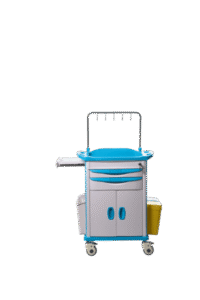
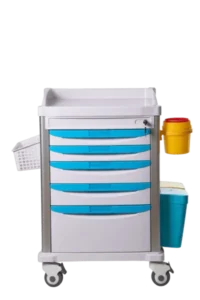
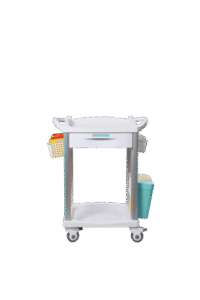
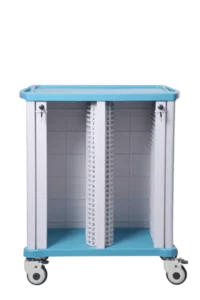
The AM-ET625 is our compact emergency trolley — five drawers, a fifty-five-centimeter width, and a defibrillator shelf on top. It’s designed for facilities that need organized, accessible code response capability but don’t have the floor space, the case volume, or the ACLS scope to justify a full six-to-eight drawer crash cart. Five drawers, when properly configured, cover the essentials: emergency medications, basic-to-intermediate airway, IV access and circulation, diagnostics, and disposables. You’re not carrying surgical airway kits or intraosseous drills — those belong in the ET780. You’re carrying what a BLS-to-ACLS team needs in the first five minutes of a code before the paramedics or the rapid response team arrives.
The drawer color scheme is simplified: red for medications, blue for airway, yellow for circulation, green for equipment, and the bottom drawer for fluids and miscellaneous. Each drawer has full-extension slides and foam insert dividers — the medication drawer is pre-cut for BLS and first-line ACLS drugs. No custom configuration required. You open the drawer, the drugs are in labeled compartments, and a staff member who only runs codes once every six months can find what they need. That’s the design principle: the ET625 works for the general ward nurse or the dialysis technician, not just the ED resuscitation specialist.
The defibrillator shelf is sized for a standard AED or a compact biphasic defibrillator — not the full pacing-capable units that live on the ET780, but anything that delivers a shock and displays a rhythm. The oxygen cylinder bracket on the side holds a D-size tank with a quick-release strap. A single telescoping IV pole mounts on the opposite side. The push handle is on one end only — designed for a single responder pushing toward the patient, not for a team transport scenario. The casters are one hundred millimeters, twin-wheel, with two locking and two free — enough stability for a stationary code but not optimized for high-speed corridor transport.
Where does the ET625 belong? Dialysis centers, outpatient surgery centers, dental clinics doing sedation, community health clinics, school health centers, occupational health units at industrial sites, and any facility where a code is a low-frequency, high-stakes event rather than a daily occurrence. It’s also the right cart for hospital departments that need code capability but don’t need an ED-grade crash cart — radiology suites, physical therapy gyms, and outpatient procedure areas. If your facility’s code team is internal and ACLS-trained, the ET750 gives you more organization and capacity. If your code response relies on calling 911 and managing the first five minutes, the ET625 gives you organized, accessible emergency supplies without overwhelming your staff or your floor plan. Contact me with your facility type and code response protocol — I’ll tell you which ET model fits your actual emergency, not the worst-case scenario.
Frequently Asked Questions
What specifications should I review for this model?
Key specifications including dimensions, capacity, power requirement and material composition are provided in the model datasheet. Contact us with your project requirements for the complete specification sheet.
What documents are available for import?
Datasheet, user manual, packing information and applicable conformity documents are confirmed per destination market. Registration requirements vary by country and are reviewed project by project.
Can I request a sample or reference installation?
Sample availability and reference installation details are confirmed based on the product category and order volume. Contact us with your specific requirements.