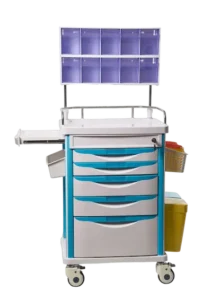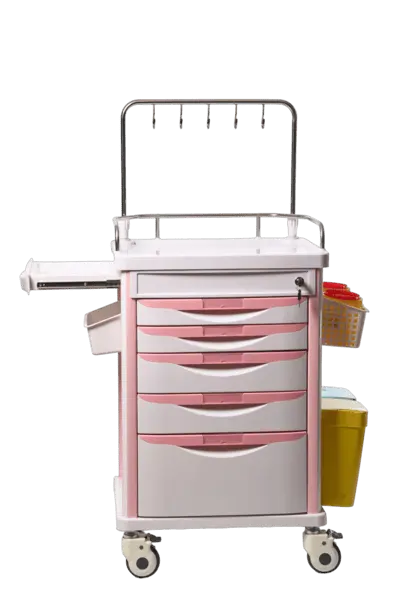
I was in a thirty-bed general medical ward in Wuhan where every bed had a different IV pole — some old, some new, some rusty at the base, some with hooks that wouldn’t stay folded. The head nurse told me they’d bought poles one at a time over fifteen years from whatever supplier was cheapest that quarter, and now her staff had to remember which pole at which bed had which quirk — bed twelve’s pole drifts, bed eighteen’s won’t lock at full height, bed twenty-three’s missing a hook. She wanted one standard pole across all thirty beds. The ITT625 is that standard.
The AM-ITT625 is the simplest infusion trolley in the ITT line — a single telescoping IV pole on a five-point wheeled base, with an integrated storage basket and a small flat shelf. It’s the hospital-grade upgrade from the generic chrome-plated IV pole that every medical supply catalog sells for cheap and every nurse eventually curses. The pole is stainless steel, telescoping from roughly one meter to one hundred eighty centimeters, with four folding hooks at the top. The locking collar at the telescoping joint is machined aluminum with a nylon insert — it doesn’t slip under load the way friction-only collars do, and it doesn’t seize after a year of exposure to alcohol wipes and disinfectant spray.
The base is a five-point star configuration with five casters — more stable than the four-caster bases on generic IV poles, because five points of contact distribute the pole’s moment across a wider footprint. The casters are one hundred millimeters, twin-wheel, with two locking. The base is chrome-plated steel, same as the pole, and the plating is medical-grade — fifty microns minimum thickness, no pinholes that become rust spots after six months of floor cleaning solution exposure. The basket mounts at waist height on the central pole — a single removable wire unit sized for a box of gloves, a roll of tape, alcohol wipes, and a handful of IV catheters. The flat shelf below the basket holds a small sharps container.
This is not an infusion trolley for multi-drug protocols. It’s a bedside IV stand for the patient who needs one or two lines — maintenance fluids, an antibiotic, or a blood transfusion — and doesn’t need pump integration, multiple poles, or a large supply basket. Its value is in being standardized, reliable, and consistent across an entire ward. When every bed has the same IV stand, nurses don’t have to think about which pole is at which bed. They reach for the locking collar in the same motion every time, and muscle memory takes over. In a thirty-bed ward, that consistency saves cumulative minutes per shift and eliminates the low-grade frustration of dealing with equipment that behaves differently at every bedside.
The ITT625 is the right choice for general wards standardizing bedside infusion equipment, pre-op holding areas, post-anesthesia care units, and any clinical environment where the majority of infusions are single-line. If your patients typically need two or more lines at the bedside, the ITT600 with two poles is the logical step up. But for the ward that just wants thirty identical, reliable IV stands that don’t drift, don’t rust, and don’t have their own personalities, the ITT625 is the honest tool. Contact me with your bed count and I’ll quote a ward-set price that reflects standardizing all your beds at once.
Frequently Asked Questions
What specifications should I review for this model?
Key specifications including dimensions, capacity, power requirement and material composition are provided in the model datasheet. Contact us with your project requirements for the complete specification sheet.
What documents are available for import?
Datasheet, user manual, packing information and applicable conformity documents are confirmed per destination market. Registration requirements vary by country and are reviewed project by project.
Can I request a sample or reference installation?
Sample availability and reference installation details are confirmed based on the product category and order volume. Contact us with your specific requirements.