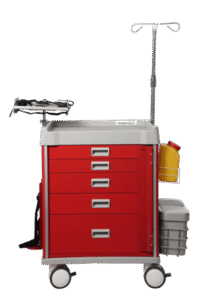
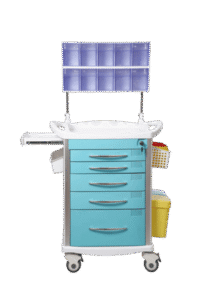
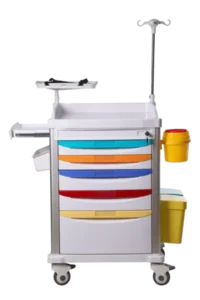
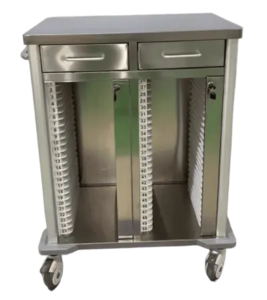
A GP clinic in Suzhou had a problem I’ve seen at a hundred primary care facilities: minor procedures — wound dressings, suture removal, skin lesion excision — happened in every consulting room, but the procedure trolley had to be shared between four rooms. The existing cart was a basic two-tray unit with no drawer storage, so the nurses had to carry a separate supply basket from room to room. Two items to wheel, two items to clean, two items to inventory. The CT690 is the treatment trolley that combines enough tray space for procedures with enough drawer storage to carry all the supplies in one trip.
The AM-CT690 is our mid-size treatment trolley with a balanced design: two stainless steel working trays at the top, four medium-depth drawers below, and two side-mounted wire baskets. The two-tray setup gives you a clean working surface and a secondary surface for supplies-in-use — not the four-level stepped system of the CT780, but entirely adequate for the fifteen-minute procedures that typify primary care and outpatient wound management. Both trays are 304-grade stainless, seamless, with raised lips, in the same dimensions as the CT780’s top trays.
The four drawers are where the CT690 differentiates itself from the CT780. The CT780 emphasizes tray surfaces; the CT690 emphasizes organized drawer storage. Four drawers mean four categories: wound dressings in one, instruments and suture kits in another, antiseptics and skin prep in a third, patient assessment tools in the fourth. The drawers are on full-extension slides with the standard fifteen-thousand-cycle rating, and the drawer fronts have the same snap-in label holders for easy category identification. These drawers are lockable — central pin-tumbler system — which makes the CT690 suitable for clinics that stock injectable local anesthetics and need them secured between cases.
The side baskets handle bulk consumables: gauze rolls, cohesive bandages, adhesive tape, and the items that have too much volume for a drawer but need to be within arm’s reach. The baskets are removable — lift them off the mounting rails for cleaning or for restocking from a central supply room. The frame is steel, white powder coat, with four anti-static casters, central locking, and a full-width push handle. Width is about sixty-two centimeters — narrower than the CT780, wider than a medication cart — striking a compromise between working surface area and corridor maneuverability.
The CT690 is the right choice for general practice clinics, community health centers, outpatient wound care services, and any clinical environment where procedures are frequent but short, and the trolley needs to carry its own supply inventory between rooms. It’s the most versatile treatment trolley in the CT range — not as tray-focused as the CT780, not as drawer-focused as the CT680, and not as compact as the CT650. It’s the generalist: two trays for the procedure, four drawers for the supplies, one trolley moving between rooms instead of a cart and a basket. If your clinic does mainly simple wound care and the four drawers are more than you need, the CT650 gives you two drawers in a smaller frame. If you’re running a dedicated wound care service, the CT780’s additional trays may serve you better. For the clinic in the middle, the CT690 is the balance point. Contact me with your procedure list and I’ll map the drawer categories.
Frequently Asked Questions
What specifications should I review for this model?
Key specifications including dimensions, capacity, power requirement and material composition are provided in the model datasheet. Contact us with your project requirements for the complete specification sheet.
What documents are available for import?
Datasheet, user manual, packing information and applicable conformity documents are confirmed per destination market. Registration requirements vary by country and are reviewed project by project.
Can I request a sample or reference installation?
Sample availability and reference installation details are confirmed based on the product category and order volume. Contact us with your specific requirements.