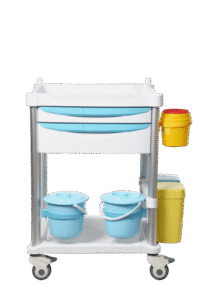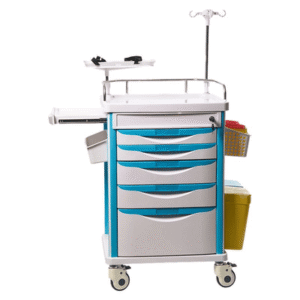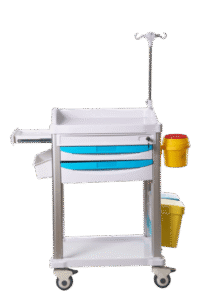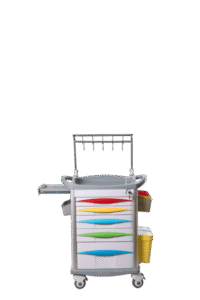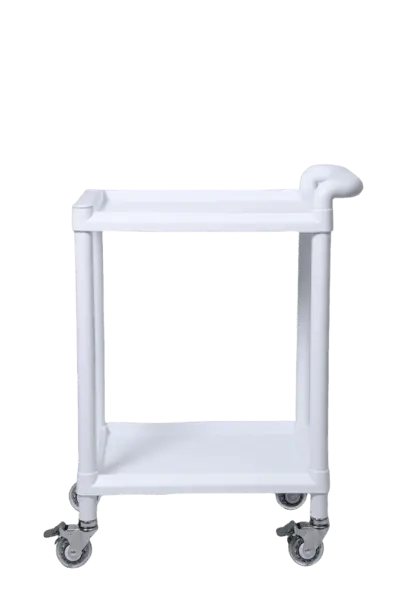
Every hospital ward has a workhorse trolley — the one that lives in the treatment room and gets used for dressing changes, IV starts, minor exams, and the hundred small procedures that don’t justify wheeling in a specialized cart. It doesn’t have a dramatic clinical story because it’s so fundamental that nobody thinks about it until it’s missing. I walked into a new community hospital last year and the first thing I noticed was the treatment room had no procedure trolley — nurses were carrying supplies to bedside in their hands, making three trips per patient. The AM-101A is that fundamental workhorse.
The AM-101A is our general-purpose medical trolley with the most practical configuration: a stainless steel top working surface, two drawers, two wire storage baskets, and tubular guard rails on three sides of the top. The stainless top is 304-grade, seamless, with a raised lip to contain spills. It’s sized for a standard dressing pack, a suture removal kit, or an IV start tray — not a full sterile field, but enough working area for ninety percent of ward procedures. The guard rails keep supplies from sliding off during transport and double as a push handle — form and function in the same piece of stainless tubing.
The two drawers are medium-depth, mounted on ball-bearing slides with full extension. One drawer typically holds procedure consumables — gauze, tape, alcohol wipes, cotton balls, bandages in graduated sizes. The other holds instruments — scissors, forceps, needle holders, in a silicone instrument mat that prevents metal-on-metal contact during movement. The wire baskets below the drawers are open-front, designed for bulk storage: rolled bandages, IV solution bags, dressing packs, and anything that’s consumed in volume and doesn’t need to be behind a locked drawer. The open basket design means you can see inventory levels at a glance — no opening drawers to check if you’re out of 4×4 gauze.
The frame is tubular steel, powder-coated white, with a lower shelf that provides additional flat storage for a procedure tray or an extra box of supplies. Four swivel casters, two locking, one hundred millimeters in diameter. The trolley is light enough — about fifteen kilograms assembled — to be moved one-handed by a nurse carrying supplies in the other hand. That matters more than the spec sheet suggests: a trolley that requires two hands to steer is a trolley that gets left in the treatment room while the nurse makes multiple trips by hand.
The AM-101A is the right trolley for general medical and surgical wards, treatment rooms, outpatient clinics, and any clinical environment where a simple, reliable procedure cart is needed. It doesn’t lock (the drawers are open-access by design), it doesn’t hold controlled substances, and it’s not an emergency cart. It’s a procedure trolley — the most basic and most used piece of mobile clinical furniture in any hospital. If you need more drawer capacity with the same stainless work surface, the AM-201F adds two more drawers. If you need a locked medication cart, the MT series is the right category. But for the ward that just needs somewhere to put the dressing tray while they change a wound, the 101A is the tool. Tell me your ward type and I’ll confirm the configuration.
Frequently Asked Questions
What specifications should I review for this model?
Key specifications including dimensions, capacity, power requirement and material composition are provided in the model datasheet. Contact us with your project requirements for the complete specification sheet.
What documents are available for import?
Datasheet, user manual, packing information and applicable conformity documents are confirmed per destination market. Registration requirements vary by country and are reviewed project by project.
Can I request a sample or reference installation?
Sample availability and reference installation details are confirmed based on the product category and order volume. Contact us with your specific requirements.