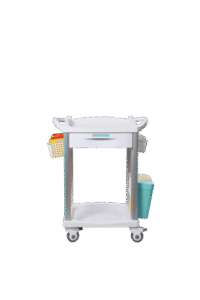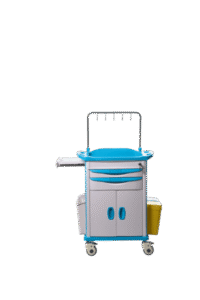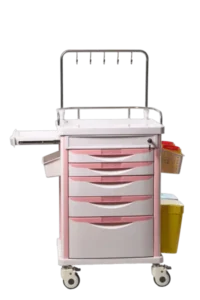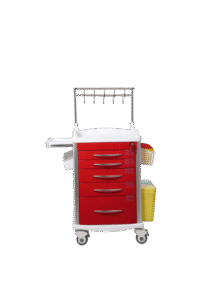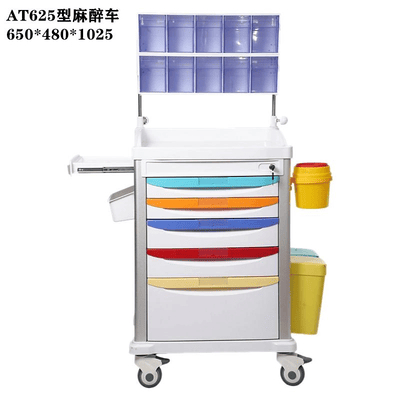
The head of anesthesia at a university hospital in Wuhan told me something I think about every time I design a trolley: “My residents treat equipment like they’re paying for it with someone else’s money. They’re not being careless — they’re being fast. And fast means the gear gets hit, shoved, and kicked into position during every emergency induction. If it can’t take that, I don’t want it in my OR.” He wasn’t looking for lightweight. He was looking for armor. The AT650 is that trolley.
The AM-AT650 is our full-size steel anesthesia trolley — seven drawers in a welded steel chassis with a powder-coated finish that’s been tested through five hundred hours of salt-spray exposure without substrate corrosion. That translates to about ten years of use in a typical OR environment where daily cleaning involves quaternary ammonium compounds and occasional bleach wipes. The steel body adds weight — the unladen trolley is about thirty-two kilograms — but that weight provides stability. When a resident pulls open a fully loaded bottom drawer during a rapid sequence induction, the trolley doesn’t tip forward. Physics is physics: mass at the base resists moment. Steel at the base provides that mass without adding a separate ballast plate.
The drawer layout mirrors the AT780: one double-locked narcotics drawer, two shallow induction/emergency drug drawers, two medium airway and disposables drawers, two deep bulk storage drawers. But the AT650 adds a side-mounted equipment rail as standard — not optional — with an integrated IV pole that extends to one hundred eighty centimeters and locks at any height. That pole holds an infusion pump, a pressure bag, or a fluid warmer directly adjacent to the work surface, which eliminates the floor stand that OR staff have been tripping over since anesthesia was delivered via ether-soaked rags.
The locked narcotics drawer uses the same independent secondary key system as the full AT line, but the AT650’s steel drawer body adds a layer of physical security that an ABS drawer simply doesn’t match. Cutting into an ABS drawer is work with a utility knife. Cutting into a steel drawer is work with an angle grinder. In a high-traffic teaching hospital where controlled substances are a perpetual audit concern, the extra barrier matters to the pharmacy compliance officer — and to the department head who signs off on the audit report.
The work surface is stainless steel with a full-perimeter lip — no seams, no crevices, one continuous piece of 304-grade stainless that can be flooded with disinfectant without worrying about liquid ingress at the edges. Underside of the tray is accessible for cleaning. The push handle is a full-width tubular steel rail mounted at one hundred centimeters — designed for a standing anesthesiologist of average height to push with their forearm horizontal. At six-plus hours into a complex case, ergonomics isn’t a luxury.
The AT650 is the choice for high-volume surgical departments where the trolley sees fifteen or more cases a week, gets cleaned aggressively between cases, and needs to survive years of being rammed into position by residents who are thinking about the airway, not the furniture. Teaching hospitals, trauma centers, and any OR suite where the equipment turnover rate is high and the abuse tolerance needs to match. If your facility needs a lighter, quieter trolley for a modern OR with gentler handling, the AT780 exists for that purpose. If your case volume is lower and space is tighter, the AT625 offers five drawers in a narrower frame. But if you need the anesthesia trolley equivalent of a cast-iron skillet — unapologetically heavy, unfailingly solid, and functionally immortal — the AT650 is what you want. Send me your surgical volume and I’ll configure the drawer dividers to match your drug list.
Frequently Asked Questions
What specifications should I review for this model?
Key specifications including dimensions, capacity, power requirement and material composition are provided in the model datasheet. Contact us with your project requirements for the complete specification sheet.
What documents are available for import?
Datasheet, user manual, packing information and applicable conformity documents are confirmed per destination market. Registration requirements vary by country and are reviewed project by project.
Can I request a sample or reference installation?
Sample availability and reference installation details are confirmed based on the product category and order volume. Contact us with your specific requirements.