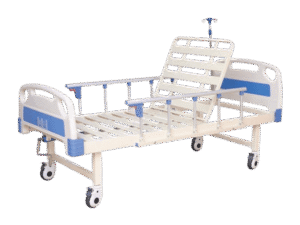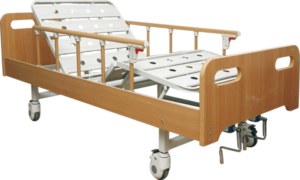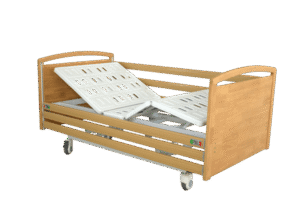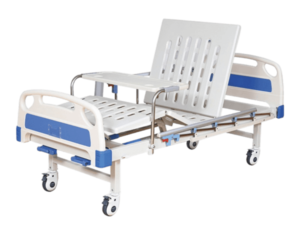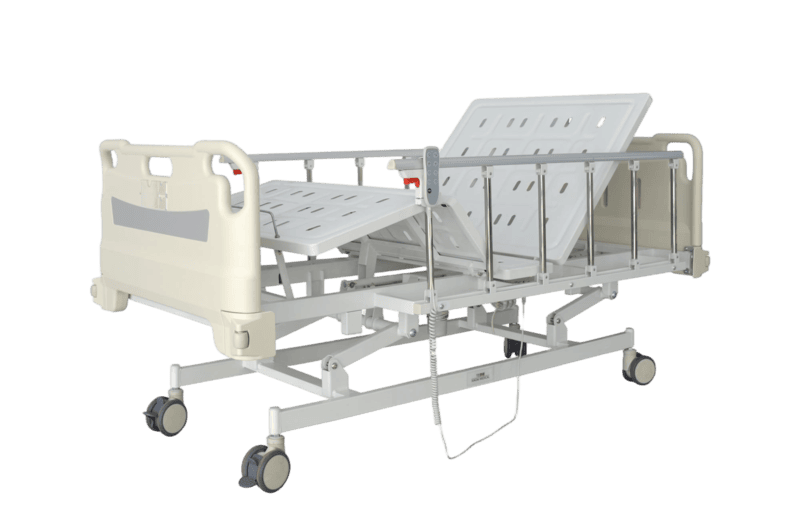
The DS03 started as the H001-13 with two upgrades that a nursing director in Kuala Lumpur asked for. She had approved the H001-13 for her hospital’s general wards and was satisfied with the bed mechanics — the Linak actuators, the quiet operation, the straightforward handset. But her night-shift nurses had flagged two things: the ABS side rails were noisy when lowered at three in the morning, and the standard mattress was firm enough for short-stay patients but not for the elderly long-stay patients who spent twenty hours a day in bed. She said, “Give me the same bed with better rails and a better mattress, and I’ll pay the difference for every bed facing the geriatric ward.” The DS03 is that bed.
The three electric functions are identical to the H001-13: backrest from zero to seventy-five degrees, knee section from zero to forty degrees, height from roughly forty-five to seventy-five centimeters. Same Linak LA27 actuators, same IPX6 rating, same ten-thousand-cycle service life. The difference is what surrounds the patient: the side rails and the mattress.
The side rails on the DS03 are aluminum alloy instead of ABS — the same rail system we use on our five-function ICU-capable beds. Aluminum doesn’t rattle when you lower it. It doesn’t flex when a confused patient grabs it and pulls. The release mechanism is the two-step safety design — lift, then push down — but the motion is damped, so the rail descends smoothly rather than dropping. At night on a quiet ward, the sound of a rail dropping is a small thing until you’re the patient in bed four who’s been startled awake for the third time since lights-out. Aluminum rails eliminate that sound. They also withstand daily disinfectant exposure without the micro-crazing that eventually appears on chemical-stressed ABS surfaces.
The mattress is where the DS03 earns its price premium. It’s a two-layer foam system — a high-resilience polyurethane core with a viscoelastic top layer that conforms to body shape without bottoming out. Total thickness is about twelve centimeters. The cover is four-way stretch PU with welded seams — waterproof, vapor-permeable, and zippered for removal. The viscoelastic layer is rated for eight-hour continuous use without pressure exceeding thirty-two millimeters of mercury at the sacrum — the clinical threshold below which pressure injury risk drops significantly. A standard hospital mattress with a single-layer foam core will exceed that threshold within two hours for an average-weight patient. For an elderly patient with fragile skin and limited mobility, those six extra hours of sub-threshold pressure are the difference between discharge with intact skin and discharge with a stage-two ulcer that becomes a wound care referral.
The frame is the same powder-coated steel platform as the H001-13, with the central brake pedal, the four anti-static casters, and the optional battery backup. The head and foot boards are ABS, removable without tools. The handset is the same membrane keypad — simple, labeled, functional. A CPR release lever at the head end drops the backrest flat in under three seconds without power — a safety feature I include even on general ward beds because codes don’t check which model you bought before they happen.
Model Comparison
| Specification | H001-02 (ICU) | H001-7D | H001-09 | H001-08 | H001-06 | H001-13 | H001-DS03 |
|---|---|---|---|---|---|---|---|
| Type | ICU electric | 7-function electric | 5-function electric | 5-function electric | 5-function electric | 3-function electric | 3-function electric |
| Load capacity | 300 kg | 250 kg | 250 kg | 250 kg | 250 kg | — | 250 kg |
| Dimensions (L×W×H) | 2150×980×480–720 mm | 2150×980×480–720 mm | 2100×980×480–720 mm | 2100×980×480–720 mm | 2150×980×480–720 mm | 2050×1000 mm (bed 1930×900) | 2100×980×480–720 mm |
| Height range | 480–760 mm | 480–760 mm | 480–760 mm | 480–760 mm | 480–760 mm | 80–760 mm | 480–760 mm |
| Backrest | 0–75° | 0–75° | 0–75° | 0–75° | 0–75° | 0–80° | 0–75° |
| Legrest | 0–45° | 0–45° | 0–45° | 0–45° | 0–45° | 0–40° | 0–45° |
| Trendelenburg | 0–13° | 0–13° | 0–13° | 0–13° | 0–13° | — | — |
| Reverse Trendelenburg | 0–13° | 0–13° | 0–13° | 0–13° | 0–13° | — | — |
| Left / Right tilt | 0–13° / 0–13° | 0–13° / 0–13° | — | — | — | — | — |
| Motor | Linak | Jiecang | Jiecang | Jiecang | Dailymag | — | Jiechang |
| Side rails | ABS with buttons | ABS | ABS | ABS | ABS with buttons | — | Aluminum 6-bar |
| Special features | CPR, one-touch stop, weighing footboard, nursing panel | Nursing console | Remote control | Remote control | Nursing tray, remote | — | Remote control |
Frequently Asked Questions
What specifications should I review for this model?
Key specifications including dimensions, capacity, power requirement and material composition are provided in the model datasheet. Contact us with your project requirements for the complete specification sheet.
What documents are available for import?
Datasheet, user manual, packing information and applicable conformity documents are confirmed per destination market. Registration requirements vary by country and are reviewed project by project.
Can I request a sample or reference installation?
Sample availability and reference installation details are confirmed based on the product category and order volume. Contact us with your specific requirements.