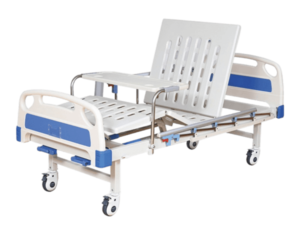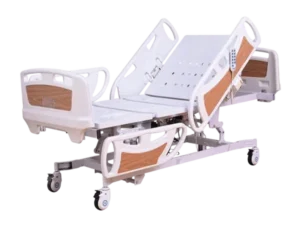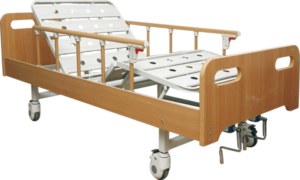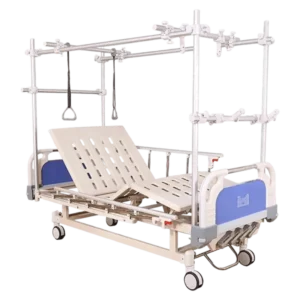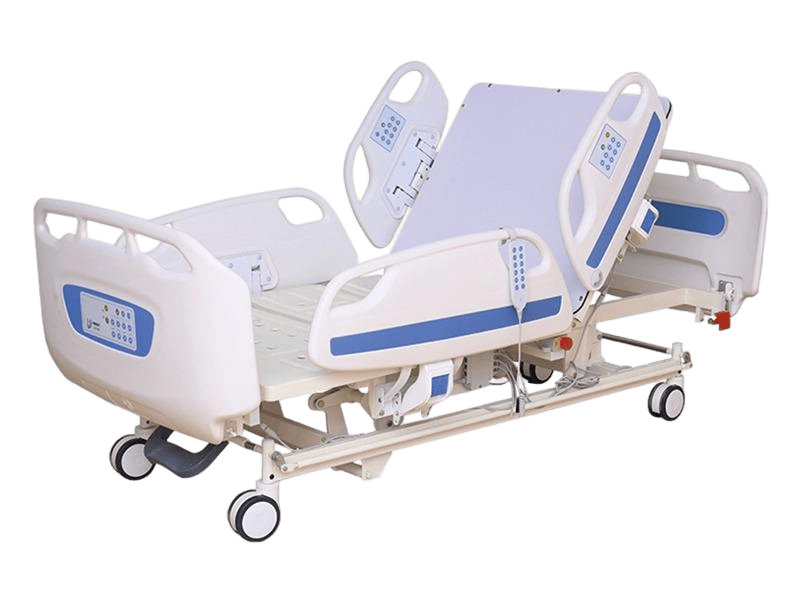
Most five-function beds tilt twelve degrees in Trendelenburg, and for most patients, twelve degrees is enough. But a respiratory therapist in Kuala Lumpur managing severe pneumonia patients during the rainy season told me that twelve degrees wasn’t giving her patients the full diaphragmatic advantage. She needed a bed that tilted more aggressively and held that angle precisely, because two degrees of tilt drift over four hours was the difference between a patient maintaining oxygen saturation on nasal cannula and escalating to high-flow. The H001-06 is the bed I built for that demand: five functions, with the tilt functions pushed farther than our standard models.
The five electric adjustments are backrest, knee, height, Trendelenburg, and reverse Trendelenburg — the same basic set as the H001-09 and H001-08. The difference is in the tilt mechanism. The H001-06 uses a higher-torque actuator on the tilt axis and a reinforced pivot joint that extends the Trendelenburg range to fifteen degrees head-down and fifteen degrees reverse Trendelenburg — three degrees more than our standard five-function beds. Three degrees doesn’t sound like much. But on a two-meter-long bed platform, three degrees at the head end translates to roughly ten centimeters of vertical displacement — enough to meaningfully shift abdominal contents away from the diaphragm in reverse Trendelenburg, and enough to deliver a clinically meaningful autotransfusion effect in full Trendelenburg for a hypotensive patient.
The tilt-lock system is also different. Standard five-function actuators hold position through the worm-gear’s inherent resistance to back-driving. The H001-06 adds an electromagnetic brake on the tilt axis that engages when the actuator stops — separate from the drive mechanism. That brake prevents the sub-degree drift that can occur over hours on a standard bed when a heavy patient is positioned at maximum tilt and their weight exerts constant load on the actuator. For the respiratory patient who needs reverse Trendelenburg maintained precisely throughout a four-hour ventilation weaning trial, that brake eliminates a variable the respiratory therapist shouldn’t have to think about.
The handset includes an incremental tilt display — a small bar graph on the LCD that shows the current tilt angle in real time. The nurse can adjust the angle in roughly two-degree increments with dedicated tilt buttons, and the bed holds exactly where it stops. This might seem like a minor UI feature, but in a respiratory ward where positioning is titrated to oxygen saturation — “raise the head another few degrees, let’s see if the sats come up” — incremental precision replaces the trial-and-error of holding a button and guessing.
The mattress platform, side rails, and frame are shared with the H001-09: four-section perforated steel, aluminum damped side rails with two-step release, powder-coated steel frame with central brake and anti-static casters. The mattress is the same viscoelastic pressure-relief system. CPR quick-release at the head end. Battery backup is standard. Weight capacity is two hundred kilograms. The IV pole sockets and drainage hooks from the H001-08 are not included — the H001-06 is optimized for positioning rather than line management, and removing those components keeps the cost focused on the tilt system.
The H001-06 is for wards where tilt positioning is the primary clinical requirement — respiratory units, neuro wards managing intracranial pressure, ICUs that want full-range Trendelenburg without stepping up to the seven-function H001-7D. If your unit doesn’t tilt patients beyond twelve degrees, the H001-09 or H001-08 saves money. But if your respiratory therapists have been asking for “just a little more angle,” the H001-06 is the bed they’re describing. Contact me.
Model Comparison
| Specification | H001-02 (ICU) | H001-7D | H001-09 | H001-08 | H001-06 | H001-13 | H001-DS03 |
|---|---|---|---|---|---|---|---|
| Type | ICU electric | 7-function electric | 5-function electric | 5-function electric | 5-function electric | 3-function electric | 3-function electric |
| Load capacity | 300 kg | 250 kg | 250 kg | 250 kg | 250 kg | — | 250 kg |
| Dimensions (L×W×H) | 2150×980×480–720 mm | 2150×980×480–720 mm | 2100×980×480–720 mm | 2100×980×480–720 mm | 2150×980×480–720 mm | 2050×1000 mm (bed 1930×900) | 2100×980×480–720 mm |
| Height range | 480–760 mm | 480–760 mm | 480–760 mm | 480–760 mm | 480–760 mm | 80–760 mm | 480–760 mm |
| Backrest | 0–75° | 0–75° | 0–75° | 0–75° | 0–75° | 0–80° | 0–75° |
| Legrest | 0–45° | 0–45° | 0–45° | 0–45° | 0–45° | 0–40° | 0–45° |
| Trendelenburg | 0–13° | 0–13° | 0–13° | 0–13° | 0–13° | — | — |
| Reverse Trendelenburg | 0–13° | 0–13° | 0–13° | 0–13° | 0–13° | — | — |
| Left / Right tilt | 0–13° / 0–13° | 0–13° / 0–13° | — | — | — | — | — |
| Motor | Linak | Jiecang | Jiecang | Jiecang | Dailymag | — | Jiechang |
| Side rails | ABS with buttons | ABS | ABS | ABS | ABS with buttons | — | Aluminum 6-bar |
| Special features | CPR, one-touch stop, weighing footboard, nursing panel | Nursing console | Remote control | Remote control | Nursing tray, remote | — | Remote control |
Frequently Asked Questions
What specifications should I review for this model?
Key specifications including dimensions, capacity, power requirement and material composition are provided in the model datasheet. Contact us with your project requirements for the complete specification sheet.
What documents are available for import?
Datasheet, user manual, packing information and applicable conformity documents are confirmed per destination market. Registration requirements vary by country and are reviewed project by project.
Can I request a sample or reference installation?
Sample availability and reference installation details are confirmed based on the product category and order volume. Contact us with your specific requirements.