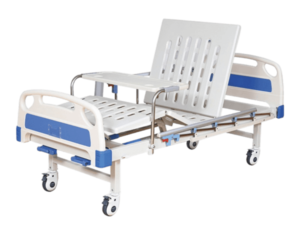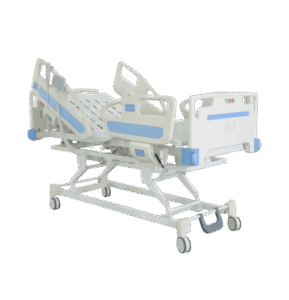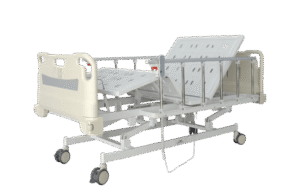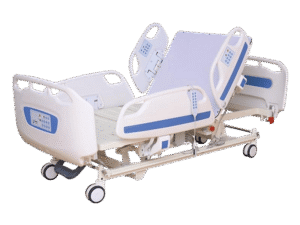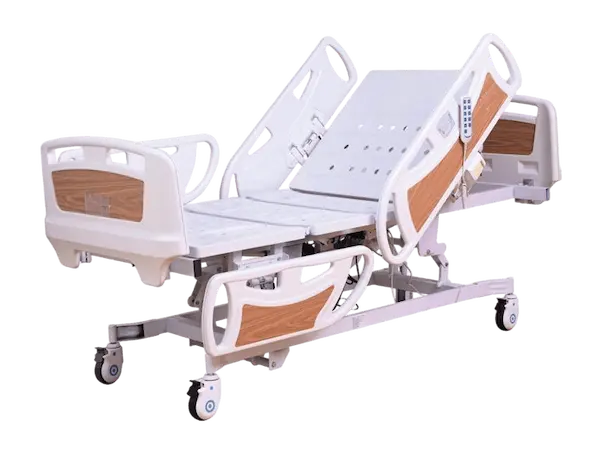
At some point in the progression from general ward to ICU, a hospital bed stops being a place where patients rest and starts being a positioning tool. I saw this clearly during a site visit to a step-down unit in Bangkok — patients were post-cardiac surgery, still intubated in some cases, and the nursing staff was adjusting bed positions ten to fifteen times per shift per patient. Head up for weaning from the ventilator. Trendelenburg for a hypotensive episode. Reverse Trendelenburg to reduce intracranial pressure. Cardiac chair for a patient transitioning to oral intake. A three-function bed would have covered maybe half of those adjustments. The nursing staff needed five. The H001-09 is our five-function electric bed built for that level of clinical positioning demand.
Five independent electric adjustments: backrest from zero to seventy-five degrees, knee section from zero to forty degrees, height from roughly forty-five to seventy-five centimeters, Trendelenburg tilt to twelve degrees head-down, and reverse Trendelenburg tilt to twelve degrees head-up. The tilt functions are what separate a five-function bed from a three-function. Trendelenburg — the whole bed platform angled head-down — shifts blood volume toward the central circulation, a basic maneuver for hypotension and shock that’s been in medical textbooks for over a century. Reverse Trendelenburg — head-up tilt — reduces intracranial pressure in neuro patients and improves respiratory mechanics by using gravity to pull the diaphragm downward. These aren’t comfort positions. They’re clinical interventions delivered by bed angle.
The cardiac chair position is a programmed combination — backrest at roughly sixty-five degrees, knee section elevated, and the entire platform tilted slightly forward at the foot end — that creates a seated posture mimicking a cardiac chair without transferring the patient out of bed. For a patient weaning from mechanical ventilation, sitting upright reduces the work of breathing. For a patient with congestive heart failure, it reduces venous return and pulmonary congestion. The position is accessed from the handset with one button — the nurse doesn’t need to manually dial in three angles while the patient’s oxygen saturation is dropping.
The actuators are Linak — five independent LA27 or LA31 units depending on the function, all IPX6 rated. The control system has a lockout function: the nurse can disable specific adjustments per patient. A confused patient who keeps lowering the bed rail won’t accidentally lower the bed itself if the height function is locked. The handset is a membrane keypad with a small LCD that shows battery status and lockout state — more feedback than the H001-13’s basic handset, but still immediate and intuitive.
The side rails are aluminum alloy with damped lowering and the two-step safety release. The mattress is the same two-layer viscoelastic system as the DS03 — twelve centimeters, pressure-relief rated, waterproof zippered cover. Head and foot boards are ABS, removable. Central brake pedal, four anti-static casters. CPR quick-release at the head end — push the red lever, backrest drops flat. The optional battery backup covers roughly twenty full cycles during a power loss.
The H001-09 is for the ward that bridges general care and intensive care — step-down units, high-dependency units, post-surgical observation, respiratory wards, neuro wards. It’s where the clinical staff needs positioning as a treatment modality, not just a comfort feature. If Trendelenburg is a maneuver your nurses perform more than once a week, the H001-09 is the minimum bed specification. If not, the three-function DS03 or H001-13 saves money. Send me your unit type and the most common positioning scenarios your staff handles — I’ll map which functions actually get used and whether five is the right number.
Model Comparison
| Specification | H001-02 (ICU) | H001-7D | H001-09 | H001-08 | H001-06 | H001-13 | H001-DS03 |
|---|---|---|---|---|---|---|---|
| Type | ICU electric | 7-function electric | 5-function electric | 5-function electric | 5-function electric | 3-function electric | 3-function electric |
| Load capacity | 300 kg | 250 kg | 250 kg | 250 kg | 250 kg | — | 250 kg |
| Dimensions (L×W×H) | 2150×980×480–720 mm | 2150×980×480–720 mm | 2100×980×480–720 mm | 2100×980×480–720 mm | 2150×980×480–720 mm | 2050×1000 mm (bed 1930×900) | 2100×980×480–720 mm |
| Height range | 480–760 mm | 480–760 mm | 480–760 mm | 480–760 mm | 480–760 mm | 80–760 mm | 480–760 mm |
| Backrest | 0–75° | 0–75° | 0–75° | 0–75° | 0–75° | 0–80° | 0–75° |
| Legrest | 0–45° | 0–45° | 0–45° | 0–45° | 0–45° | 0–40° | 0–45° |
| Trendelenburg | 0–13° | 0–13° | 0–13° | 0–13° | 0–13° | — | — |
| Reverse Trendelenburg | 0–13° | 0–13° | 0–13° | 0–13° | 0–13° | — | — |
| Left / Right tilt | 0–13° / 0–13° | 0–13° / 0–13° | — | — | — | — | — |
| Motor | Linak | Jiecang | Jiecang | Jiecang | Dailymag | — | Jiechang |
| Side rails | ABS with buttons | ABS | ABS | ABS | ABS with buttons | — | Aluminum 6-bar |
| Special features | CPR, one-touch stop, weighing footboard, nursing panel | Nursing console | Remote control | Remote control | Nursing tray, remote | — | Remote control |
Frequently Asked Questions
What specifications should I review for this model?
Key specifications including dimensions, capacity, power requirement and material composition are provided in the model datasheet. Contact us with your project requirements for the complete specification sheet.
What documents are available for import?
Datasheet, user manual, packing information and applicable conformity documents are confirmed per destination market. Registration requirements vary by country and are reviewed project by project.
Can I request a sample or reference installation?
Sample availability and reference installation details are confirmed based on the product category and order volume. Contact us with your specific requirements.