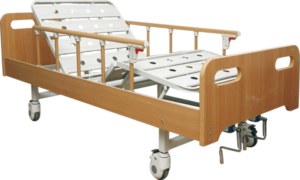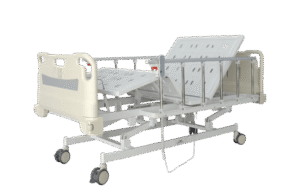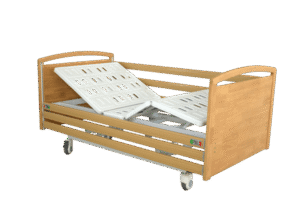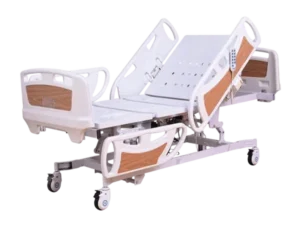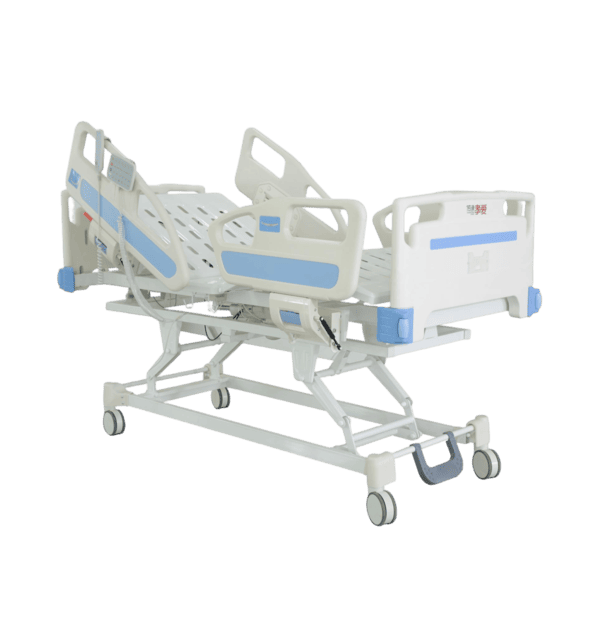
In a teaching hospital, the bed is part of the clinical education. Residents learn positioning protocols during rounds — cardiac chair for CHF, reverse Trendelenburg for ICP management, full Trendelenburg for central line insertion. The attending physician expects the bed to execute every position in the protocol without limitation, because the resident’s learning shouldn’t be constrained by equipment that only does three things. The H001-7D is our seven-function bed — the most complete positioning suite we build short of the full ICU platform — and it exists for hospitals where clinical versatility is not negotiable.
Seven electric functions: backrest from zero to seventy-five degrees, knee section from zero to forty degrees, height from roughly forty-five to seventy-five centimeters, Trendelenburg to twelve degrees head-down, reverse Trendelenburg to twelve degrees head-up, cardiac chair position with independent foot section elevation, and a dedicated leg elevation function that raises the lower extremities without flexing the knee — different from the knee-break function, and clinically important for patients with lower-extremity edema, DVT prophylaxis, or post-orthopedic surgery elevation requirements. The cardiac chair is a programmed multi-axis movement — backrest to roughly seventy degrees, knee section elevated, foot section lowered, platform slightly tilted — accessed from a single button on the handset. The patient transitions from supine to seated in about forty-five seconds, smoothly.
The seven-function configuration means the bed has an actuator dedicated to each movement axis. No shared mechanisms, no “this lever does two things depending on position.” Each function is independent, which means the clinical team can combine positions freely — reverse Trendelenburg with legs elevated, for example, which offloads the diaphragm while reducing lower-extremity venous pooling. A bed with shared mechanisms forces compromises in positioning. A bed with seven independent actuators doesn’t.
The actuators are Linak — a mix of LA27 and LA31 units, all IPX6, all with the ten-thousand-cycle service life. The control system has a full lockout suite: the nurse can lock individual functions, the handset itself can be locked with a PIN, and the bed rails have integrated controls on the inner face so the patient can adjust backrest and knee within nurse-set limits. The handset is backlit with a larger LCD than the five-function models, showing all seven function states, battery level, and any active lockouts. It’s more complex than the three-function handset, and I want to acknowledge that — a new nurse will need maybe ten minutes of orientation rather than thirty seconds. The tradeoff is that once they’re oriented, they can execute any positioning protocol the attending orders without walking around the bed looking for the right crank or actuator.
The platform is the same four-section perforated steel as our five-function beds, but the frame is reinforced at the articulation points to handle the additional loading from the cardiac chair configuration — when the patient is essentially sitting upright, the backrest hinge bears the full torso weight in a concentrated moment arm that’s rougher on the frame than a supine position. The side rails are aluminum with integrated controls, damped, two-step release. The mattress is the viscoelastic pressure-relief system. Head and foot boards are molded ABS. Central brake, anti-static casters, CPR quick-release, standard battery backup. Weight capacity is two hundred kilograms.
Model Comparison
| Specification | H001-02 (ICU) | H001-7D | H001-09 | H001-08 | H001-06 | H001-13 | H001-DS03 |
|---|---|---|---|---|---|---|---|
| Type | ICU electric | 7-function electric | 5-function electric | 5-function electric | 5-function electric | 3-function electric | 3-function electric |
| Load capacity | 300 kg | 250 kg | 250 kg | 250 kg | 250 kg | — | 250 kg |
| Dimensions (L×W×H) | 2150×980×480–720 mm | 2150×980×480–720 mm | 2100×980×480–720 mm | 2100×980×480–720 mm | 2150×980×480–720 mm | 2050×1000 mm (bed 1930×900) | 2100×980×480–720 mm |
| Height range | 480–760 mm | 480–760 mm | 480–760 mm | 480–760 mm | 480–760 mm | 80–760 mm | 480–760 mm |
| Backrest | 0–75° | 0–75° | 0–75° | 0–75° | 0–75° | 0–80° | 0–75° |
| Legrest | 0–45° | 0–45° | 0–45° | 0–45° | 0–45° | 0–40° | 0–45° |
| Trendelenburg | 0–13° | 0–13° | 0–13° | 0–13° | 0–13° | — | — |
| Reverse Trendelenburg | 0–13° | 0–13° | 0–13° | 0–13° | 0–13° | — | — |
| Left / Right tilt | 0–13° / 0–13° | 0–13° / 0–13° | — | — | — | — | — |
| Motor | Linak | Jiecang | Jiecang | Jiecang | Dailymag | — | Jiechang |
| Side rails | ABS with buttons | ABS | ABS | ABS | ABS with buttons | — | Aluminum 6-bar |
| Special features | CPR, one-touch stop, weighing footboard, nursing panel | Nursing console | Remote control | Remote control | Nursing tray, remote | — | Remote control |
Frequently Asked Questions
What specifications should I review for this model?
Key specifications including dimensions, capacity, power requirement and material composition are provided in the model datasheet. Contact us with your project requirements for the complete specification sheet.
What documents are available for import?
Datasheet, user manual, packing information and applicable conformity documents are confirmed per destination market. Registration requirements vary by country and are reviewed project by project.
Can I request a sample or reference installation?
Sample availability and reference installation details are confirmed based on the product category and order volume. Contact us with your specific requirements.