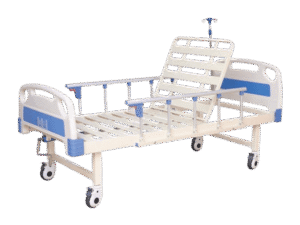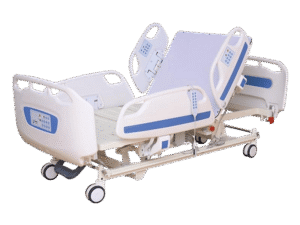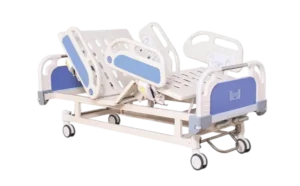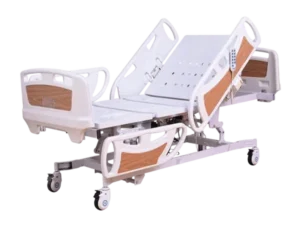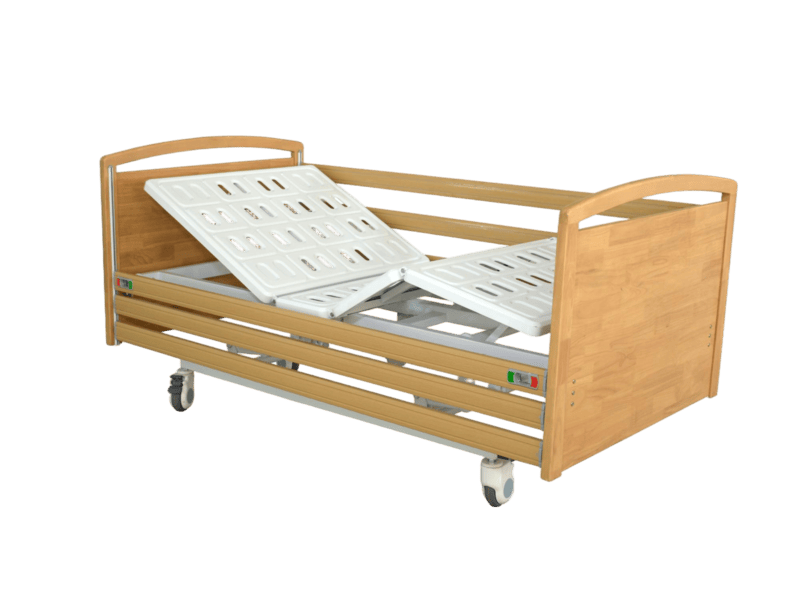
When a hospital decides to switch from manual to electric beds, the procurement conversation usually starts at the top of the line — seven functions, cardiac chair, touchscreen handset — and then the budget lands and reality sets in. The question becomes: what’s the minimum electric functionality that actually improves nursing workflow? For most general wards, the answer is three functions: backrest, knee, and height. The AM-CCXA-H001-13 delivers those three functions with the actuator quality of our higher-end beds at a price point that makes fleet replacement possible.
Three electric actuators — one for backrest, one for knee section, one for height — replace the manual cranks that nurses have been turning for decades. The backrest range is zero to seventy-five degrees. The knee section range is zero to forty degrees, with the thigh and foot sections articulating together to create the contour that prevents patient slide. The height range is roughly forty-five to seventy-five centimeters from the floor to the mattress platform. At the lowest position, a mobile patient can sit on the edge of the bed with feet flat on the floor — the position that makes independent transfers possible. At the highest, a tall nurse can provide care without bending at the waist for thirty minutes, which is how back injuries happen in nursing.
The actuators are Linak — Danish-made, the industry standard for medical linear actuation. I’ve used Linak in our beds for over a decade because I’ve seen what happens when cheaper actuators fail: the bed stops mid-position, the patient can’t be moved until maintenance arrives, and the ward manager calls me asking why the bed I sold them stranded a patient at a forty-degree angle during a night shift. Linak actuators have an IPX6 washdown rating, a duty cycle that comfortably handles thirty adjustments per day, and a service life of roughly ten thousand cycles. That’s about ten years of normal ward use. The control handset is a simple membrane keypad with large, tactile buttons labeled with pictograms — no LCD screen, no menu navigation. A nurse who’s never seen the bed before should be able to raise the backrest within three seconds of picking up the handset.
The side rails are ABS — injection-molded, collapsible, with the same two-step release as our manual beds. The head and foot boards are blow-molded ABS, removable without tools. The mattress platform is perforated steel in four sections. The frame is powder-coated steel with a central brake pedal that locks all four casters — one hundred twenty-five millimeter twin-wheel, anti-static. A battery backup is optional — nine-volt, good for roughly twenty adjustment cycles during a power outage. If your facility loses power regularly, order the backup. If not, save the money.
The H001-13 is our value-oriented electric three-function bed. It doesn’t have Trendelenburg tilt, it doesn’t have a cardiac chair position, and the side rails are ABS rather than the aluminum alloy on the DS03. Those omissions are what create the price gap between this bed and the H001-DS03. For a general medical-surgical ward where positioning needs are straightforward — sit up, knees up, bed up and down — the H001-13 does everything the staff actually uses. If you need the enhanced side rails or the upgraded mattress, step up to the DS03. If you’re making the manual-to-electric transition and wondering what you can afford across twenty or forty beds, start here. Send me your ward layout and patient acuity level — I’ll spec the right quantity and confirm the H001-13 fits.
Model Comparison
| Specification | H001-02 (ICU) | H001-7D | H001-09 | H001-08 | H001-06 | H001-13 | H001-DS03 |
|---|---|---|---|---|---|---|---|
| Type | ICU electric | 7-function electric | 5-function electric | 5-function electric | 5-function electric | 3-function electric | 3-function electric |
| Load capacity | 300 kg | 250 kg | 250 kg | 250 kg | 250 kg | — | 250 kg |
| Dimensions (L×W×H) | 2150×980×480–720 mm | 2150×980×480–720 mm | 2100×980×480–720 mm | 2100×980×480–720 mm | 2150×980×480–720 mm | 2050×1000 mm (bed 1930×900) | 2100×980×480–720 mm |
| Height range | 480–760 mm | 480–760 mm | 480–760 mm | 480–760 mm | 480–760 mm | 80–760 mm | 480–760 mm |
| Backrest | 0–75° | 0–75° | 0–75° | 0–75° | 0–75° | 0–80° | 0–75° |
| Legrest | 0–45° | 0–45° | 0–45° | 0–45° | 0–45° | 0–40° | 0–45° |
| Trendelenburg | 0–13° | 0–13° | 0–13° | 0–13° | 0–13° | — | — |
| Reverse Trendelenburg | 0–13° | 0–13° | 0–13° | 0–13° | 0–13° | — | — |
| Left / Right tilt | 0–13° / 0–13° | 0–13° / 0–13° | — | — | — | — | — |
| Motor | Linak | Jiecang | Jiecang | Jiecang | Dailymag | — | Jiechang |
| Side rails | ABS with buttons | ABS | ABS | ABS | ABS with buttons | — | Aluminum 6-bar |
| Special features | CPR, one-touch stop, weighing footboard, nursing panel | Nursing console | Remote control | Remote control | Nursing tray, remote | — | Remote control |
Frequently Asked Questions
What specifications should I review for this model?
Key specifications including dimensions, capacity, power requirement and material composition are provided in the model datasheet. Contact us with your project requirements for the complete specification sheet.
What documents are available for import?
Datasheet, user manual, packing information and applicable conformity documents are confirmed per destination market. Registration requirements vary by country and are reviewed project by project.
Can I request a sample or reference installation?
Sample availability and reference installation details are confirmed based on the product category and order volume. Contact us with your specific requirements.