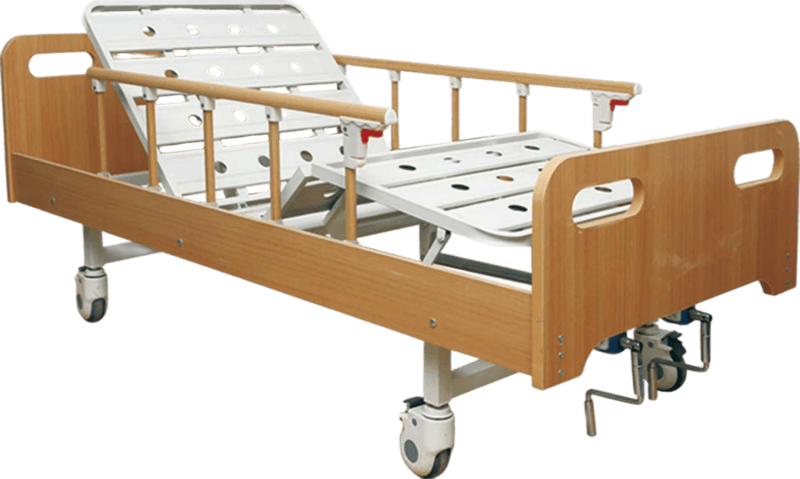
My aunt spent her last six months at home with a hospital bed in the living room. Her daughter — my cousin — had turned the entire ground floor into a care space: oxygen concentrator in the corner, bedside table with medications, a view of the garden through sliding glass doors. The only thing that didn’t belong was the bed. Steel frame, white paint, institutional head board stamped with a hospital equipment logo. It looked like a piece of the emergency department had followed her home and refused to leave. She didn’t complain about it. But I noticed she always pulled the blanket up over the head board when visitors came. The AM-B01-IV-03 is the bed I built after watching her do that.
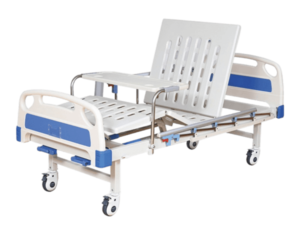
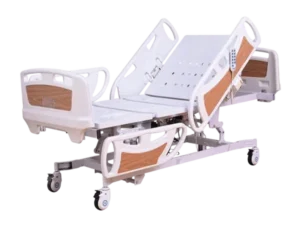
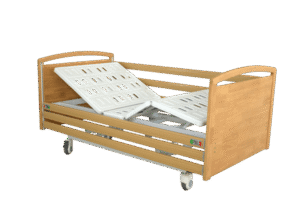
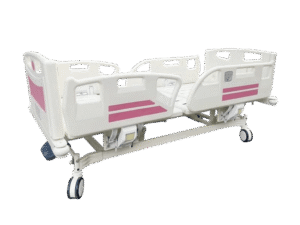
The B01-IV-03 is a manual double-crank hospital bed — backrest and knee elevation, same positioning as the B01-III-06 — with one defining difference: the head and foot boards are solid wood. Not wood-grain laminate. Not vinyl-wrapped MDF. Actual timber — beech or oak depending on the production batch, finished with a clear medical-grade lacquer that’s resistant to disinfectant wipes and doesn’t yellow under UV exposure. The wood changes the emotional register of the bed. It says “bedroom” instead of “ward.” For a patient spending their final months at home, or an elderly parent being cared for by their children, or a long-term care facility that wants its rooms to feel residential rather than clinical — that emotional register matters more than any spec sheet admits.
The crank mechanisms are the same worm-gear drives as our clinical manual beds — smooth, quiet, and they hold position without creep. The crank handles fold away under the bed frame when not in use so they don’t protrude into the walking path of a family caregiver navigating a home bedroom. The mattress platform is perforated steel with the same ventilation design as our hospital beds — because home care patients are bed-bound for hours too, and the risk of moisture-related skin breakdown doesn’t disappear when you leave the hospital. The side rails are aluminum with a wood-tone finish, soft-close — they lower with a damped motion rather than dropping with a clank that startles a dozing patient at two in the morning.
The bed height is fixed — approximately fifty-five centimeters from floor to mattress platform. That’s a compromise compared to our height-adjustable models, and I want to be upfront about it. A fixed-height bed means the caregiver bends more during transfers and bed-making. But adding height adjustment to a wooden bed frame introduces mechanical complexity that contradicts the simplicity and aesthetic the wood is supposed to provide. If height adjustment is clinically necessary — for a caregiver with back issues, for a patient who transfers independently to a wheelchair — the electric CCXA series is the right answer. If the bed lives in a home where the family wants it to feel like furniture that happens to have medical functionality, the B01-IV-03 is the answer.
The casters are one hundred twenty-five millimeter twin-wheel with two locking. Weight capacity is one hundred seventy-five kilograms. The wood is treated with an anti-fungal coat before the lacquer finish — important in humid climates where untreated wood in a bedroom grows mold within a season. Assembly is bolt-together and takes about forty-five minutes with two people.
Model Comparison
| Specification | B01-III-06 | B01-III-13 | B01-IV-03 (Wooden) | A01-III-01 |
|---|---|---|---|---|
| Type | 2-crank manual | 2-crank manual | 2-crank wooden | 1-crank manual |
| Load capacity | 182 kg | — | — | — |
| Overall dimensions | 2100×970 mm | 2090×1040×450 mm | 2040×930×500 mm | 2100×970 mm |
| Bed board | 1900×900 mm | 1900×900 mm | 2000×900 mm | 1900×900 mm |
| Backrest | 0–80° | 0–80° | 0–80° | 0–80° |
| Legrest | 0–40° | 0–45° | 0–40° | — |
| Side rails | 5-bar aluminum alloy | ABS hydraulic lift | — | Aluminum folding |
| Headboard / footboard | ABS | Composite + anti-collision wheels | Wooden | Composite |
| Casters | 125 mm, independent brakes | Central control wheels | — | — |
Frequently Asked Questions
What specifications should I review for this model?
Key specifications including dimensions, capacity, power requirement and material composition are provided in the model datasheet. Contact us with your project requirements for the complete specification sheet.
What documents are available for import?
Datasheet, user manual, packing information and applicable conformity documents are confirmed per destination market. Registration requirements vary by country and are reviewed project by project.
Can I request a sample or reference installation?
Sample availability and reference installation details are confirmed based on the product category and order volume. Contact us with your specific requirements.