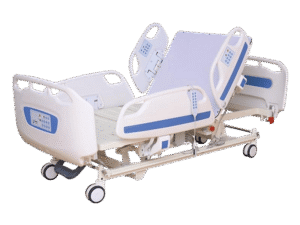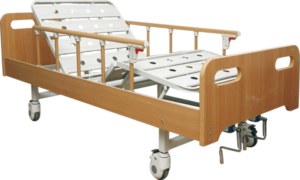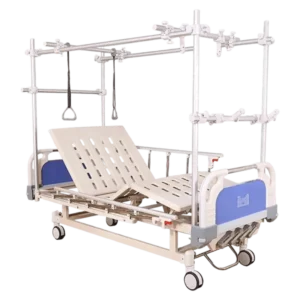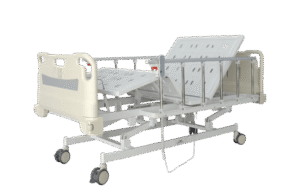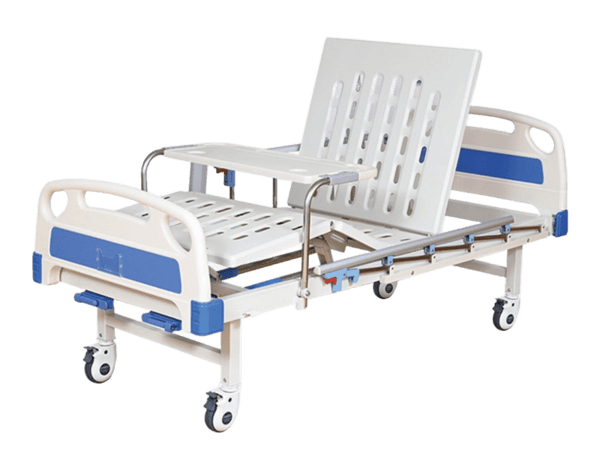
There’s a sweet spot in manual hospital beds, and it sits between the one-crank that only moves the backrest and the four-crank that requires a physio to explain. The AM-B01-III-06 hits that spot — two cranks, backrest and knee, the two positions that actually get used every day in a general ward. It’s not the cheapest bed we build and it’s not the most capable. It’s the one I recommend when someone running a nursing home or a district hospital calls and says, “I need manual beds that nurses will actually use the full range of, not beds with features they ignore.”
The two cranks are at the foot end — clearly labeled, color-coded handles so a new nurse or a family caregiver can identify backrest versus knee without training. The backrest crank raises the head section from flat to roughly seventy-five degrees through a worm-gear drive that holds position without a locking pin. You stop cranking, the backrest stays — no creep, no slow drift over hours that leaves a patient complaining they’re sliding down. The knee crank lifts the thigh section independently, breaking the mattress at the hip and knee to create a contour that reduces sacral pressure and prevents patients from sliding toward the foot end — the slow, inevitable migration that happens on a flat bed when the head is raised and gravity does the rest.
The two-crank setup solves the core positioning needs of general ward nursing: Fowler’s position for respiratory patients who breathe better sitting up, knee elevation for patients at risk of sliding or requiring lower-extremity pressure relief, and the combination of both for a seated-reading or meal-time position. What it doesn’t do — and what you’d need the B01-III-16 four-crank for — is Trendelenburg positioning, leg elevation independent of knee break, or height adjustment. For a general ward bed that stays at fixed height, those aren’t missing features. They’re unnecessary complexity.
The frame is powder-coated steel with rectangular tubing at the main load-bearing rails. Head and foot boards are ABS — removable without tools by pulling the release tabs at both sides. Side rails are aluminum alloy with a drop-down mechanism that requires two deliberate actions: lift slightly, then push down. That two-step release prevents accidental drops when a confused patient grabs the rail and pulls. The rails themselves are spaced with vertical bars narrow enough that a standard adult head won’t fit through — the dimensional standard that distinguishes a side rail from a hazard.
The mattress platform is perforated steel in four sections — head, seat, thigh, foot — with ventilation that matters in humid climates where mattress underside moisture is a mold risk. Casters are one hundred twenty-five millimeter twin-wheel with two locking. Weight capacity is one hundred seventy-five kilograms. The bed is delivered partially assembled — frame, head and foot boards, side rails — and a competent maintenance person with a wrench can have it patient-ready in thirty minutes.
The B01-III-06 is the manual bed for facilities that have reliable power but prefer manual positioning — either for cost reasons, maintenance simplicity, or environments where electric actuation is one more thing to break. Nursing homes. Long-term care. District hospital general wards. Clinics with short-stay observation beds. If all you need is backrest and knee, two cranks is the right number. Less is not enough. More is money you don’t need to spend. Send me your bed count and typical patient profile — I’ll confirm the two-crank fits.
Model Comparison
| Specification | B01-III-06 | B01-III-13 | B01-IV-03 (Wooden) | A01-III-01 |
|---|---|---|---|---|
| Type | 2-crank manual | 2-crank manual | 2-crank wooden | 1-crank manual |
| Load capacity | 182 kg | — | — | — |
| Overall dimensions | 2100×970 mm | 2090×1040×450 mm | 2040×930×500 mm | 2100×970 mm |
| Bed board | 1900×900 mm | 1900×900 mm | 2000×900 mm | 1900×900 mm |
| Backrest | 0–80° | 0–80° | 0–80° | 0–80° |
| Legrest | 0–40° | 0–45° | 0–40° | — |
| Side rails | 5-bar aluminum alloy | ABS hydraulic lift | — | Aluminum folding |
| Headboard / footboard | ABS | Composite + anti-collision wheels | Wooden | Composite |
| Casters | 125 mm, independent brakes | Central control wheels | — | — |
Frequently Asked Questions
What specifications should I review for this model?
Key specifications including dimensions, capacity, power requirement and material composition are provided in the model datasheet. Contact us with your project requirements for the complete specification sheet.
What documents are available for import?
Datasheet, user manual, packing information and applicable conformity documents are confirmed per destination market. Registration requirements vary by country and are reviewed project by project.
Can I request a sample or reference installation?
Sample availability and reference installation details are confirmed based on the product category and order volume. Contact us with your specific requirements.