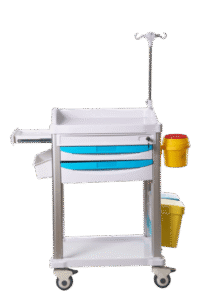
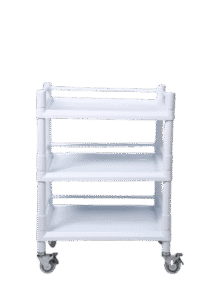
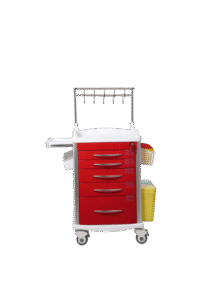
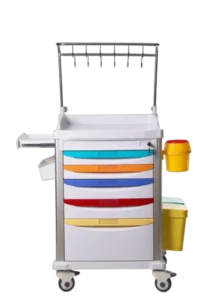
A pharmacy director at a six-hundred-bed hospital in Nanjing called me last spring with a problem that had nothing to do with drugs and everything to do with logistics. Her team was making eleven trips per shift from the central pharmacy to the wards — not because they were slow, but because their medicine trolleys held four small drawers and the morning medication pass required nine different drug categories. Every extra trip was fifteen minutes of a pharmacist’s time, multiplied by three shifts, seven days a week. She needed a trolley that could carry more per trip. That’s the AM-MT780.
The MT780 is our largest medicine delivery trolley in the MT series — eight drawers across three sizes, total internal volume just over eighty liters. Three shallow drawers at the top for ampoules, vials, and small-dose injectables. Three medium drawers in the middle for blister-pack tablets, pre-filled syringes, and unit-dose pouches. Two deep drawers at the bottom for IV fluid bags, irrigation bottles, and bulk consumables. Each drawer divider kit is adjustable — the pharmacist sets the compartment grid to match the ward’s formulary, not the other way around. When a new drug enters the formulary and an old one retires, you move dividers. You don’t buy a new trolley.
The drawer system uses full-extension ball-bearing slides rated for fifteen thousand cycles. That’s roughly five years of three-shift use at a busy hospital. When a drawer opens fully, nothing is hidden at the back — no pharmacist ever has to crouch and squint into a half-open drawer hunting for a box of metformin that slid to the rear. The central locking mechanism secures all eight drawers with a single key turn, and the lock core is a pin-tumbler type — not the wafer locks that wear out and start accepting neighboring keys after eighteen months. Narcotics shouldn’t live in a medicine delivery trolley anyway, but the controlled substances that do belong here stay behind a lock that actually locks.
The chassis is powder-coated steel with a wrap-around rubber bumper at mid-height. The bumper absorbs the corridor impacts that inevitably happen when you’re pushing a fully loaded trolley through a hospital wing at shift change. Four swivel casters — one hundred twenty-five millimeters, twin-wheel design — with central locking via a foot pedal at the base. The casters are the kind that don’t accumulate hair and dust in the bearing housing, which is a small thing until you’ve spent ten minutes cutting surgical tape and patient hair out of caster wheels because a trolley started pulling left.
Where does the MT780 belong? In any hospital or long-term care facility that runs centralized medicine distribution to satellite wards. The eight-drawer configuration means one pharmacist can deliver the full morning medication pass for a thirty-bed ward in a single trip. That’s the difference between two trolleys and one — or between one pharmacist and two. If your distribution volume doesn’t require eight drawers, the MT680 gives you six drawers at a smaller footprint and lower cost. But if “too many trips” is the complaint your pharmacy staff brings to every operations meeting, the MT780 is the honest answer. Reach out with your ward count and daily medication categories — I’ll map the drawer configuration that fits your workflow.
Frequently Asked Questions
What specifications should I review for this model?
Key specifications including dimensions, capacity, power requirement and material composition are provided in the model datasheet. Contact us with your project requirements for the complete specification sheet.
What documents are available for import?
Datasheet, user manual, packing information and applicable conformity documents are confirmed per destination market. Registration requirements vary by country and are reviewed project by project.
Can I request a sample or reference installation?
Sample availability and reference installation details are confirmed based on the product category and order volume. Contact us with your specific requirements.