Professional Stair Climber for Wheelchair: The 11D Portable Electric Power‑Lift Solution
When a building has no elevator, wheelchair users can end up “locked out” by the architecture itself. For families, hospitals, long‑term care facilities, and patient transport teams, this is not just inconvenient. It increases transfer delays, raises the risk of secondary injury, and puts caregivers at real risk of back and shoulder strain. Manual stair chairs can be low cost, but they depend heavily on strength and perfect technique. Fixed lift systems reduce effort, but they are expensive, require installation, and cannot be moved between sites.
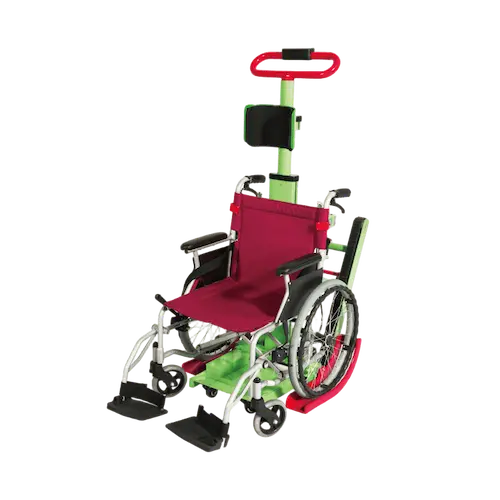
The 11D Portable Electric Series is a stair climber for wheelchair that turns stair transfers into a controlled, powered process instead of a lifting task. It helps protect the passenger on the stairs and reduces physical strain on the operator. From the first screen, it also supports how international buyers evaluate products: clear specifications, verifiable safety mechanisms, and a compliance pathway (CE/ISO) that aligns with Google’s E‑E‑A‑T expectations for trustworthy product content.
CTA (recommended above the fold):
Send staircase photos, stair angle (or step dimensions), user weight range, and daily usage frequency. We’ll recommend the right 11D configuration and provide pricing, lead time, and spare parts options.
1) Introduction: Overcoming the Vertical Barrier
The core value of a stair climber for wheelchair is simple: safe vertical mobility when there is no elevator, when permanent lifts are not possible, or when you need portability across multiple locations. The 11D is built for repeatable, real‑world use cases such as:
- Daily up/down access in older multi‑story residential buildings
- Community care visits and mobile medical transport
- In‑facility transfers across floors in hospitals and clinics
- Emergency planning and evacuation readiness in care centers
For buyers, the key question is not “Can it climb stairs?” It is: Can it do it safely, can one operator run it, will it stop instantly if control is released, and can staff be trained with a standard SOP?
2) Why the 11D: Engineering the Future of Accessibility
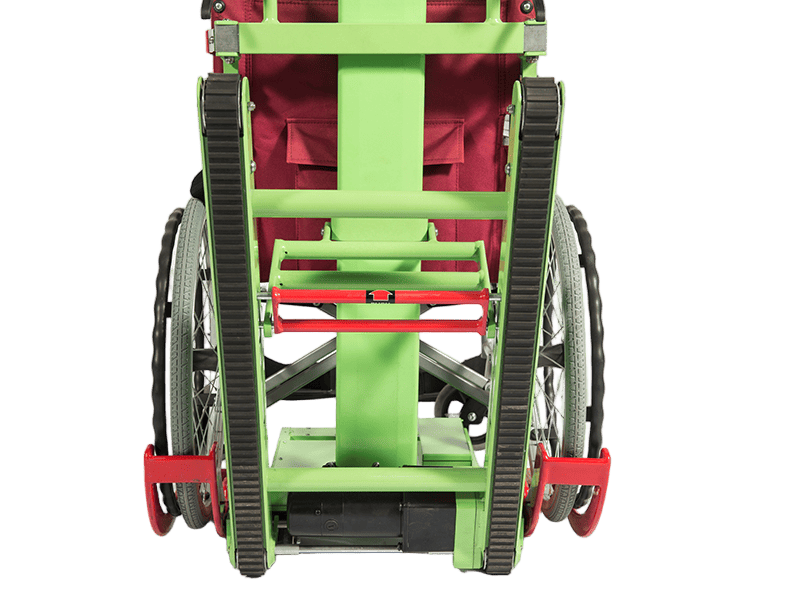
Caterpillar track technology (distributing weight across $\ge 3$ steps)
Stair risk comes from edges and drop‑offs. Wheels can lose traction at step transitions, while high‑friction rubber tracks maintain a larger, more continuous contact area. The 11D track system helps spread load across multiple steps (typically $ge 3$), improving stability and reducing slip risk.
This is what separates a professional stair climber for wheelchair from “a chair that happens to move”: multi‑point traction, consistent contact, and controlled step‑to‑step motion.
High‑torque brushless motor ($200text{ W}$) for efficient, quieter power
The 11D uses a $200\text{ W}$ brushless drive option designed for stable output and improved operating consistency. Brushless systems are commonly favored for efficiency, durability, and reduced noise—important in residential stairwells, hospital corridors, and care facilities.
When people search for a stair climber for wheelchair, what converts is not flashy claims. It is dependable performance that feels controlled and repeatable.
Aviation‑grade aluminum alloy construction (strength-to-weight advantage)
A high‑strength aluminum alloy frame supports durability and handling without unnecessary bulk. The 11D supports up to $\le 160\text{ kg}$ (350 lbs), covering a wide range of users and matching common institutional procurement requirements. In a stair climber for wheelchair, material choice directly impacts long‑term stability, corrosion resistance, and lifecycle cost.
3) Key Features: Designed for “Zero‑Gravity” Operation
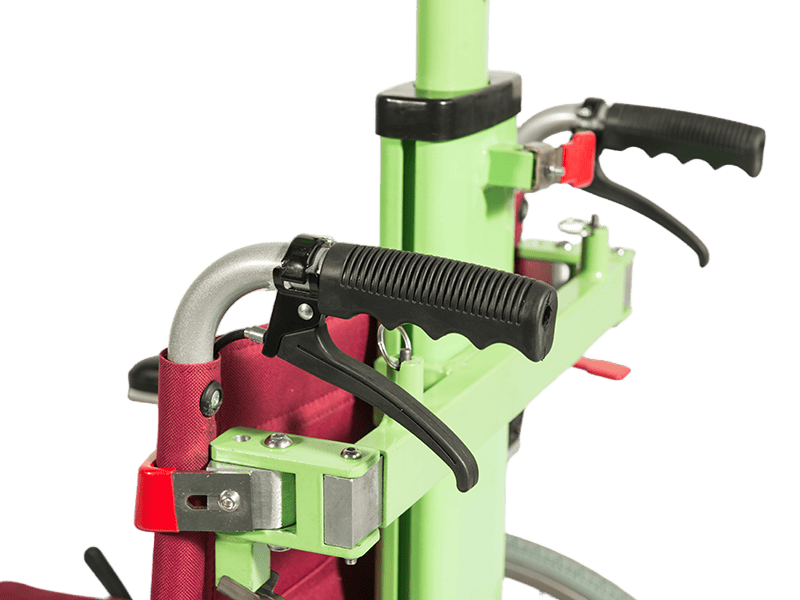
The 11D is an electric solution. The operator uses simple up/down controls on the handle, reducing the unpredictable “lift and hold” moments found with manual options. For first‑time users and staff training, electric control is easier to standardize—one of the strongest purchase drivers for a stair climber for wheelchair.
Electromagnetic auto‑brake (trust anchor: release to stop)
On stairs, trust comes from predictable safety behavior. The 11D’s electromagnetic braking is designed to stop instantly on the staircase if the operator releases the control. This helps reduce runaway risk and is a major factor in professional purchasing decisions.
Adjustable headrest + $4$‑point safety harness
During a roughly $35^\circ$ tilt posture, the passenger must be secured properly. The 11D includes an adjustable headrest and a $4$‑point safety harness to support stable posture and reduce unwanted movement, improving both physical safety and perceived safety during stair travel.
4) Technical Specification Table (Rich Snippet Magnet)
This table is where buyers compare. It is also where Google can easily extract scannable product data. Place it high on the page, and ensure the keyword stair climber for wheelchair appears naturally near this section.
| Specification | 11D Series Technical Details |
|---|---|
| :— | :— |
| Material | High‑strength Aviation Aluminum Alloy |
| Load Bearing Capacity | $\le 160\text{ kg}$ / 350 lbs |
| Track System | Industrial‑grade anti‑slip rubber crawler |
| Battery Life | $80\text{–}100$ floors (Lithium‑ion $24text{ V}$) |
| Braking System | Automatic electromagnetic brake |
| Folded Dimensions | Compact $105 \times 50 \times 30\text{ cm}$ (approx.) |
Buyer checklist: For any stair climber for wheelchair, confirm load capacity, braking logic, track durability, supported stair angle, and one‑operator stability.
5) Portability: From Car Trunk to High‑Rise Apartment
Fold‑and‑go design (real portability, not “portable in theory”)
If it cannot travel in a vehicle, it will not get used across sites. The 11D foldable design is meant for practical storage in an SUV or sedan trunk, supporting multi‑site deployment. A professional stair climber for wheelchair should pass a “trunk test,” not just a brochure claim.
Travel compliance (removable lithium battery + airline rules)
If customers search “travel” with a stair climber for wheelchair, battery policy is the deciding factor. The 11D uses a removable lithium battery for easier logistics, but airline approval always depends on watt‑hour limits and carrier rules.
Authoritative references:
- IATA (air transport standards): https://www.iata.org/
- FAA (official U.S. aviation guidance hub): https://www.faa.gov/
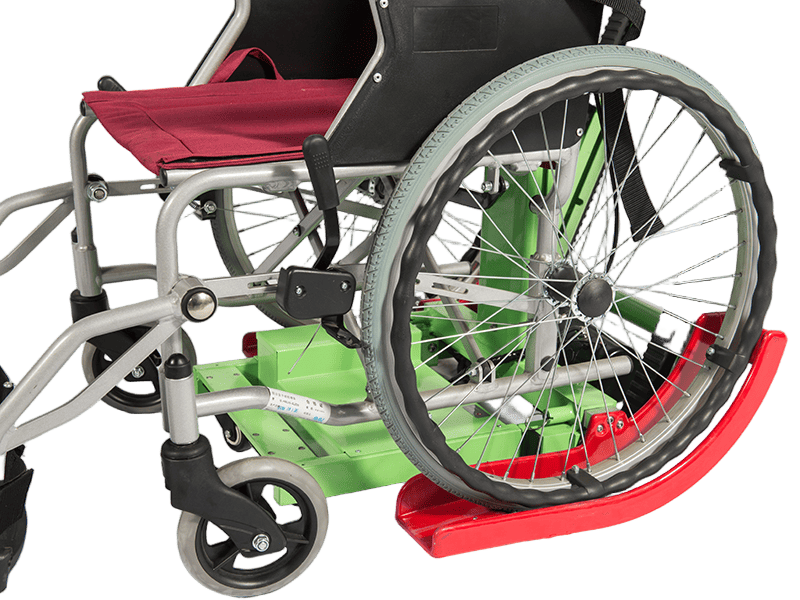
360° swiveling wheels for flat-ground maneuvering
The 11D is designed to maneuver on flat ground with 360° swivel wheels, helping it function as a temporary transport chair in hallways, landings, and doorways. This reduces “device switching” and makes the workflow smoother before and after stairs.
6) Comparison: Electric vs. Manual Stair Chairs
Manual stair chairs
- High physical strain for the caregiver
- Harder controlled descent on steeper stairs
- Higher risk and fatigue when transporting users with $\gt 100\text{ kg}$ body weight
Electric (11D)
- Motorized control reduces lifting and pulling
- More consistent operation and easier training SOPs
- Safer option for higher‑weight and higher‑frequency transport scenarios
Most buyers choose an electric stair climber for wheelchair for one reason: lower risk and more repeatable safety, not just convenience.
7) Safety Guide: Tips for First‑Time Operators (Helpful + High‑Trust)
- Check track tensionInspect tension and visible wear to ensure traction remains consistent.
- Secure the passengerFasten the $4$‑point harness and confirm headrest support.
- Recline until the tracks fully engageAdjust tilt so the track system is fully loaded and stable on the steps.
- Maintenance and storageClean tracks with non‑corrosive methods. For battery longevity, store at about $20^\circ\text{C} \text{–} 25^\circ\text{C}$ when possible.
A professional stair climber for wheelchair should support a training‑friendly SOP, not require “hero strength” or improvisation.
8) FAQ (Top Search Queries, Answered Clearly)
Can the 11D be used on curved stairs?
Track-based portable systems perform best on straight runs. Curved or spiral stairs introduce alignment and landing‑space constraints that can reduce stability. For safety and transparency, the 11D stair climber for wheelchair is recommended primarily for straight staircases with adequate landing space.
What is the maximum stair angle?
Typically up to about $35^\circ \text{–} 40^\circ$ depending on site conditions and staircase geometry. Share photos and step dimensions so we can confirm compatibility.
How long does the battery last?
Battery performance depends on load, stair angle, and frequency of use. A reference range is $80\text{–}100$ floors per charge (usage dependent). Charging time varies by battery condition and charger specifications—confirm during quotation.
Get a Quote: Match the Right 11D Configuration to Your Staircase
If you need a professional, trainable, multi‑site stair climber for wheelchair, the 11D Portable Electric Series is built to deliver controlled stair transfers with lower physical strain, strong safety braking, and practical portability.
To speed up quoting and configuration, send:
- Staircase photos (including landings)
- Step height + tread depth (or estimated angle)
- User weight range (including any $\gt 100\text{ kg}$ requirement)
- Daily transfer frequency and primary scenario (home, hospital, care facility, transport)