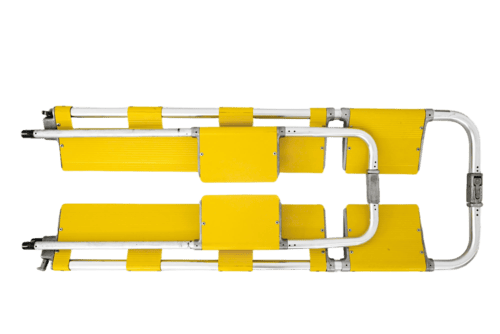
AM-SC005 Scoop emergency stretcher
emergency stretcher is built for fast, controlled patient transfer in time-critical environments such as ambulance services, EMS response, emergency departments, and disaster relief operations. When every second counts, a dependable emergency stretcher must be quick to deploy, stable in use, and practical for repeated daily calls. This model focuses on a split-type scoop structure that supports “minimal movement” transfer techniques, helping rescuers manage trauma cases more safely and efficiently.
Unlike many conventional solutions that require lifting a patient onto a frame, a scoop stretcher can be separated into two halves and assembled around the patient. This approach is widely used for situations where excessive rolling, turning, or repositioning may increase risk. In real-world rescue workflows, the AM-SC005 emergency stretcher supports a smoother sequence from approach, to positioning, to securing, to lift-and-carry, and finally to handover—whether that handover is to an ambulance cot, a hospital bed, or an imaging trolley.
For procurement teams, it is also important that an emergency stretcher fits operational constraints. Ambulances have limited storage space, emergency rooms handle high turnover, and rescue teams need equipment that can be cleaned quickly and returned to service. The AM-SC005 scoop emergency stretcher is designed to be compact when folded, straightforward to handle, and suitable for export shipments with a clear packing specification.
Why choose a scoop emergency stretcher instead of a standard stretcher?
A standard stretcher often requires the patient to be lifted, slid, or turned before loading. That process can be challenging in confined spaces or during trauma scenarios. A scoop emergency stretcher changes the workflow by enabling lateral access: the stretcher is opened into two sections, each section is positioned alongside the patient, and then both halves are locked together. This helps reduce unnecessary movement and supports better control during transfer.
For EMS teams, this matters because consistent technique reduces variability between rescuers. A well-designed emergency stretcher can help teams follow established protocols more reliably, especially when combined with cervical collars, straps, and other standard restraints. In addition, a scoop stretcher can be a practical solution for narrow corridors, stair landings, crowded accident scenes, and vehicle extractions where there is limited room to maneuver.
In short, the AM-SC005 emergency stretcher is intended as a transfer-focused tool: it is not only about carrying, but about enabling safer positioning and smoother handover across multiple points of care.and follow Patient Transport Safety of The Joint Commission (JCI)
Key features and operational benefits
1) Split design for rapid positioning and controlled transfer
The AM-SC005 scoop emergency stretcher is designed around a split structure, allowing rescuers to approach from both sides and assemble the stretcher with less disturbance to the patient. In urgent conditions, reducing steps reduces time. This is one of the main reasons many ambulance services keep a scoop stretcher as a core item in their equipment set.
2) Minimal movement support for suspected spinal injury workflows
In trauma response, suspected spinal injury protocols emphasize minimizing patient motion. A scoop emergency stretcher supports this by avoiding unnecessary rolling. While every case depends on clinical judgment and local guidelines, the ability to assemble an emergency stretcher around the patient can help teams maintain better alignment and reduce uncontrolled shifts during lift.
3) Compact folding size for ambulance storage and fast deployment
Ambulance compartments are space-limited and must remain organized for quick access. The AM-SC005 emergency stretcher offers a compact folding size to support practical vehicle storage. Faster retrieval and faster redeployment can make a measurable difference in daily response operations.
4) High-turnover suitability for emergency departments and transport teams
Emergency departments and hospital transport teams need equipment that can be used repeatedly, cleaned quickly, and inspected easily. A practical medical stretcher should support routine wipe-down cleaning and straightforward visual checks. The AM-SC005 scoop emergency stretcher is suitable for these high-frequency use patterns and can support consistent readiness.
5) Better handling in confined and complex environments
Rescue scenes are rarely ideal. Crowded areas, tight corners, narrow stairs, and vehicle interiors can complicate patient handling. A scoop emergency stretcher can reduce the space required for loading because it can be positioned from the sides rather than requiring a full lift from above. This makes the medical stretcher useful for teams that regularly operate in constrained environments.
Typical use scenarios (EMS, ambulance, hospital, rescue)
The AM-SC005 scoop emergency stretcher is suitable for a wide range of operational settings:
- Ambulance and EMS response: a scoop emergency stretcher for rapid pickup, stabilization, and transfer from scene to vehicle
- Vehicle extraction and confined-space rescue: supports side-entry positioning when full access is limited
- Emergency department triage: helps move patients between triage, treatment bays, and imaging areas with controlled handling
- Hospital internal transfer: as an emergency stretcher option for urgent moves between wards, ED, and diagnostic units
- Disaster relief and mass-casualty incidents: a practical stretcher for organized, repeatable transfer workflows
- Fire and rescue teams: can complement other devices and support controlled lifting and handover
In many systems, a scoop emergency stretcher is part of a broader patient movement chain. It can work alongside other devices such as spinal boards, ambulance stretchers, transport trolleys, and restraint systems, depending on local protocols.
Specifications (AM-SC005)
Below specifications are based on the parameter table you provided:
- Model: AM-SC005
- Expanded size: 167 × 43 × 6 cm
- Folding size: 120 × 43 × 9 cm
- Packing size: 172 × 55 × 8 cm
- Load limit: — (not provided)
- Quantity per carton: 1 pc
- Net weight (N.W.): — (not provided)
- Gross weight (G.W.): 9 kg
If you later confirm the load limit and net weight, it is strongly recommended to add them to the product page. For buyers comparing an emergency stretcher across suppliers, load capacity and net weight are often decision-making criteria.
Quality, inspection, and routine maintenance (recommended page section)
For professional buyers, an emergency stretcher is not only a product but also part of a safety system. To support stable daily use, many organizations apply routine checks such as:
- Verify locking points are secure before lifting the emergency stretcher
- Confirm no visible deformation, cracks, or sharp edges
- Ensure moving parts operate smoothly and consistently
- Inspect connection points and contact surfaces after repeated use
- Document cleaning and inspection cycles as required by facility policy
These practices help reduce operational risk and extend service life in high-frequency emergency environments.
Cleaning and turnover readiness
A high-usage emergency stretcher must support fast cleaning and return-to-service. In most systems, teams follow standardized wipe-down and disinfection procedures after each use. While cleaning protocols vary by institution and region, many buyers evaluate whether an emergency stretcher has practical surfaces for fast wipe-down and whether the design minimizes hard-to-reach contamination points.
For export buyers and distributors, this topic also matters for end-user training. Adding simple cleaning guidance to the product documentation can help customers use the emergency stretcher correctly and maintain it in daily operations.
Export packing and logistics advantages
International buyers often need predictable packing data for shipping planning and warehouse allocation. The AM-SC005 scoop emergency stretcher provides clear packing information:
- Packing size: 172 × 55 × 8 cm
- Quantity: 1 pc per carton
- Gross weight: 9 kg
This information supports freight cost estimation, container planning, and inventory operations. For distributors, predictable packaging simplifies shelf planning and fulfillment. For project procurement, it simplifies the documentation process for importing an stretcher into the destination market.
Purchasing guidance (for distributors, hospitals, and projects)
When purchasing an emergency stretcher for a project, it is helpful to match the product to the actual workflow and constraints. Before requesting a quotation, buyers often confirm:
- Intended use environment (ambulance, ED, hospital transport, rescue team)
- Storage constraints and preferred folding size for the emergency stretcher
- Expected user training level and standard operating procedure
- Any required labeling, documentation, or packaging standards
- Whether OEM branding is required for the stretcher
- Delivery timeline, destination port, and order quantity
Providing these details can speed up quotation, production arrangement, and shipment planning.
FAQ (Frequently Asked Questions)
1) What is the main advantage of a scoop emergency stretcher?
A scoop emergency stretcher can be separated into two halves and assembled around the patient. This can reduce unnecessary rolling and support more controlled transfer compared to many standard stretcher workflows.
2) Is the AM-SC005 emergency stretcher suitable for ambulance storage?
Yes. The folding size is 120 × 43 × 9 cm, which supports more compact storage and quicker access in ambulances and emergency vehicles.
3) What is the packing size and gross weight for shipping?
The packing size is 172 × 55 × 8 cm, and the gross weight is 9 kg per carton (1 pc). This makes international shipping planning more straightforward for emergency stretcher distributors and project buyers.
4) Is load limit provided for this model?
The table you provided lists the load limit as “—”. If you share the confirmed load limit, it can be added to the product page to strengthen buyer confidence when comparing an emergency stretcher.
5) Can this emergency stretcher be used in hospital internal transfers?
Yes. Many hospitals use a scoop emergency stretcher as part of urgent internal transfer workflows, especially when patient movement should be minimized.
Call to action
If you need a scoop emergency stretcher for EMS deployment, ambulance stocking, hospital procurement, or distributor supply, request the latest quotation and lead time for AM-SC005. Share your destination country, order quantity, and any OEM branding requirements so the correct shipping plan and documentation can be prepared for your emergency stretcher order.
also we have transport stretchers electric wheel chair
Product parameters