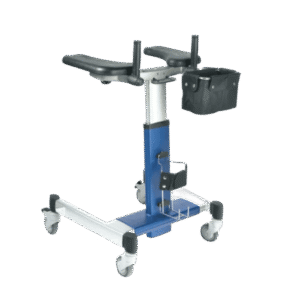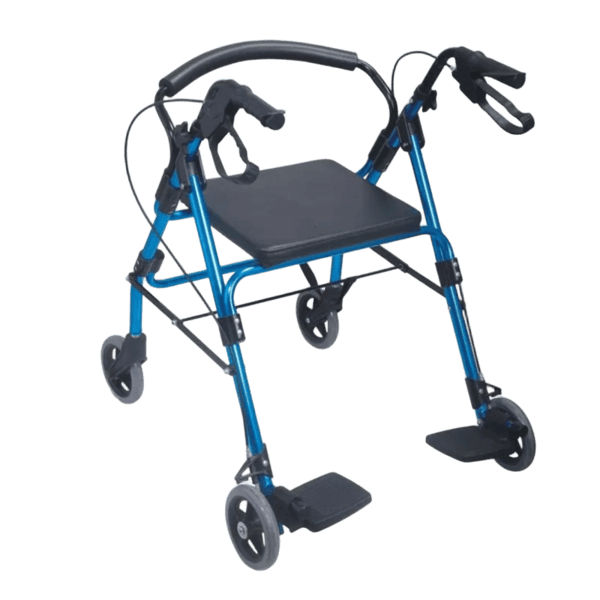
Parkinson’s doesn’t just make walking hard—it makes starting to walk hard. The phenomenon has a clinical name, festinating gait, but what it looks like in real life is a person frozen at the edge of a chair, leaning forward with their hands on their knees, willing their feet to take the first step while their brain’s motor signals stall somewhere between the basal ganglia and the quadriceps. A standard rollator helps once you’re moving, but it does nothing for the transition from sitting to standing where Parkinson’s patients lose the most time and the most confidence. The AM-FS9650LH is a standing rollator: it combines the sit-to-stand leverage of a standing frame with the four-wheel mobility and seated rest option of a rollator, so the same device that gets you up from the chair keeps you moving to the kitchen and gives you a place to sit when you get there.
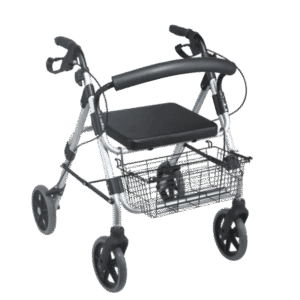
The frame is aluminum with a reinforced front arch that positions two extended-height hand grips at an angle optimized for pulling up from a seated position rather than pushing down from standing. The grips are positioned roughly 60 millimeters higher and 40 millimeters further forward than on a standard rollator, which changes the leverage vector from vertical push to diagonal pull—a biomechanically stronger motion for patients with Parkinson’s-related rigidity in the shoulders and hips. The four wheels are 8-inch solid polyurethane, large enough for door thresholds and uneven pavement but not so large that the rollator feels like a shopping cart. The rear wheels have loop-lock hand brakes with a push-to-lock parking function; squeeze to slow down, push down to lock both wheels when sitting.
The seat is a padded nylon sling, 350 millimeters wide, with a 135-kilogram weight capacity. It’s not a lounge chair—it’s a rest stop, built for the three minutes you need to catch your breath between the bedroom and the bathroom, or the five minutes you wait in line at the pharmacy. Underneath the seat, a removable polyester storage basket holds about 5 kilograms of groceries, medication, or a jacket. When the rollator is folded, the seat lifts and the sides come together, reducing the width to about 280 millimeters for storage against a wall or in a car trunk. Folded weight is 7.8 kilograms—light enough that a caregiver can lift it into a trunk without straining, but stable enough that it doesn’t feel flimsy under the patient’s weight during the sit-to-stand transition.
If you’re treating Parkinson’s patients, or if you have Parkinson’s and you’ve tried a standard rollator that helps with walking but not with standing, the 9650LH addresses the part of the mobility sequence that standard rollators ignore. Contact me through the form below and I’ll send you the full spec sheet and a video of the sit-to-stand transition.
Frequently Asked Questions
What specifications should I review for this model?
Key specifications including dimensions, capacity, power requirement and material composition are provided in the model datasheet. Contact us with your project requirements for the complete specification sheet.
What documents are available for import?
Datasheet, user manual, packing information and applicable conformity documents are confirmed per destination market. Registration requirements vary by country and are reviewed project by project.
Can I request a sample or reference installation?
Sample availability and reference installation details are confirmed based on the product category and order volume. Contact us with your specific requirements.