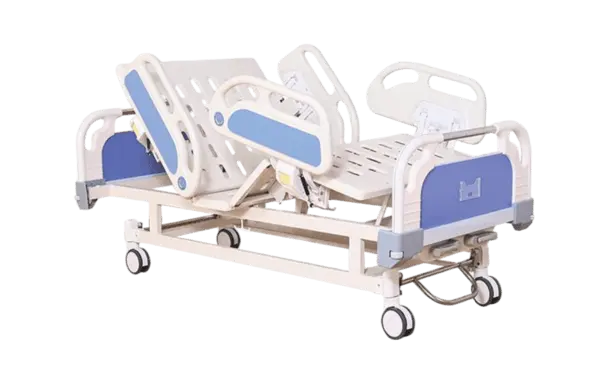
The Definitive Guide to the AM‑B01‑III‑13 Hospital Bed Manual: 2‑Crank Precision & Reliability
A dependable hospital bed manual is still the global standard in thousands of wards, nursing homes, and home‑care settings—especially where power supply is unstable, budgets are strict, or maintenance resources are limited. Electric beds can be excellent, but they introduce motors, control boards, sensors, and service dependencies that do not fit every facility.
The AM‑B01‑III‑13 is designed as the “sweet spot” between medical‑grade durability and cost efficiency. This page is intentionally written to serve two purposes: a buying guide for procurement teams and a practical hospital bed manual for clinical staff who need clear, repeatable operating steps.
Request a quote (recommended above the fold):
Send destination country, required quantity, and your preferred configuration (side rails, mattress type, IV pole). We will reply with price, lead time, packing details, and a documentation set for tender submission.
1) Why a Manual Hospital Bed Still Wins in 2026 (Reliability + Value)
Reliability when power is not guaranteed
In many regions, outages and voltage instability can interrupt patient positioning at the worst time. A hospital bed manual eliminates that risk by keeping adjustments fully mechanical. Backrest and knee‑rest positioning remains available in every scenario—no power required.
Cost vs. performance (what buyers should compare)
The true value of a hospital bed manual is not just purchase price. It is:
- lower lifetime failure risk (no motors to burn out),
- predictable maintenance (mechanical parts, simple tools),
- easier training (consistent crank operation),
- better long‑term uptime in resource‑limited settings.
Designed for clinical reality
AM‑B01‑III‑13 is built for daily ward use: frequent cleaning, constant movement, and repeated adjustments. It is a practical choice for general wards, long‑term care facilities, and emergency/disaster relief clinics.
2) Engineering the 2‑Crank System: Mechanical Simplicity at Its Best
A high-quality hospital bed manual should be simple to use, but engineered to stay smooth after years of cranking.
Precision adjustment (independent sections)
AM‑B01‑III‑13 uses a dual‑crank system with independent control:
- Backrest: $0^\circ \text{–} 75^\circ$
- Knee/leg-rest: $0^\circ \text{–} 45^\circ$
That independence matters clinically because it supports feeding posture, respiratory relief, comfort positioning, and circulation support—without forcing staff into “one position fits all.”
Fold‑away crank handles (safer in tight wards)
The fold‑away design reduces trip hazards and prevents accidental bumps in narrow bed rows. For procurement, this is a small detail that improves safety and reduces equipment damage—exactly the kind of “low drama” advantage that makes a hospital bed manual a better long-term buy.
Zero‑power dependency (no compromise during outages)
The mechanical design ensures patient positioning is never blocked by power failures. For many hospitals, that alone justifies choosing a hospital bed manual over an electric bed in certain wards or regions.
3) Material Integrity: Built for Decades of Clinical Use
A bed can look strong in photos and still fail in real wards. AM‑B01‑III‑13 is built around proven materials and coatings that are designed for repeated disinfection and constant use.
Cold‑rolled steel construction + medical‑grade anti‑corrosion coating
This is more than “paint.” The process typically combines:
- electrophoretic coating (better coverage, stronger rust protection)
- powder spraying (durable finish for daily cleaning and abrasion)
For a hospital bed manual, corrosion resistance is not cosmetic. It protects structural stability and caster performance over time.
ABS removable panels (head/foot boards)
ABS panels are chosen for:
- high impact resistance,
- easy disinfection,
- durability under frequent handling.
The lock-and-release design also supports faster access during urgent airway management or emergency head access (such as intubation workflows).
Related buyer search terms naturally supported: manual medical bed, 2‑crank patient bed, adjustable ward bed.
4) Technical Specifications & Performance Data (SGE-Friendly)
Google and buyers both reward scannable “data density.” Use this table directly in your product page for faster comparison and better procurement clarity.
| Specification | AM‑B01‑III‑13 Technical Detail | Clinical Advantage |
|---|---|---|
| :— | :— | :— |
| Adjustment System | Manual 2‑Crank (Stainless Steel) | Maintenance‑friendly; high mechanical leverage |
| Max Load Capacity | $\le 190\text{ kg}$ / 420 lbs | Suitable for bariatric patient care |
| Overall Dimensions | $2120 \times 970 \times 500\text{ mm}$ | Fits standard ward footprints |
| Backrest Range | $0^\circ \text{–} 75^\circ \ (\pm 5^\circ)$ | Supports feeding and respiratory relief |
| Leg-rest Range | $0^\circ \text{–} 45^\circ \ (\pm 5^\circ)$ | Helps comfort positioning and circulation |
| Caster System | $125\text{ mm}$ silent covered casters | Quieter transport with dual braking support |
If your team is evaluating multiple options, keep your comparison consistent: load rating, angle ranges, caster diameter, coating process, and side rail design are the real differentiators for a hospital bed manual.
5) Safety & Comfort: Protecting the Patient and Caregiver
Collapsible aluminum side rails (6‑pole design)
The aluminum alloy side rails provide fall protection while allowing easier patient entry and exit. In daily use, that reduces caregiver strain and helps patients move more safely.
IV pole integration (four corner sockets)
Fluid management is routine in wards and nursing care. Four corner IV pole sockets increase flexibility for staff and reduce “workarounds” that slow care.
Ventilated mattress platform (perforated steel surface)
A ventilated platform helps reduce heat buildup and moisture retention—important factors in skin integrity management. For facilities focused on pressure injury prevention, a hospital bed manual with ventilation-friendly design supports better comfort and lower risk of pressure ulcers.
For general pressure injury prevention reference, clinicians often cite authoritative guidance such as the U.S. National Library of Medicine’s MedlinePlus overview:
- Pressure sores overview: https://medlineplus.gov/pressuresores.html
6) Step-by-Step Hospital Bed Manual: How to Operate the AM‑B01
This section directly matches “manual” search intent and helps reduce training time.
- Crank deployment
Locate the fold‑away crank handles and pull them out fully until locked in the operating position.
- Adjusting the backrest
Turn the backrest crank clockwise to elevate. Turn counterclockwise to lower. Stop at the desired angle and confirm stable positioning.
- Adjusting the knee/leg-rest
Use the second crank to raise or lower the knee section independently for comfort and circulation support.
- Locking the casters
Engage the independent braking system before transferring a patient or performing bedside care.
- Daily maintenance (simple, repeatable)
- Clean and disinfect ABS panels per facility protocol.
- Lubricate screw rods on a scheduled basis (per your maintenance plan).
- Inspect cranks, fasteners, and caster brakes for abnormal resistance or noise.
A well-designed hospital bed manual system should feel smooth, predictable, and low-effort for staff across shifts.
7) ROI Analysis: Why Procurement Teams Choose the AM‑B01
Low TCO (Total Cost of Ownership)
A hospital bed manual typically offers:
- no motors to replace,
- no control boards to fail,
- fewer specialized service calls,
- longer usable life in harsh environments.
Global compliance mindset (for tenders and distributors)
Many international projects expect documentation aligned with CE and ISO 13485. For hospital bed safety, IEC 60601‑2‑52 is commonly referenced as the specific safety standard for medical beds.
Authoritative external references:
- IEC (standards body): {{https://www.iec.ch/}}
- ISO 13485 standard info: {{https://www.iso.org/standard/59752.html}}
- WHO patient safety (broad safety context): https://www.who.int/teams/integrated-health-services/patient-safety
Versatility across settings
AM‑B01‑III‑13 fits general wards, nursing homes, and temporary clinics because it is durable, easy to train, and independent from electricity—exactly why a hospital bed manual remains a global staple.
8) FAQ: High-Volume Questions About Manual Hospital Beds
Is a manual hospital bed hard to crank?
No. The high‑torque screw system is designed to require minimal force in normal operation. Proper lubrication and routine inspection keep it smooth.
Can the head and foot boards be cleaned with bleach?
ABS is generally chemically resistant and compatible with many common disinfectants. Always follow your facility’s protocol and disinfectant manufacturer instructions.
What is the warranty on the mechanical cranks?
Include your specific warranty terms in this section (duration, coverage scope, spare parts policy). If you share your warranty policy, I can format it into procurement-friendly language.
Ready to Compare Pricing and Lead Time?
If you want a durable, tender-friendly hospital bed manual that remains functional through outages, reduces long-term failure risk, and stays easy to maintain, the AM‑B01‑III‑13 is built for that role.
Send: quantity, destination, and any required accessories (side rails, IV pole, mattress).
We will respond with quote, lead time, packing list, and compliance documentation.