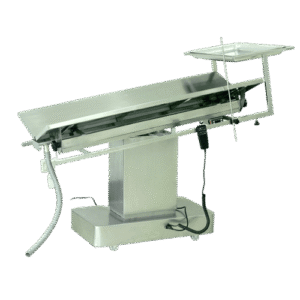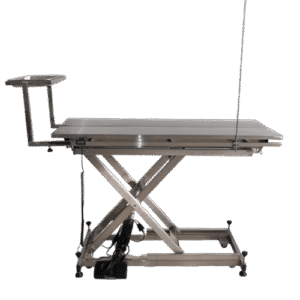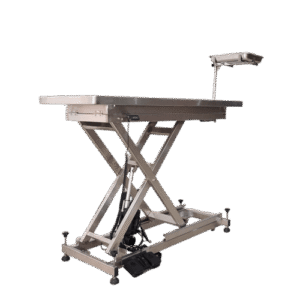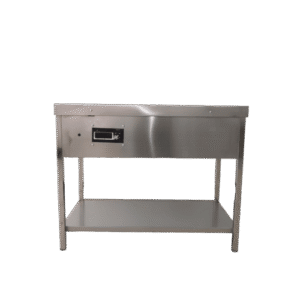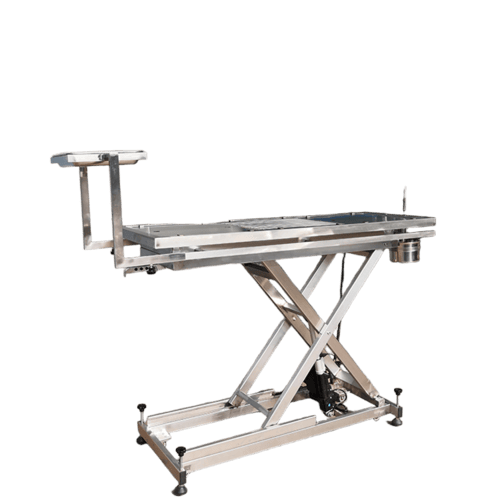
The AM-P1 is the table I designed for veterinarians who do not ask what something costs — they ask whether it is the best available. This is our flagship electric vet operating table, and every decision we made during its development started from the assumption that the practice buying it was not compromising on anything. Not on materials, not on build quality, not on the details that separate a good surgical table from a great one.
The defining feature is the inlaid tabletop. Most surgical tables have a surface that is mechanically attached to the frame with fasteners and gaskets — functional, but over years of use the seams become collection points for fluids, hair, and debris, and the surface can begin to separate slightly at the edges. You have seen it: the tiny gap where the tabletop meets the rim, dark with accumulated material that no amount of scrubbing quite reaches. The P1 uses an inlaid construction where the tabletop is recessed directly into the frame. The result is a seamless transition from surface to edge with no exposed fasteners, no crevices, and nowhere for contamination to establish a foothold. That matters enormously when you are running a surgical suite that handles complex cases — orthopedics, neurosurgery, oncology procedures where a surgical site infection would be catastrophic for the patient and devastating for the practice.
The lift mechanism supports 229 kilograms. That number is not arbitrary and it is not marketing math. It means you can place a large-breed dog on the table, add monitoring equipment and a forced-air warming unit, have two clinicians leaning on the surface during a difficult extraction or reduction, and the table does not budge, does not drift, does not complain. The height range of 48 to 98 centimeters covers every clinician from the shorter veterinary student to the tall surgeon who has spent years hunching over tables that were too low for them. The electric drive is smooth enough that you can make micro-adjustments mid-procedure — a centimeter up or down — without the lurch that cheaper drives produce, the kind of movement that makes everyone in the room freeze for half a second.
The foot pedal control is sealed against fluid ingress. It sounds like a small detail, and it is, until you are three years into ownership and the pedal on a lesser table has shorted out because blood and saline found their way inside. I specified 304-grade stainless steel for the entire frame — the visible surfaces, the internal structure, the column housing, every bracket and fastener. That decision added cost and did not make the marketing materials any flashier, but it is what determines whether a table still looks and functions like new after five years of aggressive daily cleaning.
This is the table for specialty and referral practices, for teaching hospitals, and for any clinic where the OR is the center of the business and the equipment needs to match the caliber of the medicine being practiced. If your surgeons are doing TPLOs twice a week, spinal surgeries, and the cases that other clinics refer out, the AM-P1 is the table that belongs underneath those patients.
Model Comparison
| Specification | AM-P1 | AM-P2 | AM-P3 | AM-P4 | AM-P6 | AM-P7 |
|---|---|---|---|---|---|---|
| Tabletop size | 140×50 cm | 140×50 cm | 140×50 cm | 140×50 cm | 90×50 cm | 100×55 cm |
| Tabletop style | Inlaid (1/3 grille + 2/3 plane) | Flat | V-type constant temp. | V-type | Rounded corner | Seamless flat |
| Tabletop material | 304 SS 1.5 mm | 304 SS 1.5 mm | 304 SS | 304 SS 1.5 mm | 304 SS | 304 SS |
| Frame | 304 SS brushed 2.0 mm | 304 SS brushed 2.0 mm | 304 SS | 304 SS brushed 2.0 mm | — | 304 SS |
| Side rail | 10×25 mm | — | — | 10×25 mm | — | — |
| Height range | —(样册未列) | —(样册未列) | —(样册未列) | —(样册未列) | 75–105 cm | 80 cm(固定) |
| Lift control | Hand + foot switch | Hand + foot switch | Electric | Hand + foot switch | Electric foot control | — |
| Tilt | Manual, 4 gears | — | — | — | — | — |
| Weighing | No | No | No | No | Yes (high-precision electronic) | Yes |
| Accessories | Thickened tray, infusion rack, dirt basin | Infusion rack, dirt basin | Pull-out sink, buckle rope | Thickened tray, infusion rack, dirt basin | — | — |
Frequently Asked Questions
What specifications should I review for this model?
Key specifications including dimensions, capacity, power requirement and material composition are provided in the model datasheet. Contact us with your project requirements for the complete specification sheet.
What documents are available for import?
Datasheet, user manual, packing information and applicable conformity documents are confirmed per destination market. Registration requirements vary by country and are reviewed project by project.
Can I request a sample or reference installation?
Sample availability and reference installation details are confirmed based on the product category and order volume. Contact us with your specific requirements.