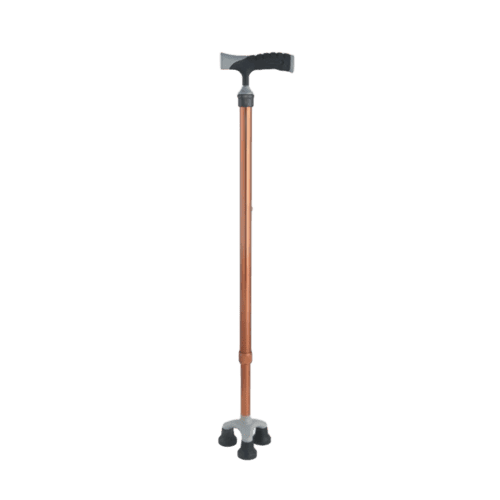
Two weeks after hip replacement surgery, the incision is healing well but the joint itself is still raw—every impact that travels up from the ground through the cane and into your body registers somewhere in the surgical site. An orthopedic surgeon in Kuala Lumpur was the first person to point out to me that standard canes transmit too much impact vibration for early post-op use, and that patients compensate by using the cane less, which slows recovery. The AM-FS9207LW-2 was built around that insight. It’s an orthopedic cane with a shock-absorbing tip system that reduces ground impact transmission by approximately forty percent compared to a standard rubber tip—not enough to eliminate the sensation of walking, but enough to make the difference between dreading each step and tolerating the necessary movement that recovery demands.
The shock absorption comes from a two-stage tip assembly: an outer rubber shell for ground contact and an internal elastomeric core that compresses on impact and rebounds during the swing phase. The elastomer is tuned to compress under approximately 15 kg of downward force—right around the partial weight-bearing threshold that most orthopedic patients are cleared for in the first month post-surgery—so the absorption activates naturally during normal gait without requiring the user to deliberately press down. The rubber outer shell is 22 mm diameter with a crosshatch tread pattern for grip on wet surfaces.
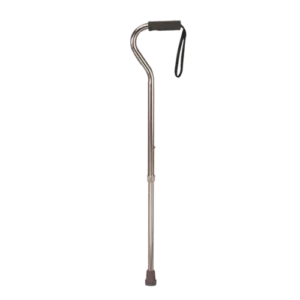
The handle is an offset anatomical grip, molded from a dual-density material: a firm polypropylene core for structural support and a softer thermoplastic rubber outer layer for comfort. The offset positions the handle directly over the shaft’s load axis, which reduces the wrist extension that contributes to carpal tunnel aggravation during prolonged cane use. Height adjusts from 74 cm to 97 cm. The shaft is 6061 aluminum with a brushed anodized finish. Total weight is 440 grams, weight capacity 130 kg.
The 9207LW-2 ships with two spare shock-absorbing tip assemblies, because the one thing an orthopedic patient doesn’t need is to discover their cane tip has worn out when the nearest medical supply store is closed. I recommend replacing the tip assembly every four to six months for daily users, or sooner if visible cracking appears on the elastomer core. For physical therapy clinics, we also offer the tip assemblies in bulk packs of twenty—contact me for those if you’re dispensing canes to a high volume of post-op patients.
If you supply orthopedic clinics, post-surgical rehabilitation centers, or hospital discharge programs, this is the cane I’d add to your formulary. Contact me for clinical pricing and volume discounts.
Frequently Asked Questions
What specifications should I review for this model?
Key specifications including dimensions, capacity, power requirement and material composition are provided in the model datasheet. Contact us with your project requirements for the complete specification sheet.
What documents are available for import?
Datasheet, user manual, packing information and applicable conformity documents are confirmed per destination market. Registration requirements vary by country and are reviewed project by project.
Can I request a sample or reference installation?
Sample availability and reference installation details are confirmed based on the product category and order volume. Contact us with your specific requirements.