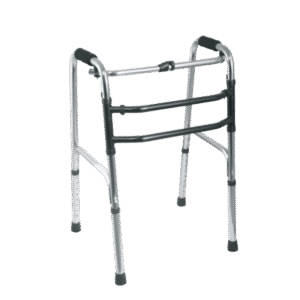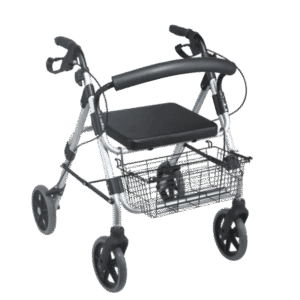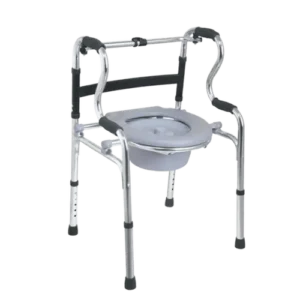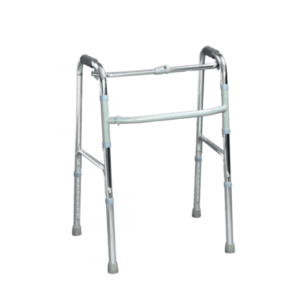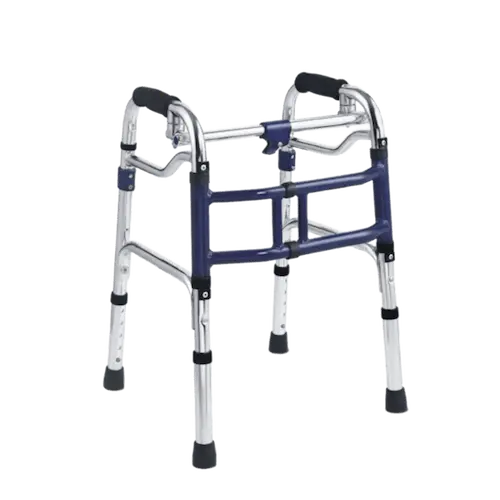
The hardest part of walking after hip replacement surgery isn’t the walking itself—it’s the first five seconds of getting up. The patient is seated at the edge of the bed, their surgical hip is screaming at the idea of bearing weight, and the standard walker sitting two feet away might as well be on another planet because reaching for it requires leaning forward with a hip that currently hates leaning forward. The AM-FS9503L addresses that specific moment. It’s a standing walking frame with extended-height hand grips positioned to be reachable from a seated position, so the patient can grip first, then rise, rather than rising first and groping for the walker second. The sequence matters more than most people realize.
The frame is aluminum with a wider-than-standard base—660 millimeters across at the rear, tapering to 580 millimeters at the front—which gives the patient a stable platform during the sit-to-stand transition when their center of gravity is furthest forward and most unstable. The hand grips extend upward to 980 millimeters at maximum height, about 100 millimeters higher than standard walker grips, because the leverage angle for pulling yourself up from a chair is different from the angle for supporting yourself while walking. The grips themselves are molded vinyl with a textured thumb rest that orients the hand correctly without the patient having to look down.
The height adjusts from 820 to 980 millimeters at the hand grip in seven positions, and the frame folds with a center-pull mechanism that takes about two seconds. Folded depth is 210 millimeters, weight is 2.9 kilograms. The rear legs have our standard glide caps, and the front legs can be ordered with either caps or 5-inch wheels—I recommend caps for patients in the first two weeks post-surgery when any unintended forward movement is a fall risk, then switching to wheels once the patient has developed enough hip stability to control forward progression.
This isn’t a walker you stay on for months. It’s a transitional device for the first two to four weeks after hip surgery, when standing up is the most dangerous part of the mobility sequence and a standard walker doesn’t provide enough support during that specific transition. A physiotherapist in Kuala Lumpur told me she keeps three of these in her post-op ward specifically for total hip replacement patients on day one of mobilization, and she’s seen fewer assisted falls during the sit-to-stand phase since switching from standard frames. I’m Linjian Xiao. If your orthopedic ward or rehab clinic handles post-hip patients, the 9503L is worth a look. Contact me below for details.
Frequently Asked Questions
What specifications should I review for this model?
Key specifications including dimensions, capacity, power requirements and material composition are provided in the model datasheet. Contact us with your project requirements for the complete specification sheet.
What documents are available for import?
Datasheet, user manual, packing information and applicable conformity documents are confirmed per destination market. Registration requirements vary by country and are reviewed project by project.
Can I request a sample or reference installation?
Sample availability and reference installation details are confirmed based on the product category and order volume. Contact us with your specific requirements.