There’s a moment during an ENT exam when you have a speculum in one hand, an instrument in the other, and you’re tilting your head at an angle that would make a chiropractor wince — because the overhead exam light is casting your own shadow into the very cavity you’re trying to see. Or you’re in a dental operatory where the ceiling light can’t reach the distal molar from the correct angle. These aren’t equipment failures. They’re geometry problems. And the solution isn’t a brighter ceiling light — it’s getting the light source onto your head, aimed exactly where you’re looking.
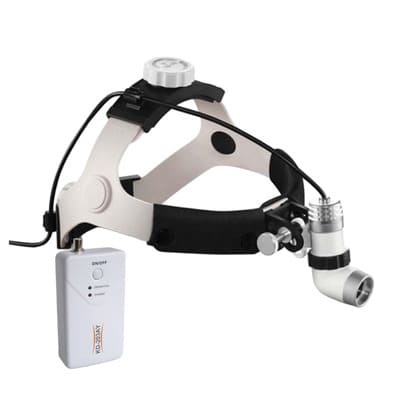
The AMKD-203AY-3 is our rechargeable head-mounted LED examination lamp. It weighs 200 grams on the head, runs for four-plus hours on a charge, and puts 12,000 lux at 200mm working distance — right where the clinician needs it. This is not a surgical light replacement. It’s a different category entirely, designed for examination, minor procedures, and situations where the patient can’t or shouldn’t be positioned under a fixed light.
The 3W LED source is from an internationally recognized manufacturer — we don’t put no-name emitters in anything — and the optical design produces an even, circular spot with adjustable diameter. Color temperature ranges from 4,000K to 5,500K, which gives you neutral-to-cool white light that preserves tissue color accuracy. This matters especially in dermatology, where lesion color is a primary diagnostic signal, and in dental shade matching, where even a slight color cast can throw off a restoration.
The headband is made from lightweight medical-grade materials, designed for extended wear without the pressure points that make you want to tear it off after twenty minutes. It meets standard medical disinfection requirements — wipe it down with the same surface disinfectant you use on everything else. The power bank clips to a belt or pocket, and the connecting cable is long enough that you can position the battery pack out of your working range without awkward routing. You can also run it directly from AC power while charging, so if you forget to plug it in overnight, you’re not dead in the water for a morning procedure list.
We designed this with a deliberately broad set of clinical targets. ENT specialists use it for nasopharyngoscopy and ear exams. Dentists and oral surgeons use it for cavity preparations and extractions where overhead lights create shadow cones. Dermatologists use it for lesion inspection and minor excisions. General surgeons use it for bedside procedures in the ICU where wheeling in an exam light isn’t practical — and for micro-surgery where a fixed light can’t follow the working angle. Veterinary clinicians have become a significant user group as well, because animals don’t cooperate with positioning under fixed lights, and a headlamp solves the mobility problem entirely.
The charge time is five hours for a full cycle, and the battery delivers four hours of continuous operation. That’s enough for a full morning or afternoon procedure block. The light spot is adjustable — tighten it for a focused beam during detailed inspection, widen it for broader illumination during wound care or suturing. The brightness control is straightforward, not buried in menus.
At the price point, this is a practical tool, not a capital equipment line item. Departments buy them in multiples — one for each exam room, one for the crash cart, one for the mobile unit. They get used because they’re simple: put it on, turn it on, work. No ceiling mounts, no arm adjustments, no calling facilities to reposition a light that was installed for a different procedure type five years ago.
If you’re in a specialty where lighting makes the difference between seeing pathology and missing it — and you’re tired of compensating with awkward body positions — this is the solution. Contact us for pricing on singles or department bundles. Your neck will thank you, and your diagnostic accuracy probably will too.