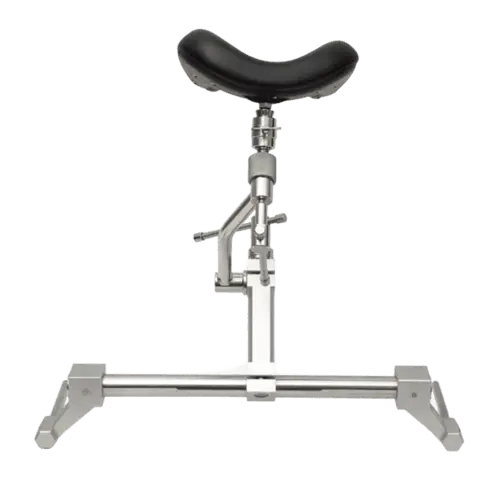
A millimeter of unintended movement during a craniotomy is a millimeter too many. The neurosurgeon working through a microscope at ten-times magnification on a vessel smaller than the lead in a mechanical pencil doesn’t need to feel the patient’s head shift when an assistant leans against the table. The AM-TJ002 skull clamp exists to make sure that never happens. It’s a three-pin rigid fixation device that locks the patient’s skull to the operating table with the kind of absolute stability that brain surgery demands—and then gives the surgeon the flexibility to reposition during the case without breaking sterility or losing fixation.
The clamp uses a three-point fixation system: two pins on one side of the head mount and a single opposed pin on the other, applying calibrated pressure to the outer table of the skull. The pins are available in adult and pediatric sizes, and the pressure application is controlled—enough to prevent movement, not enough to penetrate the inner table. The head frame attaches to the operating table via a universal connector compatible with most standard OR table rails, and the entire assembly can be repositioned during surgery without releasing the pins from the skull.
The adjustment range is where the AM-TJ002 earns its place in the operating room. The anterior-posterior travel is 350 mm, lateral travel is 400 mm, and vertical travel is 350 mm. The swing angle reaches 75 degrees in either direction, which means the surgeon can reposition the patient’s head for a different approach angle mid-procedure—temporal to frontal, for example—without breaking down the sterile field. The installation center distance adjusts from 190 to 590 mm, accommodating pediatric to large adult skull dimensions. A flexible shaft head frame retractor is included for soft tissue retraction during the approach, and the clamp is compatible with standard operating table mounts.
This is a neurosurgery device first, but it also serves orthopedic and ENT procedures where rigid cranial fixation is required. The difference between the AM-TJ002 and other skull clamps in our line is the balance of rigidity and adjustability—it locks harder than lighter headrests but gives the surgeon more intraoperative flexibility than fixed-position clamps.
If you’re outfitting a neurosurgery OR or replacing aging head fixation equipment that’s lost its locking precision over years of use, the AM-TJ002 is the clamp I recommend for routine craniotomies and intracranial procedures. I’m Linjian Xiao. Contact me for the full spec sheet, pin size options, and current pricing—I’ll make sure you get the configuration that matches your surgical volume and table compatibility.