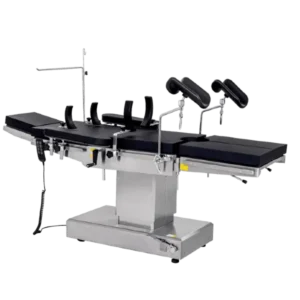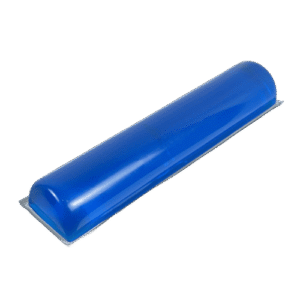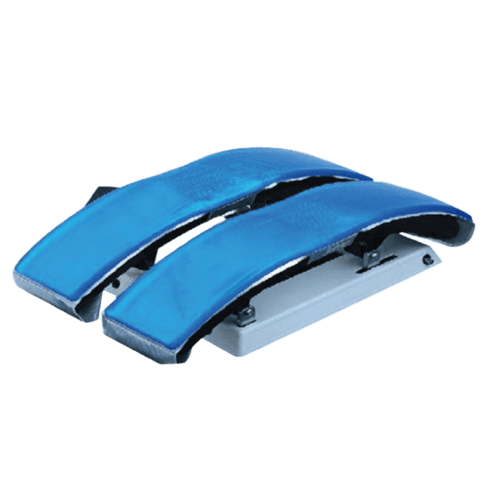
A spine surgeon in Mumbai once showed me his positioning setup for a six-hour scoliosis correction: a collection of gel rolls, foam wedges, and silicone pads assembled in a configuration that looked like a Tetris game about to collapse. If one thing shifted during the procedure—and with a patient on a Jackson table being rotated for fluoroscopy, things shift—the pedicle screw trajectory could be off by several degrees. The AM-TW-022 is a single-unit full-body positioning pad designed for spinal surgery, with anatomically contoured support channels that maintain spinal alignment from the cervical to the sacral level. You place it on the table, position the patient, and strap them in—the pad does the rest.
The pad is a full-length unit at 180 cm, designed to accommodate patients from approximately 150 cm to 195 cm in height. The core is a dual-density foam construction: high-resilience polyurethane at the torso supports, where the majority of the patient’s weight concentrates, and a slightly softer formulation at the limb zones for comfort. A 12 mm gel overlay spans the entire pad surface, providing continuous pressure redistribution and a coefficient of friction that prevents the patient from sliding when the table is tilted for surgical access. The outer covering is fluid-impermeable medical-grade PVC with radio-translucent properties—it won’t show up on intraoperative fluoroscopy as an artifact that obscures the vertebral bodies you’re trying to visualize.
The spinal alignment channel runs the full length of the pad and is designed to maintain the natural lordotic and kyphotic curves of the spine in prone position. The thoracic section has a recessed zone for the sternum that reduces anterior chest wall pressure while supporting the clavicles and rib margin. The pelvic section includes iliac crest cutouts and a pubic relief channel that prevents compression of the external genitalia—a detail that gets overlooked in generic surgical pads but matters a lot when the patient is going to be prone for four to eight hours. The face cradle is a separate adjustable unit with a gel horseshoe that connects to the head end via a mounting bracket that allows height and angle adjustment without disturbing the rest of the pad.
The pad includes integrated lateral supports—removable foam bolsters that Velcro to the sides of the pad and prevent the patient from rolling during table rotation. These are particularly important for procedures on a Jackson or Wilson frame where the table articulates and the patient’s position relative to gravity changes. The bolsters are adjustable along the length of the pad, so you can position them at the thorax and pelvis regardless of the patient’s height. The pad attaches to any standard operating table with four heavy-duty straps, and the entire unit weighs 6.5 kg—two people can manage it, one can do it in a hurry.
If your spine service is performing multi-level fusions, deformity corrections, or any procedure where millimeter positioning matters and the patient will be on the table for most of a shift, the TW-022 belongs in your OR. Contact me below for the full spec sheet, compatibility information, and current pricing.
Frequently Asked Questions
What specifications should I review for this model?
Key specifications including dimensions, capacity, power requirement and material composition are provided in the model datasheet. Contact us with your project requirements for the complete specification sheet.
What documents are available for import?
Datasheet, user manual, packing information and applicable conformity documents are confirmed per destination market. Registration requirements vary by country and are reviewed project by project.
Can I request a sample or reference installation?
Sample availability and reference installation details are confirmed based on the product category and order volume. Contact us with your specific requirements.