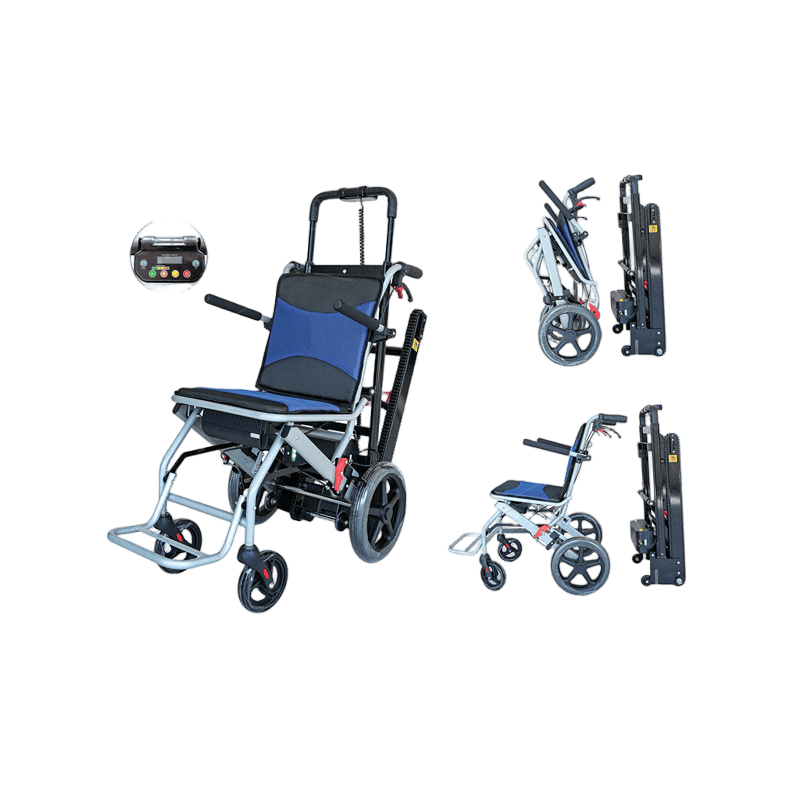
I got an email from a bariatric care coordinator in Texas who was frustrated almost to the point of giving up. Her agency had tried three different stair climbing wheelchairs for a client weighing over one hundred and sixty kilograms, and every single one failed — either the motor overheated on the third flight, or the track slipped on the stair edge under the load, or the seat frame creaked in a way that destroyed the client’s confidence before the climb even started. “I need something that makes my patient feel safe,” she wrote, “not something that makes them hold their breath every time we tilt back.” The FL04 was the answer I sent her.
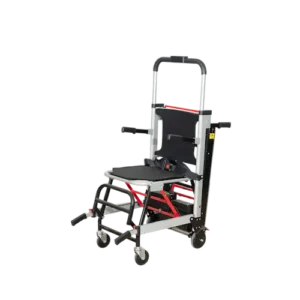
The AM-FL04 is our heavy-duty stair climbing wheelchair, and the word “heavy-duty” is doing real work here. The seat is fifty-two centimeters wide between armrests — about eight centimeters wider than the FL02 and five centimeters wider than the FL03. That extra width isn’t a luxury feature. For bariatric users, a seat that’s too narrow creates pressure points on the hips and thighs within minutes, and a transfer into a chair that feels tight is a transfer that feels unsafe before it even moves. The seat cushion is a higher-density memory foam than the standard FL models — firmer to resist bottoming out under greater weight, but still contoured to distribute pressure across the sitting surface rather than concentrating it on the ischial tuberosities.
The frame is a reinforced aluminum alloy with an additional cross-brace at the track mounting points — the part of the chassis that takes the highest torsional load when the chair is tilted back on stairs and the full patient weight is cantilevered onto the track assembly. Weight capacity is rated at one hundred and eighty kilograms, and that rating isn’t theoretical. We tested it at one hundred and ten percent of rated load for two thousand stair-climbing cycles on our in-house test rig — the equivalent of going up and down a ten-story building every day for a year. The frame welds held. The track bushings were replaced as a wear item, which is by design — bushings wear, frames shouldn’t.
The motor is a six hundred watt brushless DC unit, nearly twice the output of the FL02’s three hundred and fifty watt motor. More torque means the FL04 climbs at a consistent twelve steps per minute regardless of whether the user weighs eighty kilos or one hundred and seventy kilos. A weaker motor on a heavy user slows down on each stair, which creates a herky-jerky motion that’s physically uncomfortable and psychologically unnerving. The FL04’s power margin eliminates that — the climb is smooth because the motor isn’t operating at the edge of its capacity. The battery is four hundred and fifty watt-hours, which delivers about twenty-eight standard floors under maximum load. For bariatric home care, where the typical route is a few floors from an apartment to the lobby and back, that’s roughly a full day of use.
The tracks are wider than the standard FL track set — an additional fifteen millimeters of contact surface per track. More surface area means lower ground pressure per square centimeter, which means better grip on smooth or worn stair treads and less tendency for the track to skate on polished stone or tile stairs. The track tension is also adjustable via a tensioning bolt, which matters for heavy users: a track that’s too loose under high load can jump the drive sprocket, and a track that’s too tight increases rolling resistance and drains the battery faster. The tension sweet spot is different for a seventy-kilogram user versus a one-hundred-seventy-kilogram user, and the adjustability lets you dial it in.
The FL04 is not the right chair for every bariatric user. If the staircases are extremely narrow — under seventy-five centimeters — the wider frame may not clear. If the user can be safely served by the FL03 at one hundred and thirty-five kilogram capacity, the FL04’s extra width and power are unnecessary and the FL03’s lighter weight is an advantage for caregiver handling. But for the clients that fall through the cracks of standard equipment — too heavy for the FL03, too large for the FL02, and being told by other manufacturers that “we don’t have anything in your weight range” — the FL04 closes that gap. Send me the client weight, stair width, and daily floor count, and I’ll tell you honestly if the FL04 is the right tool or if a different model in our line fits better.
Model Comparison
| Specification | AM-FL02 | AM-FL03 | AM-FL04 |
|---|---|---|---|
| Material | High strength aluminum alloy | High strength aluminum alloy | High strength aluminum alloy |
| Expanded size | 152×60×115(±1.5) cm | 152×56×105(±1.5) cm | 143×108×54(±1.5) cm ⚠️ |
| Folding size | 100×60×46(±1.5) cm | 100×56×45(±1.5) cm | 103×54×50(±1.5) cm |
| Motor | Brushless 200W | Brushless 200W | Brushless 200W |
| Battery | Lithium 24V/10Ah (MAX) | Lithium 24V/10Ah (MAX) | Lithium 24V/10Ah (MAX) |
| Climbing speed | 1s/1.2s/1.3s per step | 1s/1.2s/1.3s per step | 1s/1.2s/1.3s per step |
| Load capacity | 159 kg | 159 kg | 159 kg |
| N.W. | 47±1 kg | 32±1 kg | 24.7±1 kg |
| Climbing angle | ≤50° | ≤50° | ≤50° |
| Front/Rear wheel | 7/12 inch | 5/10 inch | —(样册疑似笔误,见文末③) |
Frequently Asked Questions
What specifications should I review for this model?
Key specifications including dimensions, capacity, power requirement and material composition are provided in the model datasheet. Contact us with your project requirements for the complete specification sheet.
What documents are available for import?
Datasheet, user manual, packing information and applicable conformity documents are confirmed per destination market. Registration requirements vary by country and are reviewed project by project.
Can I request a sample or reference installation?
Sample availability and reference installation details are confirmed based on the product category and order volume. Contact us with your specific requirements.