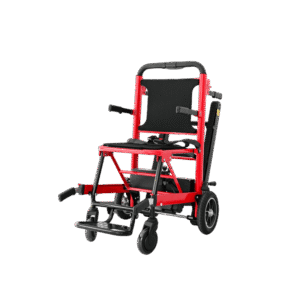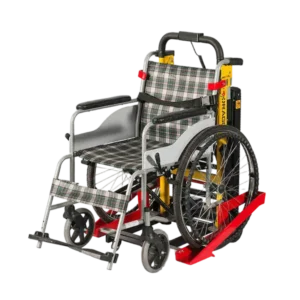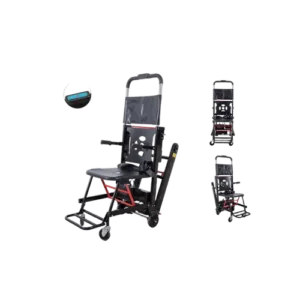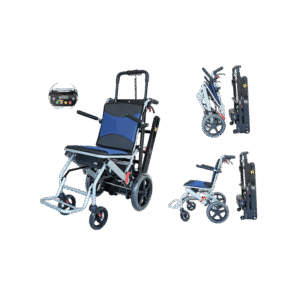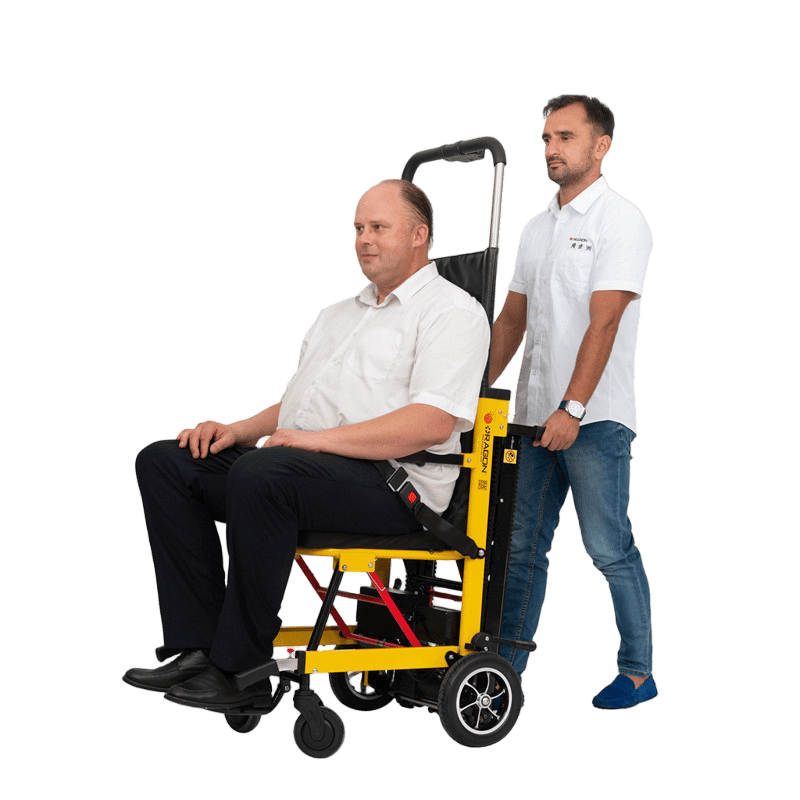
Walk-up apartment buildings without elevators are the silent dread of every EMS crew working in older cities. A 75-year-old patient with chest pain on the fifth floor of a pre-war building with narrow stairs, tight landings, and no elevator—the call itself is routine, but the carry is anything but. A manual stair chair requires at minimum two strong operators to tilt and lower step by step, and every landing turn is an opportunity to lose control. The AM-SW03 replaces that entire physical ordeal with a motorized track system: the operator guides the chair, the machine does the lifting and lowering.
The chair uses a brushed motor driving a rubber track system, powered by a 13.6 Ah lithium battery good for approximately 120 floors of continuous stair navigation on a single charge. The track grips each stair edge sequentially, distributing the patient’s weight across multiple contact points instead of relying on operator strength. You tilt the chair back to engage the track, squeeze the throttle, and the track walks the chair up or down the stairs at a controlled pace. An emergency brake engages automatically if the throttle is released, holding the chair in place on the staircase.
The frame is aluminum alloy—durable but light enough that the total unit weight stays at 32 kg for the manual adjustment model and 37 kg for the electric adjustment model. Both versions fold to roughly 100 x 48 x 31 cm for ambulance storage. The electric adjustment model adds a powered backrest recline, which is genuinely useful when a cardiac patient can’t sit fully upright. Load capacity is 160 kg for both models. Front and rear wheels are 10-inch and 5-inch respectively, large enough to roll over door thresholds and sidewalk cracks without catching.
The key advantage over a manual stair chair is single-operator capability. In ideal conditions—straight staircase, cooperative patient—a trained operator can manage the SW03 alone, which frees the second responder to carry equipment, manage the patient’s airway, or prep the ambulance. In practice, most crews still prefer a two-person approach for the extra margin, but the physical strain reduction is dramatic regardless. Your back will notice the difference after the third call of the shift.
If your EMS service covers neighborhoods with high-density walk-up housing, the SW03 pays for itself in reduced crew injuries alone. Contact me for a spec sheet and current pricing—I’ll help you figure out whether the manual or electric adjustment model fits your protocols.
Model Comparison
| Specification | AM-ST003A | AM-SW01 | AM-SW03 | AM-SW02A | AM-SW02 | AM-SW04 | AM-SW05 |
|---|---|---|---|---|---|---|---|
| Material | High strength aluminum alloy | High strength aluminum alloy | High strength aluminum alloy | High strength aluminum alloy | High strength aluminum alloy | High strength aluminum alloy | High strength aluminum alloy |
| Expanded size | 158×47.5×104(+3.5) cm | 158×62×129(±1) cm | 158×62×129(±1) cm | 100×64×155(±3.5) cm | 100×64×155(±3.5) cm | 130×61×157(±1) cm | (81–135)×63×(101–158) cm |
| Folding size | 102×47.5×32(±3.5) cm | 102×62×31.5(±1) cm | 102×62×31.5(±1) cm | 100×64×32(±3.5) cm | 102×66×30(±3.5) cm | 101×61×32(±1) cm | 101×63×35 cm |
| Motor | Carbon brush 120W | Carbon brush 120W | Carbon brush 120W | Carbon brush 120W | Carbon brush 120W (dual motor) | Carbon brush 200W (dual motor) | Carbon brush 200W |
| Battery | 24V/13AH (MAX) | Lithium 24V/13AH (MAX) | Lithium 24V/13AH (MAX) | Lithium 24V/13AH (MAX) | 24V/13AH (MAX) | 24V/13AH (MAX) | 24V/13AH (MAX) |
| Climbing speed | Avg 40 steps/min (5%) | 1s/1.2s/1.3s per step | Avg 40 steps/min (±5%) | 1s/1.2s/1.3s per step | 1s/1.2s/1.3s per step | 1s/1.2s/1.3s per step | 1s/1.2s/1.3s per step |
| Load capacity | 159 kg | 159 kg | 159 kg | 159 kg | 159 kg | 159 kg | 159 kg |
| N.W. | 28±2 kg | 31±2 kg | 30±1 kg | 37±2 kg | 37±2 kg | 31±2 kg | 32±2 kg |
| Climbing angle | ≤50° | ≤50° | ≤50° | ≤50° | ≤50° | ≤50° | ≤50° |
| Front/Rear wheel | 3/5 inch | 5/10 inch | 5/10 inch | 5/10 inch | 5/10 inch | 5/10 inch | 5/10 inch |
Frequently Asked Questions
What specifications should I review for this model?
Key specifications including dimensions, capacity, power requirement and material composition are provided in the model datasheet. Contact us with your project requirements for the complete specification sheet.
What documents are available for import?
Datasheet, user manual, packing information and applicable conformity documents are confirmed per destination market. Registration requirements vary by country and are reviewed project by project.
Can I request a sample or reference installation?
Sample availability and reference installation details are confirmed based on the product category and order volume. Contact us with your specific requirements.