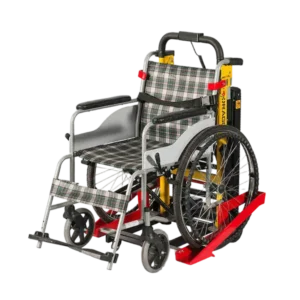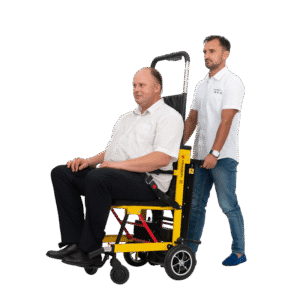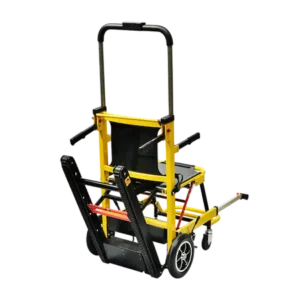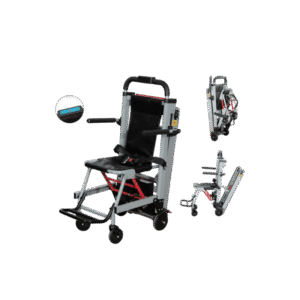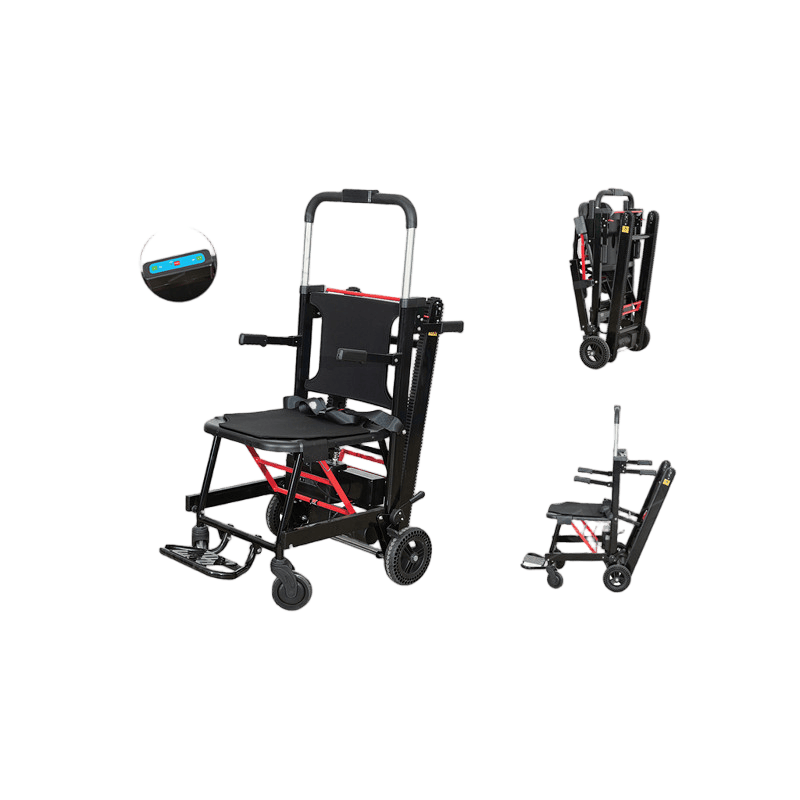
There’s a particular kind of client I think about when I design the top end of a product line. It’s the person who uses the chair not twice a week but six times a day — living in a walkup, working from home, visiting the ground-floor pharmacy, meeting a friend for coffee, going back up, coming down again for dinner. The chair isn’t an occasional tool; it’s the infrastructure of their daily mobility. When you use something that heavily, the difference between “functional” and “comfortable” stops being a luxury distinction and becomes a quality-of-life question. The EST90C is the chair I built for that person.
The AM-EST90C is the premium model in our EST stair climbing wheelchair line — longest range, quietest motor, and the most comfortable seat we make. The battery is a four hundred and eighty watt-hour lithium pack, the largest in the EST series, delivering approximately forty-two standard-height floors on a full charge. That’s enough for a full day of heavy use with margin: morning commute down, back up after a doctor’s appointment, down again in the afternoon for an errand, up for dinner, down for an evening walk. No range anxiety. No structured charging schedule that dictates when the user can and can’t leave their apartment. The battery management system includes cell-level balancing and thermal cutoff, and the pack is designed for one thousand charge cycles before capacity dips below eighty percent — roughly three years of daily charging.
The motor is the same brushless DC platform we introduced in the 2026 EST00C, but tuned for an even quieter noise profile — about two decibels lower than the mid-range model through acoustic damping in the motor housing and a redesigned gearbox cover. In practical terms, the chair produces roughly the noise level of a running refrigerator at one meter. It won’t wake a sleeping spouse when the user comes home late. It won’t make the user feel like they’re arriving with a fanfare every time they enter a restaurant or a friend’s living room. Quiet matters not just for neighbors but for dignity.
The seat is the part I spent the most time on. It’s a multi-layer construction: a memory foam top layer that conforms to body shape under body heat, a higher-density support layer underneath to prevent bottoming out, and a gel-infused center section to dissipate heat during extended sitting. The seat pan is wider than the standard EST seat — forty-eight centimeters between armrests — and the backrest angle is adjustable through a twenty-degree range with a single lever. Users who spend forty-five minutes in the chair between transfers can find their own angle rather than accepting whatever the factory decided was ergonomic. The armrests are wider and flatter than standard, making them usable as a stable surface for a phone, a book, or a cup of coffee — small things that compound across a day of use.
The climbing mechanism is the proven EST track system with automatic stair-edge detection: the track engages each stair independently, and the motor torque adjusts in real time based on the resistance it encounters. On a staircase with uneven risers — common in older buildings — the chair adapts without lurching or hesitating. The joystick controller includes a speed dial with three preset modes: slow for anxious users or steep stairs, standard for everyday use, and a slightly faster mode for long straight staircases where the user is comfortable with speed. The emergency descent brake is mechanical, not electronic — it engages if the chair exceeds a set descent speed regardless of whether the battery has power.
The EST90C is the most expensive chair in the EST line, and I’m not going to pretend otherwise. It costs more than the EST00C because a larger battery, a higher-end motor, and a premium seat cost more to manufacture. Whether the premium is worth it depends entirely on usage. For a user who climbs stairs three times a week and could charge between uses, the EST00C is more than adequate and the EST90C is overkill. For a user whose mobility depends on this chair six times a day, every day, the extra range eliminates stress, the quieter motor preserves privacy, and the seat comfort prevents the cumulative fatigue that turns a mobility tool into a source of resentment. If that’s your situation — or a client’s — reach out. I’ll send you the full spec comparison chart against the rest of the line so you can see where the EST90C’s extra investment goes, and where it doesn’t.
Model Comparison
| Specification | AM-EST90C | AM-EST001 | AM-EST00C | AM-EST01S |
|---|---|---|---|---|
| Material | High strength aluminum alloy | High strength aluminum alloy | High strength aluminum alloy | High strength aluminum alloy |
| Expanded size | 159×63×112(±1) cm | 158×63×104(±1) cm | 158×47.5×104(±1) cm | 146×56×98(±1) cm |
| Folding size | 106×63×36(±1) cm | 102×47.5×32(±1) cm | 102×47.5×32(±1) cm | 100×56×27(±1) cm |
| Motor | Carbon brush 120W | Carbon brush 120W | Carbon brush 120W | Carbon brush 100W |
| Battery | 24V/13AH (MAX) | 24V/13AH (MAX) | 24V/13AH (MAX) | Lithium 24V/10Ah (MAX) |
| Climbing speed | Avg 40 steps/min (5%) | Avg 40 steps/min (5%) | Avg 40 steps/min (5%) | Avg 40 steps/min (5%) |
| Load capacity | 159 kg | 159 kg | 159 kg | 100 kg |
| N.W. | 27±1 kg | 28±2 kg | 25±2 kg | 21±0.5 kg |
| Climbing angle | ≤50° | ≤50° | ≤50° | ≤50° |
| Front/Rear wheel | 5/8 inch | 3/5 inch | 3/5 inch | 4/5 inch |
Frequently Asked Questions
What specifications should I review for this model?
Key specifications including dimensions, capacity, power requirement and material composition are provided in the model datasheet. Contact us with your project requirements for the complete specification sheet.
What documents are available for import?
Datasheet, user manual, packing information and applicable conformity documents are confirmed per destination market. Registration requirements vary by country and are reviewed project by project.
Can I request a sample or reference installation?
Sample availability and reference installation details are confirmed based on the product category and order volume. Contact us with your specific requirements.