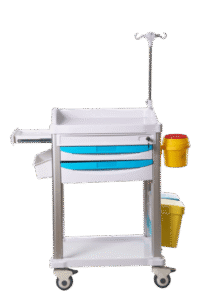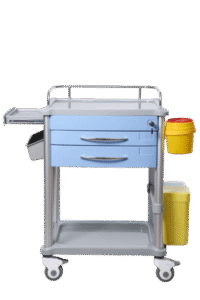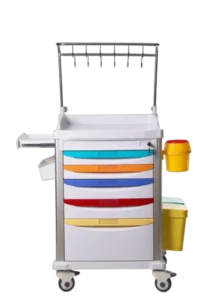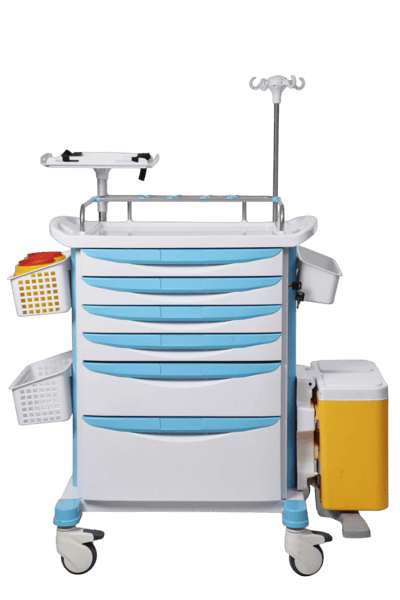
I noticed something during rounds at a general hospital in Hefei: the wards that weren’t the ICU or the ED — the general medical floors, the surgical recovery units, the orthopedic wards — all had some version of a crash cart, but none of them used it the same way. Ortho used it for casting supplies. General medicine used it for bedside procedure kits. Surgical recovery used it for post-op emergency drugs and airway equipment. They needed a cart that could be configured differently per department without being redesigned from scratch. The AM-785 is that cart.
The AM-785 is our multi-purpose emergency trolley — four large-capacity drawers, an open top shelf, and side-mounted accessory racks. Unlike the ET series with its ACLS-prescribed drawer layout, the 785 gives you four undifferentiated deep drawers that the department configures to its own workflow. The drawer dimensions are identical — ninety liters of total internal volume across four drawers — which means a department can reorganize the layout seasonally without fighting a fixed shallow-medium-deep hierarchy. Want casting materials in the top drawer? Works. Want procedure kits in the top drawer and drugs at the bottom? Also works. The flexibility is the feature.
The drawers use the same full-extension ball-bearing slides as the ET series — fifteen thousand cycle rating, smooth operation under thirty kilograms of load per drawer. Divider kits are included, and the dividers are aluminum with silicone edge seals — they stay where you put them but come out without tools when the department decides to reorganize. The drawer fronts have label slots, and we include a sheet of pre-printed label templates covering the most common department configurations: general medical, surgical, orthopedic, obstetric, pediatric, and a blank template.
The top shelf is an open ABS platform with a raised rim — no lid, no defibrillator-specific mounting, just a flat working surface that can hold a monitor, a procedure tray, a casting station, or whatever the department needs at hand level. The side racks are the differentiating hardware: two removable wire baskets on one side for bulk supplies like bandages and tape rolls, and a two-hook equipment rail on the other side for hanging items like a bag-valve mask, a stethoscope, or a suction canister. These are the details that make the 785 more useful than a generic utility cart with a medical label.
The chassis is steel, powder-coated white — not the red of a crash cart, because the 785 isn’t exclusively a crash cart. The white finish signals general clinical use, and it blends into any hospital corridor without visually screaming “emergency equipment.” Four anti-static casters with central locking, same as the ET line. Push handle at one end, and the cart is narrow enough to pass through a standard eighty-centimeter doorway without scraping — about sixty-two centimeters wide.
The AM-785 is the right choice for hospital departments that need organized, mobile supply storage for bedside procedures and the occasional emergency, but don’t need the ACLS-specific layout of an ET crash cart. It’s the generalist of our emergency trolley line — adaptable, unpretentious, and priced below the dedicated crash carts because it doesn’t include the defibrillator shelf, CPR board, or color-coded drawer system. If your department actually runs codes and needs a defibrillator shelf at hand level, the ET750 or ET780 is the correct tool. If you need a cart that holds everything from suture kits to casting tape and can be reconfigured when the department protocol changes, the 785 earns its keep. Tell me what your department stores and I’ll map the divider layout.
Frequently Asked Questions
What specifications should I review for this model?
Key specifications including dimensions, capacity, power requirement and material composition are provided in the model datasheet. Contact us with your project requirements for the complete specification sheet.
What documents are available for import?
Datasheet, user manual, packing information and applicable conformity documents are confirmed per destination market. Registration requirements vary by country and are reviewed project by project.
Can I request a sample or reference installation?
Sample availability and reference installation details are confirmed based on the product category and order volume. Contact us with your specific requirements.