During a cardiac arrest, the difference between a one-minute response and a three-minute response is survival statistics. The difference between finding the epinephrine in the first drawer you open versus the third is a nurse yelling across the room while the code team leader is already calling out the next intervention. I’ve watched enough mock codes to know that a crash cart’s value isn’t in how much it holds — it’s in how fast the right thing appears in someone’s hand. The ET750 is our standard emergency crash cart, and “standard” here means an ACLS-organized layout that every nurse on the code team can navigate without thinking.
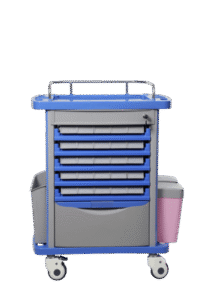
The AM-ET750 has six drawers, color-coded by clinical function: red for emergency medications, blue for airway management, yellow for circulation and IV access, green for diagnostic tools, white for disposables, and the bottom drawer for fluid and volume resuscitation supplies. The color system isn’t decorative — it’s a visual shorthand that works when someone is shouting instructions across a chaotic room and the responder’s working memory is fully occupied. “Second blue drawer” is faster and less error-prone than “the drawer below the airway drawer.” Every second counts in a code, and seconds get wasted on verbal navigation.
The top section is a defibrillator shelf — a flat ABS platform with a retaining lip, sized to hold a standard biphasic defibrillator with room for the pads cable and ECG leads. Below the shelf, a pull-out CPR board is integrated into the frame — slide it out, position it under the patient, and the code team has a rigid surface for effective chest compressions without hunting for a separate board that’s stored in a supply closet two hallways away. The oxygen tank bracket is mounted on the side of the chassis, holding a standard D- or E-size cylinder with a quick-release strap. No tools needed to swap tanks mid-code.
The drawer slides are full-extension ball-bearing, each drawer pulling out to expose its full contents. The medication drawer has removable divider inserts configured for ACLS drug organization: epinephrine front-left, amiodarone front-right, atropine, lidocaine, sodium bicarbonate, calcium — the exact layout can be modified but the default follows AHA guidelines for code cart setup. The airway drawer accommodates a full range of endotracheal tubes, laryngoscope handles and blades, supraglottic airway devices, and a bag-valve-mask resuscitator. When anesthesia arrives at the code, everything they need is in that drawer — not scattered across the cart.
The chassis is steel, powder-coated in the standard hospital red that signals “crash cart” across language barriers. The wrap-around bumper is at mid-thigh height — the height at which doorframes, bed rails, and gurney edges make contact during a rapid response. Four anti-static casters with central locking — the same conductive rubber as our anesthesia line — prevent static buildup during defibrillation. A side-mounted handle on both ends gives the code team two push points, because sometimes a crash cart gets steered from the front during a transport and sometimes it gets pulled backward through a narrow doorway.
The ET750 is the right cart for emergency departments, ICUs, and general medical-surgical wards that maintain code response capability. It’s the standard — six drawers, full ACLS organization, defibrillator shelf, CPR board. If your code team needs more capacity for a high-acuity ED or a cardiac ICU, the ET780 adds two more drawers and a larger defibrillator platform. If you need a more compact version for a smaller facility, the ET625 offers five drawers in a narrower frame. But for the hospital unit that needs one reliable crash cart that every staff member can use without retraining, the ET750 is the reference design. Send your code team composition and I’ll recommend the drawer configuration that matches your protocols.
Frequently Asked Questions
What specifications should I review for this model?
Key specifications including dimensions, capacity, power requirement and material composition are provided in the model datasheet. Contact us with your project requirements for the complete specification sheet.
What documents are available for import?
Datasheet, user manual, packing information and applicable conformity documents are confirmed per destination market. Registration requirements vary by country and are reviewed project by project.
Can I request a sample or reference installation?
Sample availability and reference installation details are confirmed based on the product category and order volume. Contact us with your specific requirements.